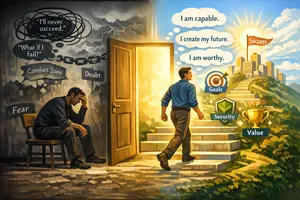
Career Change After Becoming a Parent: How to Reignite Motivation and Purpose

You’re not alone—career change after becoming a parent is one of the most common (and most confusing) inner shifts ambitious people face.
Not just your schedule or your sleep (although, yes). I mean the way you relate
to work itself. The things that used to motivate you—progress, achievement,
building something impressive—can suddenly feel… oddly ineffective. Like your
internal “why” got up and quietly left the building.
I noticed this before I even became a dad. On paper, life looked like it
should’ve been peak gratitude: a career to build, momentum, a future to work
toward. But inside, my drive degraded. The same inner engine that used to push
me forward felt like it vaporized.
That’s the moment many people start privately considering a career change after becoming a parent, even if nothing looks “wrong” from the outside.
I looked for the spark
everywhere—new goals, new plans, more strategy, more discipline. And when it
didn’t work, something else took its place: cynicism. Resentment. A low-grade
anger that was always on standby.
Even after I became a dad, I couldn’t shake it.
Then I had an epiphany watching my son. He had this clean, intact joy—like life
hadn’t taught him to brace for impact yet. And it hit me: I would do anything
to protect that spark in him… but I wasn’t treating my own inner state with
anything close to that level of care.
And here’s the part that matters for you and me: as parents, our careers aren’t
just careers. They’re classrooms. Our relationship with work—our stress, our
cynicism, our purpose, our presence—becomes part of what our kids (and
partners, and honestly our future selves) learn is normal.
This page is for ambitious, capable 25–45 year olds (employed or self-employed)
who aren’t looking for a quick pivot or a motivational quote taped to a laptop.
You’re willing to do the deep work: the honest work. The uncomfortable work.
The long-term fix work. The kind that changes your story instead of just
changing your LinkedIn headline.
Why parenthood changes your career (even if your job didn’t change)
A career change after becoming a parent often isn’t about chasing novelty—it’s about your life demanding a truer foundation. It changes what you can tolerate, what feels meaningful,
and what you’re no longer willing to sacrifice in exchange for “success.”
Before a kid, you can brute-force your way through misalignment. After a kid,
the misalignment gets louder. Not because you’re weaker—because you’re carrying
more, and you’re clearer about what actually matters.
Your values sharpen—and your tolerance for “pointless” drops
A lot of careers are built on borrowed fuel:
- recognition
- momentum
- proving
- fear of falling behind
- the identity of being “the capable one”
Then you become a parent and your system starts asking different questions:
- “Is this worth the hours it costs?”
- “Is this who I want to be when I walk through the door?”
- “Is this what I want my child to think adulthood feels like?”
If you’re thinking about a career change after becoming a parent, it may be because “fine” no longer feels honest.
Your nervous system is carrying more than your calendar admits
Parenthood isn’t only logistics. It’s load.
Even in a good season, you may be holding:
- broken sleep
- constant context switching
- background worry you can’t turn off
- the pressure to be both present and productive (at once, forever)
So if your motivation dips, it might not be a mindset issue. It might be
capacity. And capacity changes everything.
Time stops being abstract (every hour suddenly has a cost)
Before, you could tell yourself: “I’ll make it up later.”
After kids, later is not guaranteed, and time is no longer theoretical.
A late meeting isn’t just a late meeting. It’s dinner missed. It’s bedtime
missed. It’s your partner carrying more. It’s you coming home physically
present but mentally still at work.
That reality can quietly poison your relationship with your career—even if the
job is technically “good.”
The old motivators don’t hit the same anymore
This is the confusing part for high performers: you can still be competent and
still be successful, but the internal reward system stops paying out.
Not because you lost your edge. Because your ambition wants new roots: meaning,
integrity, sustainability, honesty.
If your motivation vanished, you’re not broken—your identity is updating
When
people say “I lost my motivation,” what they often mean is:
“My old reasons aren’t convincing anymore.”
That’s not a defect. It’s feedback. For many people, career change after becoming a parent begins right here: when feedback finally gets louder than fear.
The hidden gap: “I should be grateful” vs. “I feel resentful”
This gap creates shame, and shame creates silence.
You think:
“I have a job. I have a family. I’m lucky.”
…and then you feel:
“Why am I so irritated?”
“Why do I feel burdened by work?”
“Why am I less inspired than I used to be?”
That contradiction doesn’t mean you’re a bad person. It often means you’ve
outgrown the story you’ve been living inside.
Cynicism, anger, and apathy are signals (not personality traits)
In my own experience, cynicism didn’t appear because I became “negative.” It
appeared because I kept trying to force inspiration through a structure that
wasn’t honest anymore.
In general:
- Cynicism can be grief in disguise (you cared; it stopped feeling safe to care).
- Anger can be a boundary signal (something is off; you keep crossing your own line).
- Apathy can be meaning starving (or nervous system overload).
These emotions aren’t your identity. They’re messengers.
Why “just push through” works… until it doesn’t
Pushing through is a skill. It builds careers. It builds businesses. It builds
impressive lives.
But it’s not a long-term strategy for a human being—especially a human being
teaching other humans how to live.
Eventually the cost becomes:
- chronic irritation
- numbness
- performative positivity
- resentment you can’t quite name
And that’s when career change starts to look less like a luxury and more like a
necessity.
The role model effect: your relationship with work becomes a legacy
This
is where my journaling turned into a line in the sand.
Watching my son’s joy, I realized how tragic it would be if he ever adopted the
cynicism I sometimes carried. Not because he’d “learn negativity”… but because
he’d learn that’s just what life is.
Kids don’t just hear what we say—they absorb our baseline
You can tell a child “Follow your dreams!” while living in constant dread and
tension, and they won’t learn your words. They’ll learn your nervous system.
They’ll learn:
- Work = heaviness
- Responsibility = resentment
- Adulthood = bracing yourself
They’re not judging you. They’re normalizing you.
What you normalize now becomes their starting point later
Your child’s worldview comes from many sources, but you’re a major one.
So the question becomes less:
“How do I find the perfect career?”
…and more:
“How do I become the kind of person who lives with integrity, presence, and
purpose—inside the life I’m building?”
Self-love as self-respect (not arrogance, not selfishness)
Here’s the subtle shift my son brought out in me:
I held his wellbeing in high regard. I wanted to protect his light.
But I didn’t treat my own inner world with the same care.
The self-love that matters here isn’t bubble baths or hype. It’s self-respect.
It’s choosing not to abandon yourself.
It’s asking:
“If I want my child to have a life that’s honest, why am I living one that
isn’t?”
The real question: do you need a new job—or a new way of being?
Sometimes
people change jobs and feel better for three months… until their old patterns
catch up with them. This is why a career change after becoming a parent works best when it’s paired with identity-level change, not just a new environment.
New role, same people-pleasing.
New business, same overwork.
New industry, same self-betrayal (just with better branding).
So we want to be clear: what’s actually driving the dissatisfaction?
When it’s an external problem (role, culture, workload, mission mismatch)
It may be the job if:
- the workload is structurally unreasonable
- you’re rewarded for being always-on
- you don’t respect the leadership or the ethics
- the work requires you to compromise your values
- the role is misaligned with your strengths and interests
Deep work matters here too—but you’ll probably need real-world change, not just
mindset.
When it’s an internal mismatch (boundaries, identity, approval loops)
It may be an internal mismatch if:
- you feel guilty resting even when you’ve done enough
- you overdeliver to feel safe or valuable
- you can’t say no without anxiety
- your identity is fused with being “high-performing”
- you’re living inside someone else’s definition of success
This is where “career change” can still help, but only if it’s paired with
identity-level rewiring.
How to tell the difference before making a drastic move
Try these:
- If I had strong boundaries and a regulated nervous system, would this job still feel unbearable?
- What part of my current situation is truly non-negotiable to change?
- What part of my suffering is optional (caused by my patterns, not my reality)?
- If I changed careers but stayed the same internally, what would repeat?
You’re not trying to win an argument with yourself. You’re trying to get honest
data.
A
grounded path to reigniting motivation and purpose (without burning it all
down)
If
you’re ambitious and burned out, dramatic moves can feel like relief.
Quit. Pivot. Blow it up. Start over.
Sometimes that’s right. Often it’s just a nervous system begging for oxygen.
A grounded approach is slower at the start—and faster in the long run:
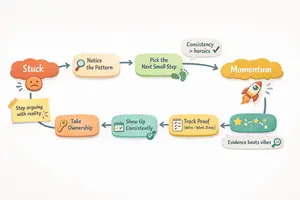
stabilize, tell the truth, realign, redesign, embody. If you’re navigating career change after becoming a parent, this stabilize-then-redesign sequence helps you move from reaction to choice.
Step 1 — Stabilize: reclaim capacity before you redesign your life
If your tank is empty, every decision feels urgent and every option feels like
it has to fix everything.
Stabilizing can look like:
- tightening your “yes” (and surviving the discomfort of disappointing people)
- setting clearer work boundaries (hours, scope, response times)
- creating white space (time to think without input)
- naming the stressors you’ve normalized
This isn’t procrastination. It’s getting your steering wheel back.
Step 2 — Tell the truth: name what you’ve been tolerating
Deep work starts here: honesty.
Tell the truth about:
- what drains you
- what you’re doing for approval
- what you’re doing out of fear
- what you keep calling “not a big deal” that is a big deal
- what you actually want (not what sounds mature at dinner parties)
In my own case, the “truth” wasn’t just “I’m tired.” It was: “I’m living with
an inner tone I would never want my son to inherit.”
Truth creates traction.
Step 3 — Realign values: choose what you’re building your work around now
Parenthood often shifts values from:
- recognition -> presence
- speed -> sustainability
- proving -> integrity
- hustle -> meaningful contribution
This isn’t about becoming less ambitious.
It’s about becoming ambitious about the right things.
Step 4 — Redesign: shape a career direction that fits the parent-you
This is where practical strategy meets self-honesty.
Consider:
- Constraints: What hours, flexibility, and travel limits are actually sustainable?
- Energy: How do you want to feel at 6pm?
- Problems: What challenges do you want to solve now?
- Environment: What kinds of teams/clients bring out your best self?
- Money: What does “enough” look like, and what tradeoffs are you willing (or not willing) to make?
A grounded career change is usually a series of intelligent experiments, not
one stressed-out leap.
Step 5 — Embody: become the person who can sustain the change
This is the identity-level part: becoming the version of you who can hold the
life you’re designing.
Because if you don’t change the patterns, you’ll recreate the same pain in a
new setting.
Embodiment looks like:
- practicing boundaries before you “need” them
- rebuilding self-trust through small promises kept
- learning to feel anger/sadness without handing them the steering wheel
- choosing self-respect over image
This is how the spark stays lit—because it’s rooted in honesty, not adrenaline.
Journal prompts for parents considering a career change After Becoming A Parent (the deep work)
You
don’t need a perfect plan to start. You need better questions.
Prompts to uncover what’s really driving your burnout
- What am I pretending not to know about my work?
- Where am I over-functioning and calling it “being responsible”?
- What do I feel angry about that I keep minimizing?
- What would I stop doing immediately if I knew I wouldn’t be judged?
Prompts to rebuild self-respect and internal trust
- Where have I been breaking promises to myself?
- What boundary do I need that I keep postponing?
- What’s one small act of self-respect I can do this week—without negotiating?
- If my child normalized my relationship with work, what would they learn?
Prompts to clarify purpose (without needing a perfect calling)
- When do I feel most like myself?
- What kinds of problems do I genuinely care about solving?
- What does “success” mean if nobody can see it?
- What am I willing to trade for meaningful work—and what am I no longer willing to trade?
Common questions (FAQ)
Is
it normal to want a career change after becoming a parent?
Yes. It’s common because parenthood changes your values, your capacity, and
your sense of what matters. You’re not “falling off.” You’re recalibrating.
Why did I lose motivation after having a baby?
Often because your old motivators were tied to freedom, proving, and
momentum—while your new reality demands sustainability, meaning, and presence.
Also: sleep and chronic stress are not neutral. They reshape everything.
What if I’m successful on paper but miserable day-to-day?
That’s usually misalignment: the external scoreboard says “winning,” but your
internal experience says “this costs too much.” That’s not ingratitude. That’s
data.
How do I make a grounded career change when I have real responsibilities?
By stabilizing first, then experimenting: adjust boundaries, renegotiate scope,
explore adjacent roles, build skills, and pressure-test options before making
major leaps. Responsibility doesn’t cancel change—it demands better design.
How long does an identity-level career transformation take?
Insight can happen fast (sometimes in a single moment watching your kid smile
at nothing). But living it—embodying it—takes practice. The goal isn’t a quick
reinvention. It’s a stable one.
If you want one more tightening pass, tell me which direction you’d like:
1) More practical (steps/checklists/examples),
2) More story-driven (your narrative threaded through every section), or
3) More “deep work” (identity patterns, self-honesty, emotional themes).
Recent Articles


-
Biggest Change in Life
Dec 31, 25 06:53 PM
 How your career can offer the biggest change in life and why mindset is the hidden barrier
 -
Process of Becoming an Adult
Oct 05, 25 12:18 PM
A practical 5-pillar framework for the process of becoming an adult: build independence, income, resilience, emotional strength, and a reputation you can use. -
Did the results of the last election hurt your industry and career?
May 02, 25 03:20 PM
Career and elections. Some helpful perspective when results seemed to have hurt your career opportunities.