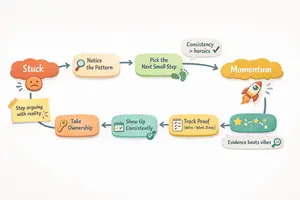
Should I Quit My Job? How To Decide
When It’s Time to Leave or Switch Careers
A Grounded Framework for Deciding What’s Next
Quitting
your job can feel like pulling the emergency lever on a moving train—final,
dramatic, and potentially expensive.
And yet, leaving the wrong role can also become the springboard to a more
meaningful, aligned, and sustainable life. The tension is real: you don’t want
to blow up your stability, but you also don’t want to spend another year
quietly unraveling on Sunday nights.
So when the question “should I quit my job” keeps circling, the goal isn’t to
force a quick answer. The goal is to build the kind of internal clarity—and
self-trust—that makes any decision cleaner, steadier, and easier to own.
Why This Decision Feels So Heavy
Many ambitious, capable professionals get stuck in an analysis loop that looks like responsibility but feels like exhaustion. You can spend months (or years) running the mental cost/benefit calculation and still remain on the fence. That’s not a personal flaw. It’s what happens when pressure, uncertainty, and identity are all tangled together.
If you need income stability but you’re hitting a breaking point, a bridge job for career change can buy you time and clarity without panic-quitting.
If this tension intensified after having a child, read this on career change after becoming a parent—it’ll help you separate burnout, values shifts, and identity-level change before you make a big move.
Here’s the shift:
You don’t need “ultimate certainty” to move forward.
You need self-authority—the ability to choose with intention and take
responsibility for what comes next.
Because the deeper fear usually isn’t “What if I choose wrong?”
It’s “What if I can’t trust myself to recover if I choose wrong?”
If you’re still wondering whether your dissatisfaction is “real enough” to justify a change, start by pressure-testing the pattern. Here are the most common signs you should quit your job—so you can separate a rough season from a role that’s no longer workable.
FOCUS ON INTENT (Before You Try to Find Certainty)
Sometimes the problem isn’t the workload or your performance—it’s that the job is pulling you away from what matters most to you. If that resonates, this guide on values misalignment at work will help you name what’s off (and what you actually need instead).
Spiraling
on “should I quit my job” can feel like a desperate call for escape. When your
nervous system is overloaded, it’s natural to emotionally check out, fantasize
about walking away, or postpone the decision indefinitely.
But major career decisions are best made from a grounded place—where you’re not
trying to flee discomfort, but instead choosing a direction on purpose.
Even if you don’t fully trust yourself right now, anchor to this:
“I’m still the one holding the reins in my life.”
Here’s the practical upside: even if you make the “wrong” call, making it with
accountability and ownership rebuilds self-trust fast. That’s how you regain
stability internally—regardless of what happens externally.
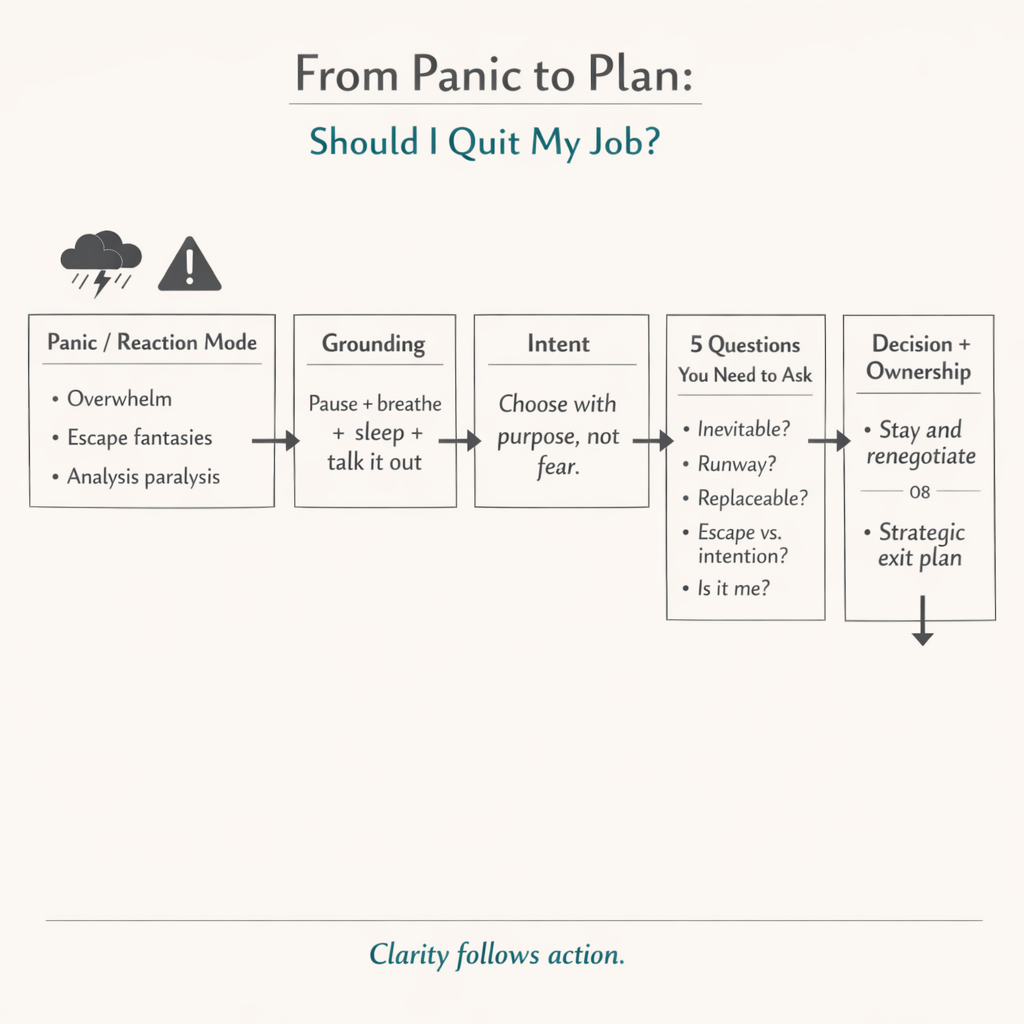
SHOULD I QUIT MY JOB — The 5 Questions You Need to Ask
1)
Is staying prolonging the inevitable?
Are you actively working a plan to improve the situation, or merely delaying
the discomfort with hope and habit?
2) If I quit, do I have a financial runway?
Runway buys time and reduces fear. If you don’t have it yet, your first step
may be building leverage—not resigning immediately.
3) How replaceable is my job?
Not “am I replaceable as a person?” (you’re not). But, is there a fall back
plan or comparable role I could find in 6 months?
4) Am I trying to escape or moving with intention toward a new future?
Escape is emotional urgency. Intention is a defined standard and a forward
plan.
If you’re not ready to quit but you know you can’t stay the same, consider a bridge job for career change as a middle step that restores capacity and options
5) Is it me?
In other words: have I used job dissatisfaction as a distraction from issues
like boundaries, health, finances, or personal ownership? Sometimes the job is
the problem. Sometimes the job is where the problem shows up most.
If the job looks good on paper but feels wrong in your body, it may be values misalignment at work. Here are the signs—and what to do next.
Even when you know you’re unhappy, timing is the part that keeps people stuck: “Do I leave now… or wait until X?” Use this breakdown of when to quit your job to find a clear threshold for staying, preparing, or stepping out.
SHOULD I QUIT MY JOB — The 5 Questions You’ll Never Fully Answer
1)
Is quitting the “right” decision?
Often there isn’t one perfect choice—just choices you can execute well.
2) How long will it take?
Transitions have ranges and probabilities, not guarantees.
3) Will I regret quitting?
Possibly. You might also regret staying. Regret isn’t a decision tool—it’s
feedback.
4) How can I feel more certain?
Certainty usually follows action, not the other way around.
5) Will quitting reinvigorate me?
It might help, but reinvigoration typically comes from alignment plus momentum—not
from a resignation letter alone.
Once you’ve accepted there may not be perfect certainty, the next move is building a transition you can actually execute—without panic and without burning your finances. Here’s how to execute a career change step-by-step, with a plan you can follow from where you are.
If your answers point toward leaving (or at least building options), here’s the step-by-step plan to do it without burning out: Execute a Career Change: A Step-by-Step Transition Plan (Without Burning Out).
CREATING CLARITY (Character Builds Confidence)
When you keep asking “should I quit my job,” what you’re really asking is:
“Can I trust myself to make the right call?”
Clarity isn’t a lightning bolt. It’s a byproduct of character—built through how you think, what you practice, and the standards you live by. The goal here isn’t to pressure you into staying or push you into leaving. It’s to refine self-authority so your decision comes from steadiness, not panic; from truth, not fantasy; from wisdom, not resentment.
Use the 10 attributes below as a clarity framework. Each one strengthens decision-making while also developing you as a person—inside and outside your career.
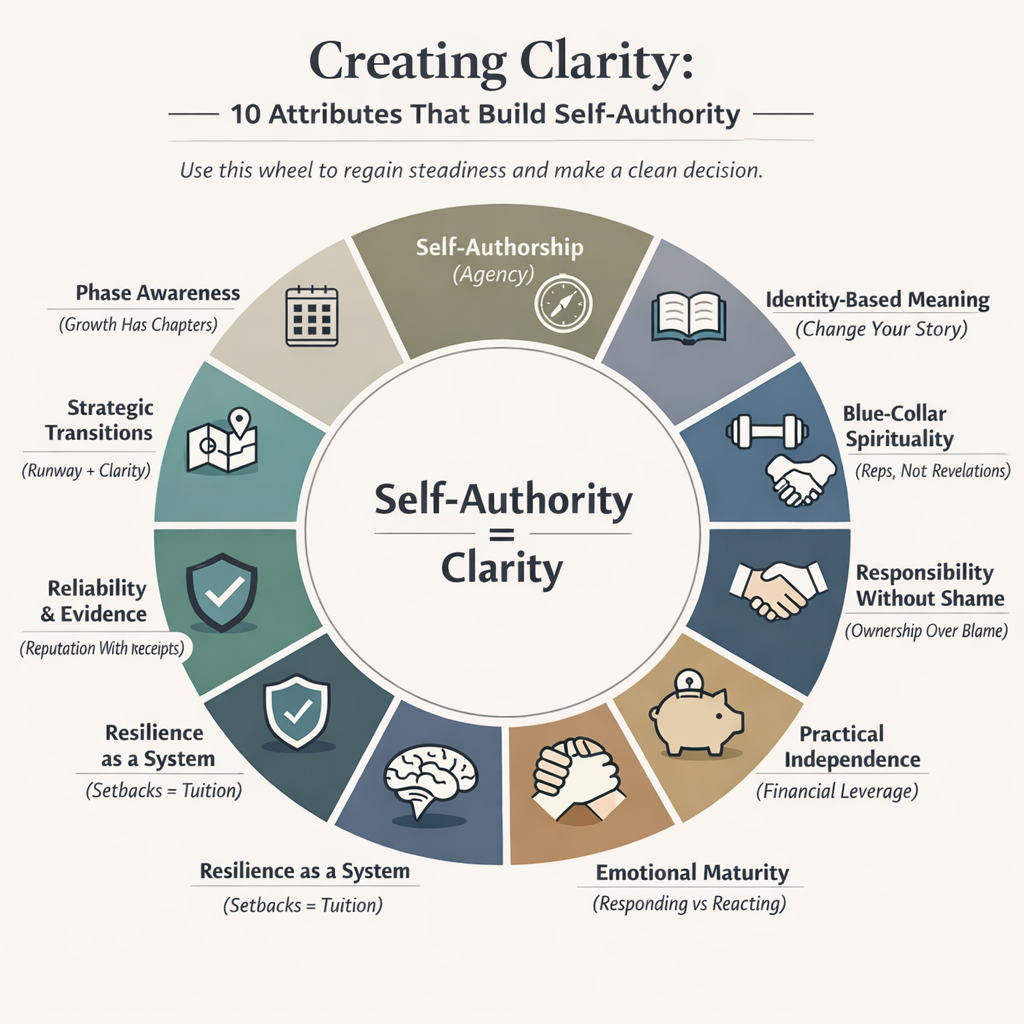
1) Self-Authorship (Agency)
Ask: What’s one controllable step I can take this week that makes this clearer?
This trains you to steer your life rather than wait for permission.
2) Identity-Based Meaning (Change Your Story)
Ask: What story am I living in this role—and what story do I want instead?
This moves meaning from “out there” to “built in here,” through growth.
3) Blue-Collar Spirituality (Reps, Not Revelations)
Ask: What small, unglamorous actions—repeated for 30 days—would change my
clarity?
This builds self-respect through consistency, not drama.
4) Responsibility Without Shame (Ownership Over Blame)
Ask: What isn’t my fault, but is still my responsibility to address?
This converts resentment into traction.
5) Practical Independence (Financial Leverage)
Ask: If I had a 3–6 month buffer, what would I choose? What’s one step toward
that?
This lowers fear and expands options.
6) Emotional Maturity (Responding vs. Reacting)
Ask: Am I responding thoughtfully—or reacting from stress and depletion?
This improves leadership, relationships, and self-trust.
7) Resilience as a System (Setbacks = Tuition)
Ask: What is this situation teaching me, and what’s the next step at my feet?
This builds recovery as a practice, not a personality trait.
8) Reliability and Evidence (Reputation With Receipts)
Ask: What evidence from the last 30 days shows I’m finishing, communicating,
and following through?
This strengthens both external reputation and internal confidence.
9) Strategic Transitions (Runway + Clarity)
Ask: Have I named the cost of staying, tested fixability, built runway, and run
small experiments?
This turns quitting into a plan, not a panic response.
10) Phase Awareness (Growth Has Chapters)
Ask: What phase am I in—misalignment, looping, consistency, momentum,
ownership—and what is it training in me?
This gives you a map forward instead of a spiral.
Closing: The Clarity Standard
If you want a simple way to know you’re ready to decide, use this:
“I can explain my decision without blaming, without fantasizing, and without
panic.”
That’s self-authority. And when you have it, the question “should I quit my
job” becomes less of a crisis and more of a strategic crossroads—one you’re
fully equipped to navigate.
Related Guides:
- Signs You Should Quit Your Job: Reasons, Red Flags, and the Emotions You Can’t Ignore
- Bridge Job for Career Change: How to Get Unstuck Without Quitting in Panic
- Career Change After Becoming a Parent: How to Reignite Motivation and Purpose
- "I Need a Career Change”—How to Tell When You’re Not in the Wrong Job, You’ve Outgrown the Old You
- Values Misalignment at work: Signs It’s Time to Change (and What to Do Next)
- When to Quit Your Job: Timing It Right Without Blowing Up Your Life
- Execute a Career Change: A Step-by-Step Transition Plan (Without Burning Out)
- How to Change Your Career (Without Burning Your Life Down): The Identity-Level Shift That Actually Sticks
- Best Jobs for Career Change: Choose the Role That Builds Your Identity (Not Just Your Resume)
Recent Articles


-
Biggest Change in Life
Dec 31, 25 06:53 PM
 How your career can offer the biggest change in life and why mindset is the hidden barrier
 -
Process of Becoming an Adult
Oct 05, 25 12:18 PM
A practical 5-pillar framework for the process of becoming an adult: build independence, income, resilience, emotional strength, and a reputation you can use. -
Did the results of the last election hurt your industry and career?
May 02, 25 03:20 PM
Career and elections. Some helpful perspective when results seemed to have hurt your career opportunities.