Signs You Should Quit Your Job:
Reasons, Red Flags, and the Emotions You Can’t Ignore
You’re not weak or
flaky; you’re responding to a mismatch, chronic stress, or values conflict.
Let’s sort signal from noise.
It
often begins quietly.
A small thought taps you mid-meeting: “Are we sure this still makes sense?”
Then it becomes a recurring inner conversation. Eventually, it can shift from
“a thought” to a full-body response—fatigue, tension, dread—your system’s way
of asking you to pay attention.
The message usually sounds like this:
“I don’t know if I can keep doing this anymore.”
If you’re here, you’re likely trying to answer a difficult question: Is this
inner dialogue a wise signal… or unhelpful anxiety trying to destabilize you?
Here’s the grounded truth: you’re not weak, flaky, or broken. When ambitious
people start noticing the signs you should quit your job, it’s often because
something real is happening—misalignment, chronic stress, a values conflict, or
a role that looks good on paper but is draining your energy and self-respect.
The goal is to separate signal from noise, with both compassion and a strategy.
Recognizing the mismatch (without turning it into self-blame)
When you’re consistently pushing against reality, reality tends to win. And
when you keep overriding the signs you should quit your job, it’s easy to make
the situation mean something personal:
“It’s my fault.”
“Why can’t I handle this like everyone else?”
“Why do I feel broken at work?”
High performers are especially skilled at equating endurance with success.
You’ve been rewarded for pushing through. But sometimes what you’re calling “a
motivation issue” is actually chronic fatigue from forcing yourself into a
role, culture, or pace that no longer fits.
That’s not a character flaw. It’s useful information.
If you want to get specific about what’s actually driving your urge to leave, start with reasons for quitting your job and see which ones match your reality.
QUICK
SELF-CHECK: Is this a bad week, or a broken situation?
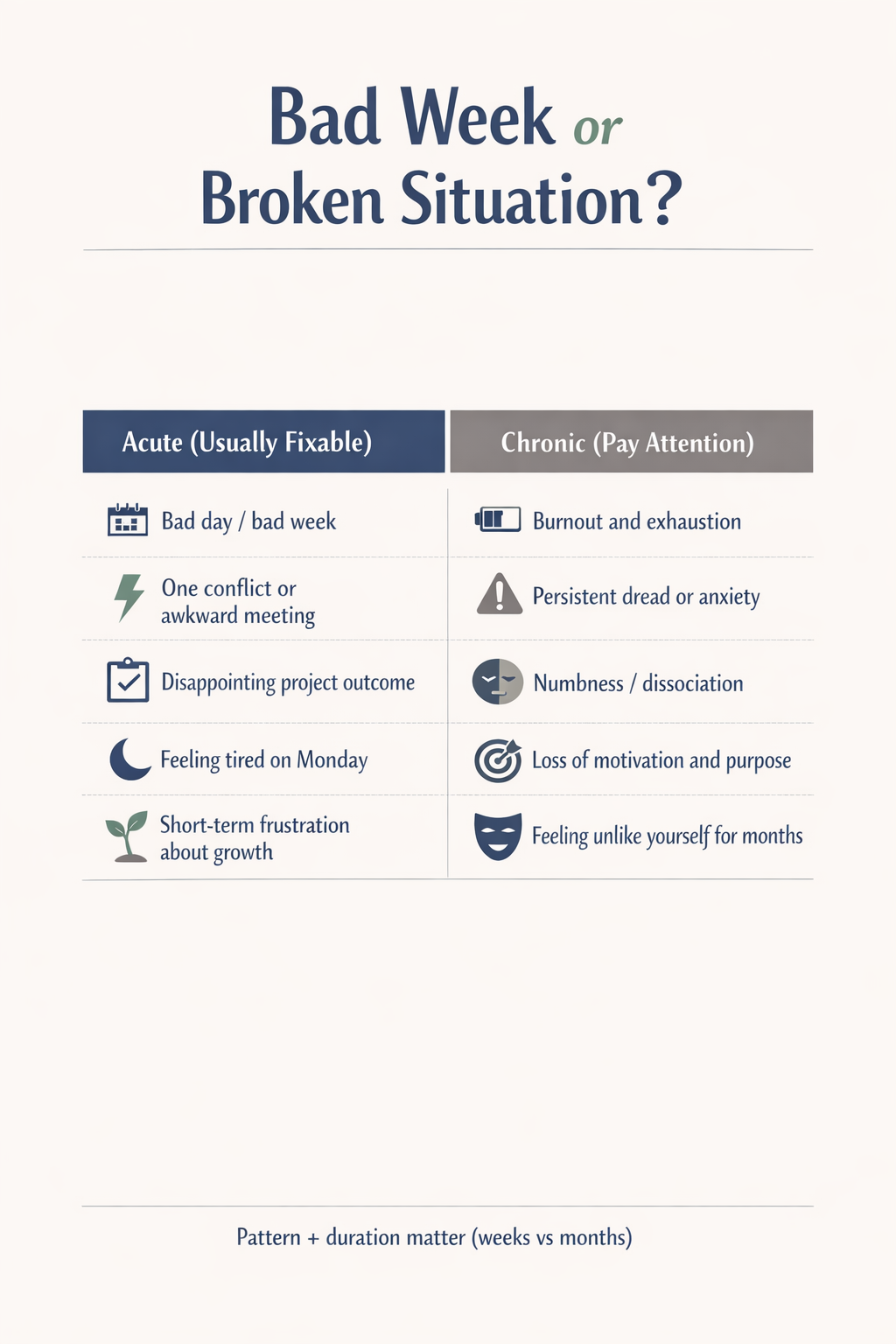
Not every rough patch is a resignation signal. That’s why it helps to look for patterns over time—the difference between a hard week and the real signs you should quit your job. Sometimes it’s just a hard season, a
difficult project, or a solvable interpersonal issue.
If you’re dealing with an isolated “bad day” or “bad week”—a tense meeting, a
mistake, a disappointing outcome—those acute moments are usually not the time
to make a major career decision. Catastrophizing can become an unhelpful
pattern, but it’s also a pattern you can change.
Building the ability to address conflict and setbacks with emotional
intelligence—regulating your response, communicating clearly, and keeping
perspective—can strengthen your professional reputation and open new
opportunities.
Acute indicators (often temporary or fixable)
- A “bad day” (or even a bad week)
- A coworker or boss interaction hurt your feelings
- You feel tired on Monday morning
- You aren’t promoted as quickly as you’d like (can become chronic over time)
- You’re disheartened by a tough lesson or setback
Chronic indicators (worth taking seriously)
- You’re burned out at work
- You’ve lost touch with the best parts of yourself
- Your purpose, pride, or inspiration has faded
- You find yourself longing for the “good old days”
- You feel numb, dissociated, or like you’re always coping
These become chronic when they’ve been consistent for months (or years) and
represent your dominant emotional experience at work.
THE MOST COMMON REASONS AMBITIOUS PEOPLE QUIT (and what that feels like)
Many
ambitious professionals don’t quit because they can’t handle pressure. They
quit when they realize it’s not merely a career move—it’s a necessary life
transition.
At a certain point, you can no longer ignore the cost of staying:
- Health and energy
- Relationships and presence
- Confidence and self-trust
- Creativity and motivation
- Identity and self-respect
Often, job dissatisfaction starts shaping your self-concept—how you see
yourself, your potential, and the person you’re becoming. That’s when leaving
becomes less about escape and more about alignment.
Importantly, quitting doesn’t need to be impulsive. It can be thoughtful,
planned, and financially informed.
EMOTIONAL RED FLAGS (when “quiet quitting” shows up in your body)
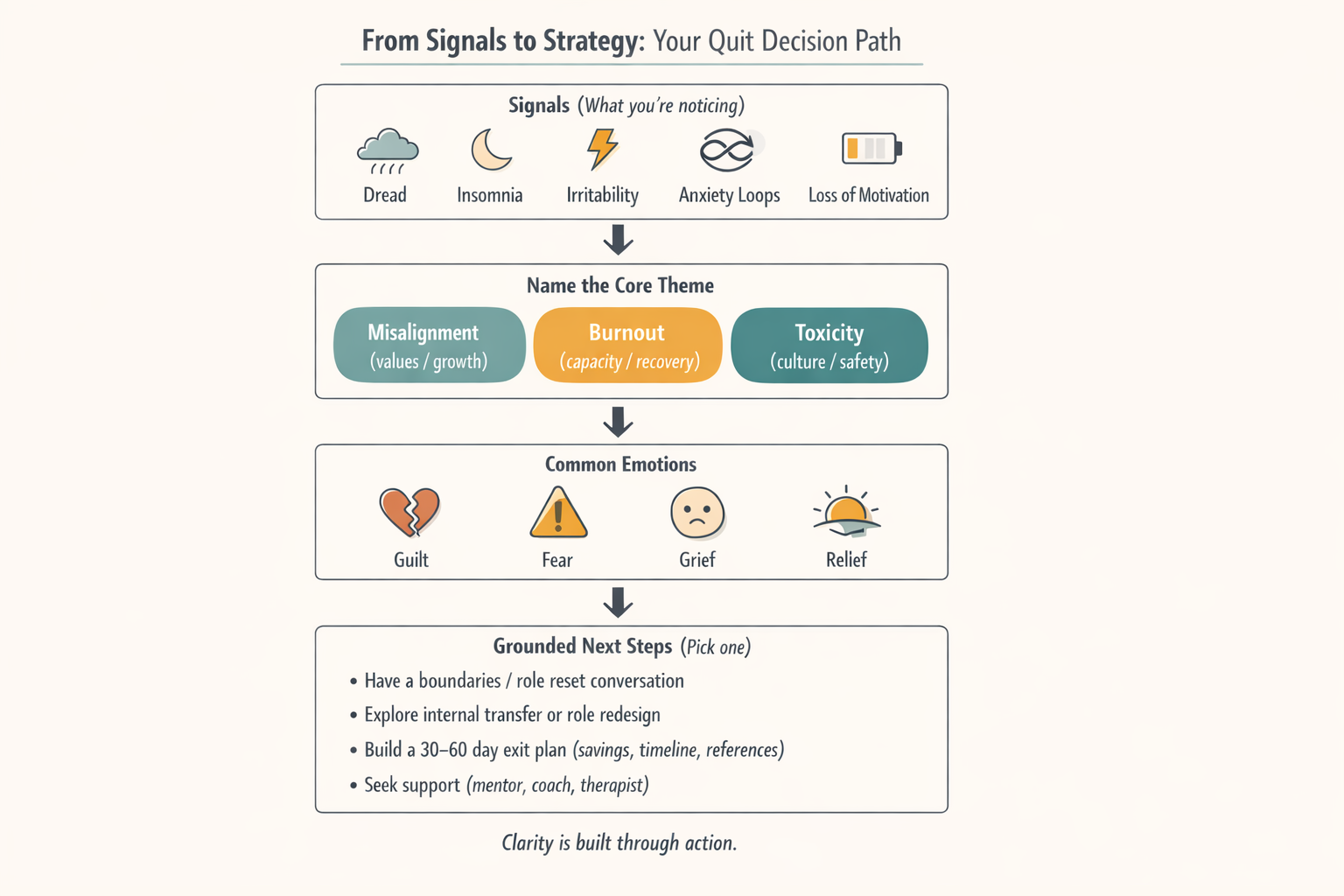
If several of these have been present consistently for 6+ months, consider them meaningful. For many professionals, these are the signs you should quit your job—not because you’re dramatic, but because your system has been operating beyond its limits for too long.
- Persistent dread
- Crying over work
- Motivation that feels forced or manufactured
- Anxiety (especially repetitive mental loops)
- “Sunday Scaries” that start early
- Dissociation or numbness
- Insomnia
- Hopelessness
- Irritability
- Burnout
Note: If you’re experiencing mental or physical health symptoms, consider speaking with appropriate licensed professionals. Support is a strength, not a liability.
THE GUILT TRAP (a common high-achiever obstacle)
Even when you know leaving is the right move, it can feel emotionally “too final” to initiate. You may wonder:
“What if I’m making a mistake?”
“Is this irresponsible?”
“Am I letting people down?”
Guilt is a normal part of transition, especially for conscientious, responsible people. It is not evidence that you should stay. It’s often a sign that you care and that you’re stepping into a new chapter.
Endings can be messy. If you can accept “imperfect but intentional,” you can move forward with integrity and build a role that fits your life—not just your résumé.
Before you assume you need to resign, check whether you’re burned out and what’s feeding it: burnout at work.
THE GUILT TRAP (a common high-achiever obstacle)
Even
when you know leaving is the right move, it can feel emotionally “too final” to
initiate. You may wonder:
“What if I’m making a mistake?”
“Is this irresponsible?”
“Am I letting people down?”
Guilt is a normal part of transition, especially for conscientious, responsible
people. It is not evidence that you should stay. It’s often a sign that you
care and that you’re stepping into a new chapter.
Endings can be messy. If you can accept “imperfect but intentional,” you can
move forward with integrity and build a role that fits your life—not just your
résumé.
If the biggest thing keeping you stuck is the emotional weight of leaving, read this next: feeling guilty about quitting your job.
PATTERN CHECK: “Am I the problem if I keep quitting jobs?”
This
question is honest and important.
There’s a difference between leaving due to misalignment and leaving repeatedly
in the hope that the next job will solve deeper issues—unclear boundaries,
chronic overfunctioning, unresolved burnout, or a lack of clarity about what
you truly need.
Some people stay too long to protect an identity of being “reliable.” Others
leave too quickly because they’re searching for relief without a clear decision
framework.
If you notice recurring patterns, treat that as feedback—not a label.
When leaving starts to feel repetitive, it’s worth investigating the pattern—start here: I keep quitting jobs.
THE FEAR OF REGRET (and how to prevent it from keeping you stuck)
Fear
of regret can trap you in indecision: you imagine every worst-case outcome and
never fully commit to change.
Quitting is an identity shift. You move from “the person with the title, role,
and schedule” to “the person figuring it out again.” Some emotional aftershock
is normal, even when the decision is right.
The goal isn’t to avoid regret altogether.
The goal is to keep building through it.
- Regret tends to decrease when you create closure, learn the lesson, and take the next practical step.
Post-quit anxiety can feel like regret (even when the decision was right). Read I regret quitting my job to separate normal aftershock from real red flags.
SIGNS YOU SHOULD QUIT YOUR JOB: Final notes
When
you ask, “Should I quit my job?” you’re often really asking:
“Can I trust myself to handle what happens next?”
That’s a self-trust question, not just a career question.
Sometimes the clearest signs you should quit your job appear when you’re being
invited to evolve—into a more self-led version of yourself, one who can choose
alignment, tolerate uncertainty, and take grounded action without needing
perfect certainty.
Clarity is rarely immediate.
Clarity is usually built through action and integrity.
Related Guides:
- Reasons for Quitting a Job: 7-Question Checklist to Know When It’s Time
- Feeling Guilty About Quitting Job? How to Leave with Integrity (Without Second-Guessing Yourself)
- Burnout at Work: When “Just Keep Going” Stops Working
- I Keep Quitting Jobs”—Am I the Problem?
- I Regret Quitting My Job: What to Do Next When the “Fresh Start” Feels Like Free-Fall
- Should I Quit My Job? How To Decide When It’s Time to Leave or Switch Careers (hub)
Recent Articles


-
Biggest Change in Life
Dec 31, 25 06:53 PM
 How your career can offer the biggest change in life and why mindset is the hidden barrier
 -
Process of Becoming an Adult
Oct 05, 25 12:18 PM
A practical 5-pillar framework for the process of becoming an adult: build independence, income, resilience, emotional strength, and a reputation you can use. -
Did the results of the last election hurt your industry and career?
May 02, 25 03:20 PM
Career and elections. Some helpful perspective when results seemed to have hurt your career opportunities.