Burnout at Work: When “Just Keep
Going” Stops Working
Learn what burnout
really feels like, why typical fixes fall short, and the practical,
identity-level shifts that help you recover for good.
My career didn’t implode in one dramatic, movie-style moment. It quietly slid into burnout at work—the kind that sneaks in wearing a “just keep going” costume until you can’t remember what energized you in the first place.
What Does Burnout Feel Like?
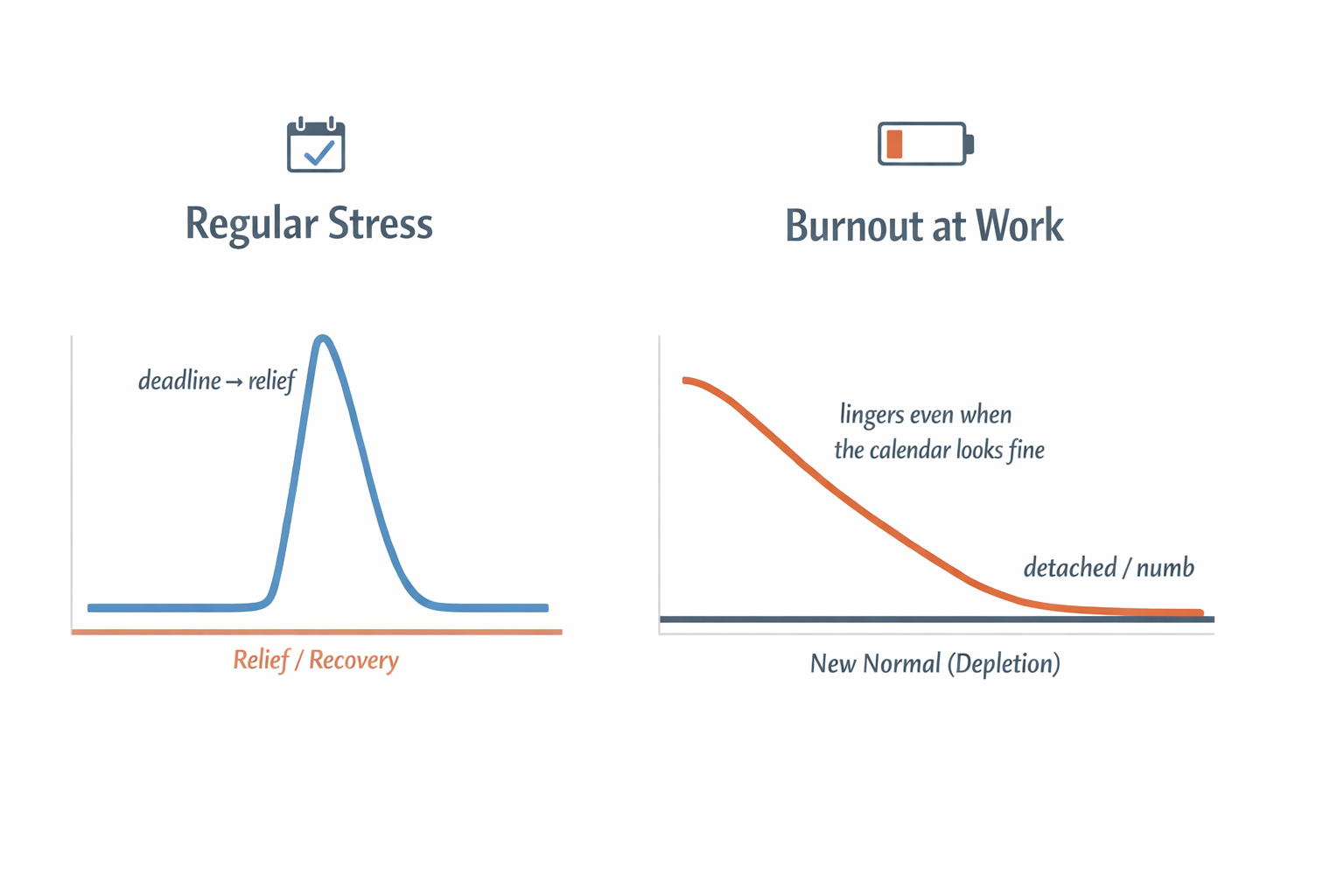
Here’s the honest definition: burnout at work is long-term mental, emotional, and physical depletion from chronic pressure, where effort stops refueling you and starts draining you. Regular stress has a beginning and an end (deadline → relief). Burnout lingers even when the calendar looks “fine,” and it slowly turns into your baseline—your new normal—until you feel oddly detached from both your work and your own personality.
BURNOUT
VERSUS REGULAR STRESS?
And
this is where a lot of ambitious people get accidentally tricked: we mislabel
it as “life stress.” We assume it’s a phase, a season, a temporary grind that
will disappear once we hit the next milestone. But if you look up years later
and realize the tiredness never left… that wasn’t a season. That was burnout at
work moving in and rearranging the furniture.
What does it feel like? Not just “I’m tired.” More like: “Will I ever feel like
myself again?” It’s the unsettling experience of losing access to the version
of you who used to be resilient, creative, and quietly confident—the one who
could solve problems without melting down in the grocery store aisle because
they were out of peanut butter. (It’s never actually about the peanut butter.)
Why Typical Fixes Don't Work
Why typical fixes don’t work (even when they’re good fixes)
Most of us ping-pong between two strategies:
1) Push harder: “I just need a reset, a stronger mindset, a heroic week.”
2) Pull back: “If I rest enough, I’ll bounce back and return to normal.”
I tried both. Repeatedly. And if you’ve been dealing with burnout at work for a
while, you can get weirdly skilled at “managing stress” without actually
addressing what’s creating the depletion. Exercise, journaling, meditation,
hobbies—great tools. But if you use them like duct tape on a system that’s
still running at redline, you’ll end up healthier… and still burned out.
How To Start Healing From Burnout At Work
My big epiphany was this: I didn’t just have a workload problem. I had an operating system problem.
I built a high-RPM identity—hyper-driven, vigilant, always proving something—because it worked. It helped me launch, grow, and win. The issue is you can’t run your internal engine at that speed forever without consequences. Eventually, the “success settings” that got you results start producing burnout at work as a predictable output.
Why slowing down can feel terrifying
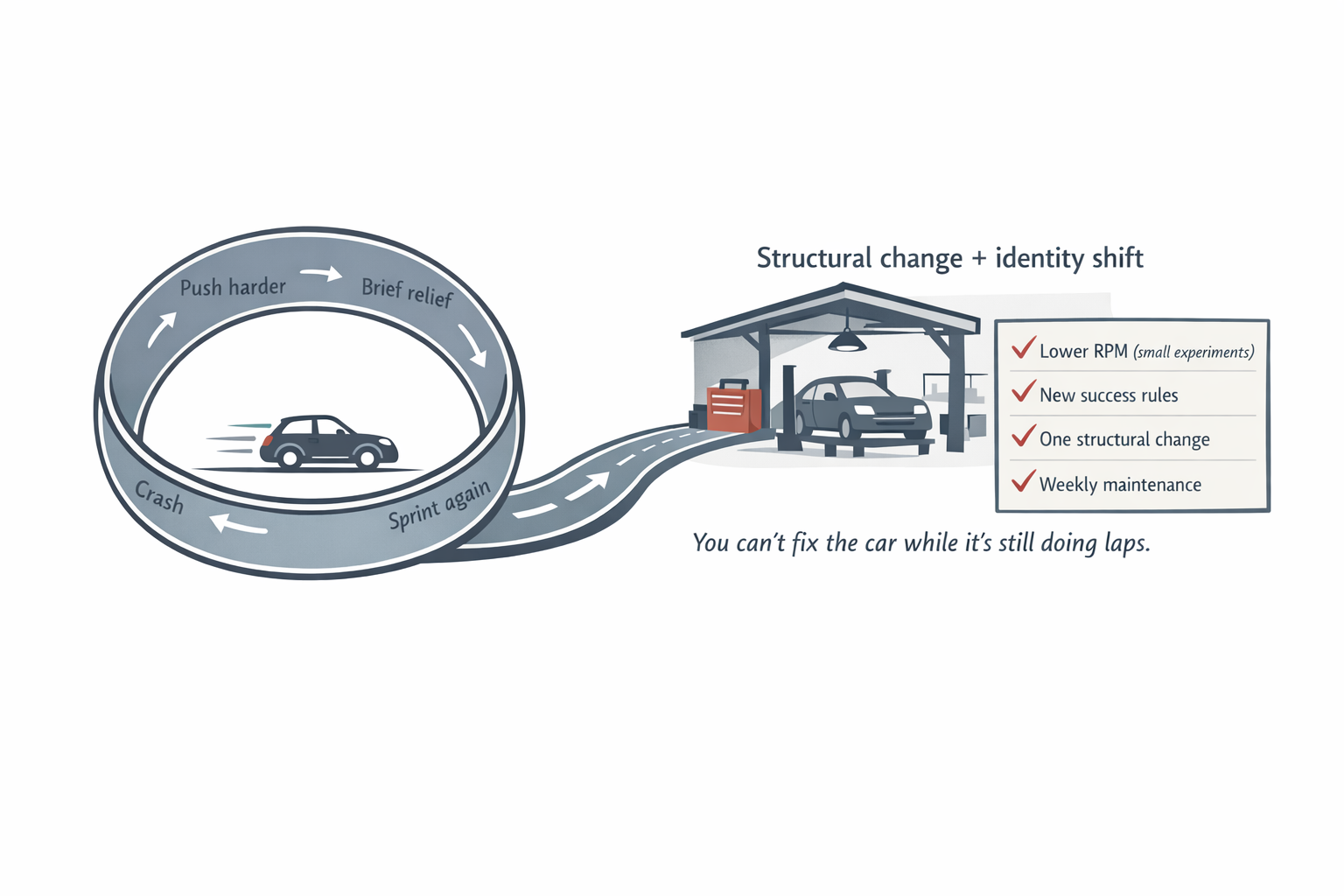
Here’s the mildly annoying part: when you finally try to rest, the success-wired part of your brain starts yelling, “Danger! Failure! Financial ruin!” So you “recover,” then sprint again, then crash again—like a productivity hamster wheel with a LinkedIn profile.
That’s why healing is often an identity-level shift, not just a scheduling tweak. It’s not only “work less.” It’s “become someone who doesn’t need to earn safety through overfunctioning.”
For me, healing meant making a structural change—not a cute self-care upgrade.
I stepped away from the business path I’d built, because I couldn’t rebuild my
relationship with work while living inside the same system that kept generating
burnout at work. Metaphorically: you can’t fix the car while it’s still doing
laps on the racetrack.
This is also why career change can be so emotionally intense. It’s not just
changing jobs. It’s letting go of an identity that once protected you: the
achiever, the grinder, the one who can handle anything. And yes, that identity
helped you get here. But it may not be the identity that can carry you forward
with peace.
A slower-burn definition of success
The hustle culture storyline says “busy = important.” But long-term contentment
usually comes from a different scoreboard: sustainable energy, clean
boundaries, work you can stay curious about for years, and a pace that doesn’t
require daily self-abandonment.
These days, I’m building around a longer horizon—less “stuff the day,” more
“build a career I can actually live inside.” Because success that costs your
nervous system isn’t success. It’s a trade. And the interest rate is brutal.
A PRACTICAL PATH TO HEAL FROM BURNOUT
1)
Recognize your burnout pattern
Burnout isn’t usually random—it’s a loop you’ve rehearsed so many times it
feels like personality. Identify your early warning signs (sleep, irritability,
dread, numbness) and what reliably triggers them. Naming the pattern turns
burnout into data, not destiny.
Example: “When I start taking ‘one more quick project,’ I lose my weekends
within two weeks and start resenting clients I used to like.”
2) Map your ‘high-RPM’ operating system
Write down the internal rules that run you: urgency, perfectionism,
over-responsibility, fear of disappointment. These beliefs are often the
invisible engine behind your pace, and you can’t change what you won’t admit is
driving. Once you see the rules, you can rewrite them.
Example: “If I’m not immediately available, I’m not valuable” becomes “I create
value by delivering outcomes, not instant access.”
3) Experiment with lowering the RPM in low-risk areas
Don’t go from 100 to zero. Run small, low-drama experiments that prove to your
brain you can slow down without everything collapsing. Pick one boundary or
simplification for 2–3 weeks and track the results in energy, quality, and
client response.
Example: Two daily email windows (11am and 4pm) with an autoresponder: “I
respond within 24 business hours.”
4) Define your new success rules
If your definition of success is “more, faster, always,” your system will keep
producing burnout. Create rules that reward sustainability: fewer priorities,
clearer finish lines, and success metrics tied to outcomes—not hours or
exhaustion. This is where identity shifts from “I prove myself” to “I build
something that supports me.”
Example: “Success is delivering two high-impact client wins per week and
protecting two deep-recovery blocks” replaces “Success is being slammed.”
5) Plan one structural change at work (not just self-care)
Burnout improves fastest when you change the structure that creates it: scope,
pricing, timelines, client fit, meeting load, or role clarity. Choose one
meaningful shift, put it on a calendar, and communicate it like a
professional—not like you’re asking permission to breathe.
Example: Increase prices 15%, remove rush options, and update your onboarding
doc so expectations are standard and sane.
6) Build a maintenance system (so you don’t relapse)
Healing isn’t a one-time glow-up; it’s ongoing calibration. Create a simple
weekly check-in to catch early signs and adjust before you slide back into old
defaults. Think of it as keeping your internal dashboard clean and readable.
Example: Every Friday, rate energy (1–10). If it’s under 6, you automatically
remove one commitment from next week—one meeting, one task, one “favor.”
Related Posts
- Should I Quit My Job? How To Decide When It’s Time to Leave or Switch Careers (hub)
- Signs You Should Quit Your Job: Reasons, Red Flags, and the Emotions You Can’t Ignore
- Feeling Guilty About Quitting Job? How to Leave with Integrity (Without Second-Guessing Yourself)
- Reasons for Quitting a Job: 7-Question Checklist to Know When It’s Time
- The "I Keep Quitting Jobs" Phase (And Why It's Not the End of Your Story)
- I Regret Quitting My Job: What to Do Next When the “Fresh Start” Feels Like Free-Fall
Recent Articles


-
Biggest Change in Life
Dec 31, 25 06:53 PM
 How your career can offer the biggest change in life and why mindset is the hidden barrier
 -
Process of Becoming an Adult
Oct 05, 25 12:18 PM
A practical 5-pillar framework for the process of becoming an adult: build independence, income, resilience, emotional strength, and a reputation you can use. -
Did the results of the last election hurt your industry and career?
May 02, 25 03:20 PM
Career and elections. Some helpful perspective when results seemed to have hurt your career opportunities.