The "I Keep Quitting Jobs" Phase (And Why It's Not The End of Your Story)
If you keep quitting jobs, it can feel like your life is turning into a highlight reel of false starts—and you may find yourself thinking, “I keep quitting jobs… what is wrong with me?” When you can’t get traction at work, the future starts looking… a little bleak.
But hang on. This isn’t a character flaw tattooed on your forehead forever.
This is a phase. A messy one. A growth-y one. An “I didn’t order this lesson”
one. But still: a phase.
"I Keep Quitting Jobs" (What This Phase Really Is)
Let’s
name it plainly: the “I keep quitting jobs” phase is a season where you start
work, but you can’t sustain it. You might quit fast, stop showing up, or
mentally check out and talk yourself into leaving—even when the job is
technically “fine.”
This isn’t just a work problem.
It’s a transition problem.
You’re in limbo: between your potential future and the lessons you haven’t
absorbed yet in the jobs you keep leaving.
And yes, it can feel like repeated gut punches.
WHY
IT FEELS SO HEAVY (Even When The Job Isn't "That Bad”)
1)
You’re stuck between “not enough” and “not yet”
You can sense you’re meant for more… but you don’t quite have the habits,
confidence, skills, or direction fully built yet. So you bounce between jobs
that feel too small and dreams that still feel out of reach.
That limbo creates frustration, resentment, and a weird kind of restlessness
you can’t nap off.
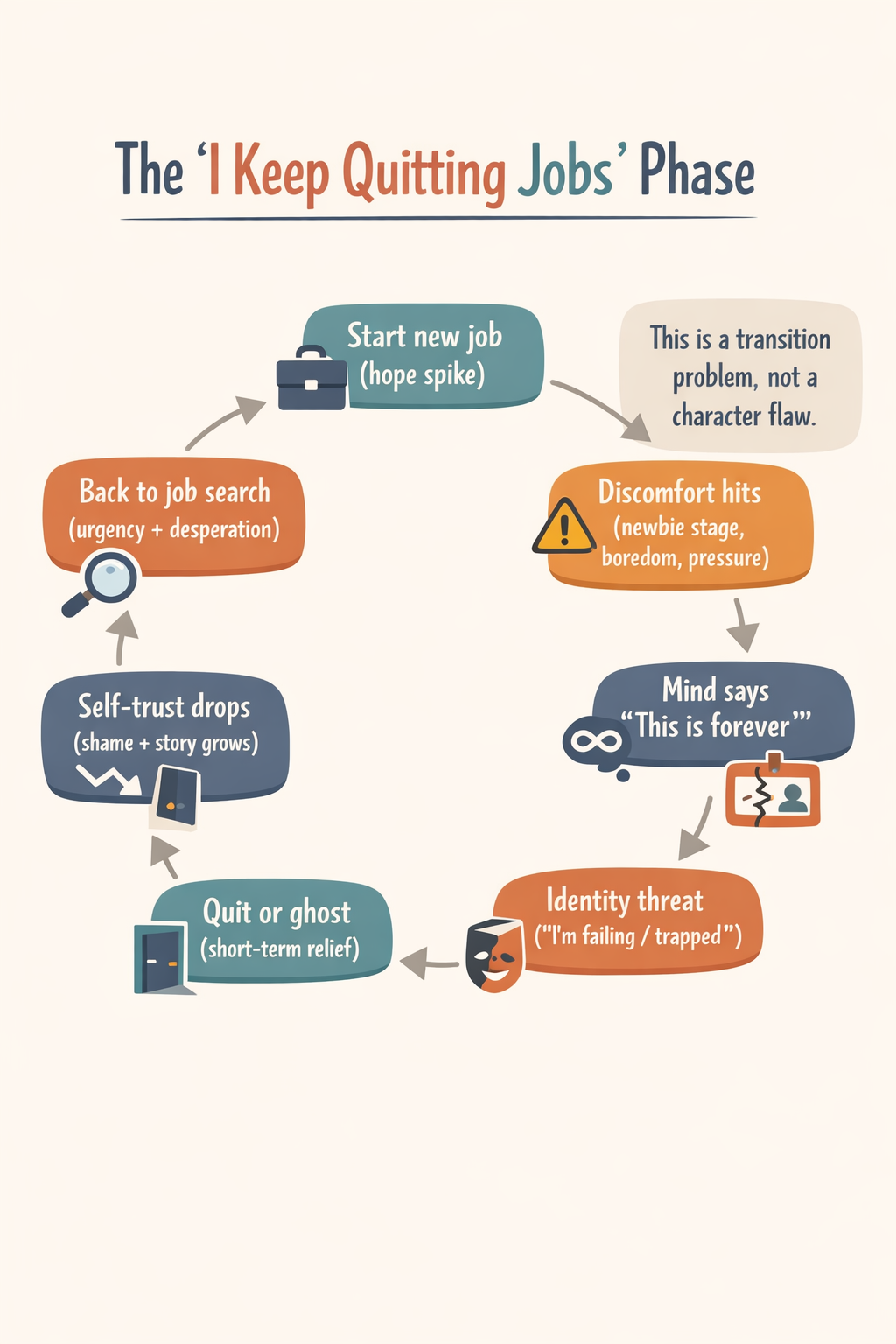
2) Every quit adds “evidence” to a painful story
Each time you leave, your brain starts collecting proof for a narrative like:
“I can’t stick with anything.”
“I’m behind.”
“I always blow it.”
And once that story gets momentum, it becomes easier to quit again—because
you’re not just quitting a job, you’re obeying an identity.
3) The job becomes a symbol (not just a paycheck)
In this phase, a job can start to represent something bigger:
- Proof you’re trapped
- Proof your business idea didn’t work
- Proof you’re “failing at life”
So quitting becomes less about the workplace and more about escaping what the
job seems to say about you.
WHY
YOU KEEP QUITTING JOBS (The Real Reasons)
Here’s
the candid list—coach hat on, but no judgment.
1) You see the work as hopeless or soul-crushing
When you believe “this is pointless,” your nervous system hears “danger.” And
it does what nervous systems do: it tries to get you out.
2) “Indefinitely” feels like a prison sentence
A lot of people don’t quit because the job is hard.
They quit because the thought of doing it forever makes them panic.
That “day in and day out” storyline is gasoline on the quit impulse.
3) Self-sabotage shows up right before stability
There’s a particular flavor of sabotage that appears when things might actually
start working. Consistency requires discomfort. Discomfort triggers escape.
Escape looks like quitting.
4) You’re ambitious—but missing a few boring keystone habits
Ambition is the spark.
Discipline is the engine.
If you haven’t built the routines that make showing up automatic, you’ll keep
relying on motivation… and motivation has the lifespan of a mayfly.
5) You’re avoiding the pain of facing your own limitations
Here’s the uncomfortable truth from the original story:
What was unbearable wasn’t the job itself.
It was the moment-by-moment experience of facing flaws, responsibility, and
“I’m not who I want to be yet.”
Quitting gives instant relief from that mirror.
A
QUICK PERSONAL STORY (My Turning Point)
When
I was about 20, I had my own version of “I keep quitting jobs.” I’d get hired,
show up for a couple days, and then… vanish. No call. No show. Just me and my
very sophisticated strategy of avoidance.
The work was entry-level: kitchens, labor, unglamorous grind. And I kept
thinking:
“I can’t do this day in and day out.”
I also wanted to start a small window-cleaning/home maintenance business—but I
couldn’t get traction. So every “regular job” felt like proof my bigger dream
had failed.
Then around 22, I sat in my car on yet another first day and had the thought:
“I can’t keep doing this.”
And for once, I didn’t mean the job.
I meant the pattern.
I stuck it out through the term. And that decision—small, unsexy,
un-Instagrammable—became a turning point. It wasn’t just about work. It was the
beginning of building resilience, tenacity, and psychological muscle.
Ironically: the exact traits I needed to build the business later.
The Real Lesson: This Is An Identity Shift, Not Just A Career Move
Often
the early jobs aren’t the dream. They’re the gym.
If you see a job as imprisonment, it can be that.
If you engage in it as training that lifts you up, it can do that too.
Your beliefs shape your mindset.
Your mindset shapes your actions.
Your actions shape your results—and eventually, your identity.
The win isn’t “finding the perfect job.”
The win is becoming the person who can finish, learn, and move up on purpose.
HOW TO CREATE A BETTER REPUTATION WITH YOURSELF
This
part matters more than most people realize.
When you repeatedly quit—especially by disappearing—you don’t just burn bridges
with employers.
You damage trust with yourself.
And low self-trust makes everything harder: interviews, new roles,
entrepreneurship, relationships, confidence.
But you can reverse it.
You can build a track record you’re proud of by:
- Showing up consistently
- Communicating instead of ghosting
- Leaving on good terms
- Finishing a defined work term
That’s how you rebuild self-esteem the real way: with evidence.
WHAT TO DO NOW (Ground in Action)
1)
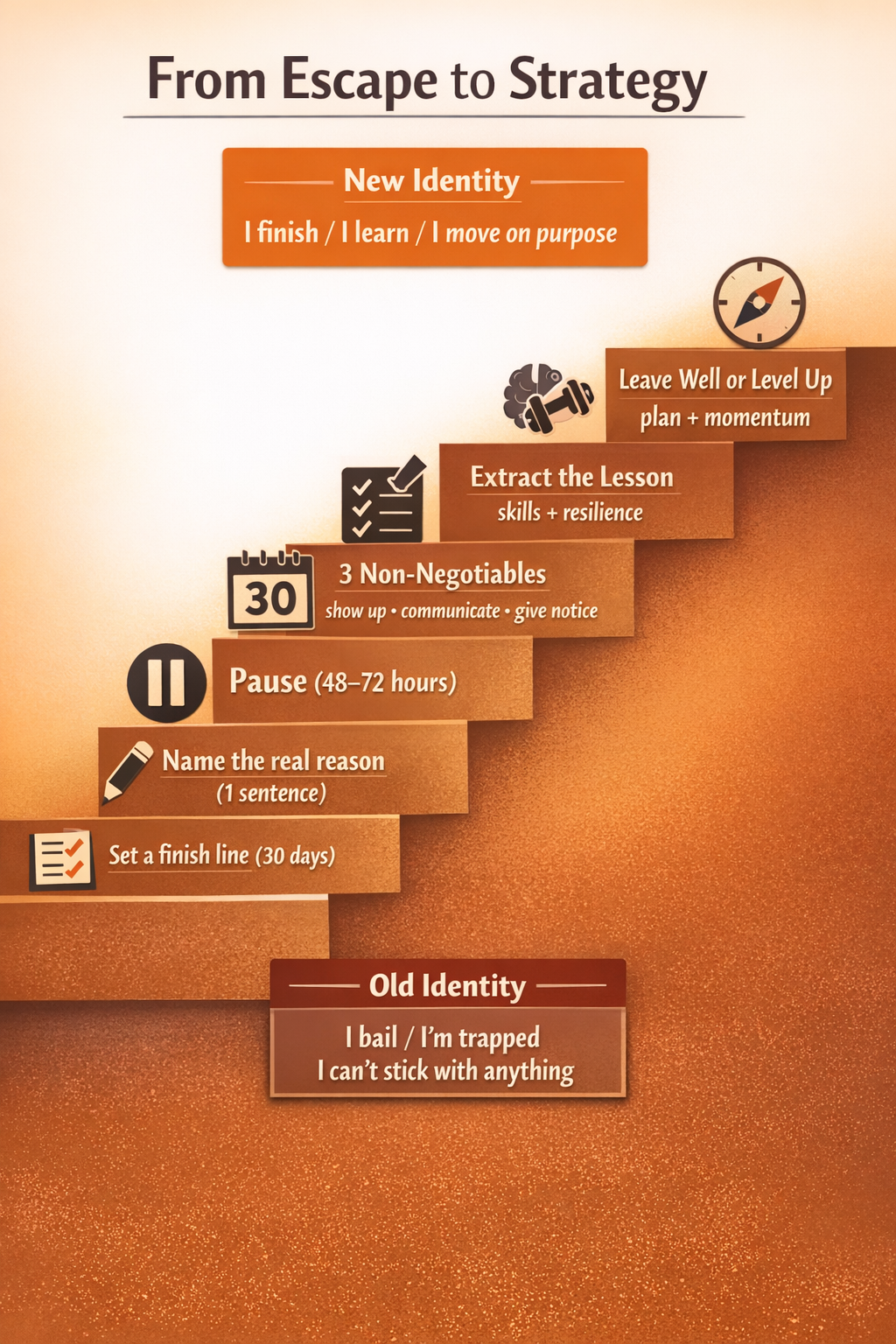
Pause the pattern before you repeat it
Make a rule: no quitting on a bad day.
Give yourself 48–72 hours before making a decision.
2) Name the real reason you want to leave (one sentence)
Examples:
- “I feel incompetent and it’s embarrassing.”
- “I feel trapped and I don’t have a plan.”
- “I feel disrespected and I haven’t set boundaries.”
Clarity turns panic into a problem you can solve.
3) Commit to a short finish line (not forever)
Your brain hates “indefinite.”
So choose a defined term:
- 30 days
- end of the contract
- until you save $X
Finish lines build resilience without triggering the prison-sentence feeling.
4) Build 3 non-negotiables for reliability
Simple, powerful:
- Show up on time
- Don’t quit without notice
- Don’t disappear—communicate
This is how you stop being the person who says “I keep quitting jobs” and start
being the person who handles hard things.
5) Extract the lesson the job is trying to teach you
Ask: “What skill will make my future easier if I master it here?”
Patience. Follow-through. Dealing with people. Consistency. Systems.
These are career multipliers.
6) If you leave, leave well
Give notice. Say thank you. Help transition.
Protect your network and your self-respect.
7) Build your next step while you’re still employed
Update resume/LinkedIn.
Apply weekly.
Take one course.
Start a small side income.
Momentum reduces the urge to blow everything up.
8) Get accountability
Tell one trusted person your finish line and check in weekly.
Patterns break faster when they’re not a solo wrestling match.
CLOSING REFRAME
If
you’re in the “I keep quitting jobs” chapter right now, you’re not
doomed—you’re being invited to grow up at an identity level.
Not into a perfect worker.
Into a sturdy person.
And once you’re sturdy, your career options expand fast.
Related Guides:
- Should I Quit My Job? How To Decide When It’s Time to Leave or Switch Careers (hub)
- Signs You Should Quit Your Job: Reasons, Red Flags, and the Emotions You Can’t Ignore
- Reasons for Quitting a Job: 7-Question Checklist to Know When It’s Time
- Feeling Guilty About Quitting Job? How to Leave with Integrity (Without Second-Guessing Yourself)
- Burnout at Work: When “Just Keep Going” Stops Working
- I Regret Quitting My Job: What to Do Next When the “Fresh Start” Feels Like Free-Fall
Recent Articles


-
Biggest Change in Life
Dec 31, 25 06:53 PM
 How your career can offer the biggest change in life and why mindset is the hidden barrier
 -
Process of Becoming an Adult
Oct 05, 25 12:18 PM
A practical 5-pillar framework for the process of becoming an adult: build independence, income, resilience, emotional strength, and a reputation you can use. -
Did the results of the last election hurt your industry and career?
May 02, 25 03:20 PM
Career and elections. Some helpful perspective when results seemed to have hurt your career opportunities.