The
Search For Meaningful Work: Stop Chasing Purpose—Start Building It (Reps, Not
Revelations)
Build meaning where you are—through small reps, real courage, and the identity upgrades that make your next move obvious.

The Meaningful Work Myth (And Why It Keeps You Scanning)
Let’s
talk about “meaningful work”—and the search for meaningful work that so many
ambitious, capable people end up trapped inside.
Not the Pinterest-quote version.
Not the “I quit my job and now I make ceramics in Portugal” version.
The real version—especially if you’re quietly cooked from trying to make your
career feel like your 24/7 calling.
So… what does meaningful work mean to you?
Is it work that satisfies you?
Work that matters?
Work with a mission, a cause, a deeper “why”?
That’s the story our culture sells:
Find the perfect thing.
Feel lit up every day.
Earn money and feel spiritually aligned while answering emails.
It’s a lovely fantasy. It also turns into a wild goose chase.
Because if you believe “meaning” is something you find out there, the search
for meaningful work turns into constant scanning: the perfect role, the perfect
industry, the perfect mission… while ignoring the stuff that’s actually shaping
your life right now.
And underneath that scanning is usually one quiet belief: I’ll be happy when I find the right thing. Here’s a deeper breakdown of why the finish line keeps moving (and how to choose meaningful work without chasing): I’ll Be Happy When… Why Chasing Success Leaves You Empty (And How to Choose Meaningful Work).
If you’re reading this and thinking, “Honestly, I’m not even inspired enough to scan anymore—I just feel numb,” start here: Feeling Lost in Your Career? When Life Passed You By at Work. It’ll help you get off autopilot and reconnect with the part of you that still knows what matters.
And that’s where the search often breaks down.
Why The Search For Meaningful Work Often Fails
Here’s
the flip:
Meaningful work isn’t primarily about solving big world problems.
It’s about facing—and transforming—your own internal ones.
Sometimes chasing grand causes is just an incredibly sophisticated form of
procrastination.
It’s easier to imagine saving the rainforest than to:
- have the hard conversation with your boss
- get your finances under control
- stop people-pleasing your way into resentment
- follow through on the boring basics
- clean up the messes you keep stepping around (literal or metaphorical)
The real meaning and real change? It’s close to home.
Work becomes meaningful when it turns into a training ground for becoming
someone you respect.
Someone with self-authority.
Someone who can handle pressure.
Someone who keeps promises to themselves.
Someone who can navigate relationships without spiraling.
That’s the “flashlight inward” move.
And yes—sometimes it’s less glamorous than a mission statement.
But it actually changes your life.
A
QUICK NOTE FOR AMBITIOUS, RESTLESS HUMANS (A.K.A. MOST OF US)
Especially
early in your career (but honestly, at any stage), it’s tempting to want a
career that looks extraordinary.
Big title.
Big impact.
Big “wow, you must love your job” energy.
Meanwhile:
- discipline is wobbly
- money is leaky
- boundaries are nonexistent
- health is hanging by a thread
- and your car is basically a storage unit on wheels
No shame. I’ve been there.
But it’s a little like demanding a five-star life purpose while your internal
“home base” is in mild disrepair.
The "Meaningful Work" Trap
When
people feel unfulfilled, the default move is to look outward.
“My job is too mundane.”
“I need something with a bigger mission.”
“If I could just find my passion, everything would click.”
Maybe.
But before you sprint into a career change, here’s the more useful question:
Is your own life in order?
Are you tending your own garden?
Because meaning doesn’t come from the job magically being extraordinary.
Work becomes extraordinary when it changes your story.
And if you’re honest, a lot of the search for meaningful work is really a
search for relief: less dread, more agency, more self-respect in your
day-to-day.
If you want a clear definition (and a way to measure it), use this: Meaningful Career: How to Define It (and How to Measure If You’re Living It). The scorecard will show you what to fix first.
CHANGE
YOUR STORY, NOT JUST YOUR JOB
The
most meaningful career paths usually have one thing in common:
they force you to outgrow an internal limitation.
Not “I found my passion.”
More like:
- “I learned how to lead even though I was terrified.”
- “I became consistent after years of chaos.”
- “I stopped avoiding conflict and my relationships improved.”
- “I found my voice and advocated for myself.”
- “I got my act together, one unsexy habit at a time.”
Those wins matter because they alter your identity.
They rewrite your narrative.
And that’s the real prize in a career change, by the way:
Not the new title.
Not the shiny industry.
The person you become on the way there.
HOW DO YOU CHANGE YOUR STORY?
Look
for the emotionally charged area.
The thing that makes you react, shut down, avoid, overwork, people-please,
procrastinate, numb out, or blow up.
That’s not a character flaw.
That’s a story—a pattern—running your life.
And if it’s showing up at work, it’s probably limiting your income, your
options, and your confidence too.
We all have these stories.
The goal isn’t to pretend they don’t exist.
The goal is to build the capacity to change them.
Because that capacity? That’s meaningful.
And here’s the sneaky part:
The best opportunities for meaningful growth are usually right at your feet.
You don’t even have to go find them.
You just have to stop dismissing them as “annoying” or “in the way.”
We often want to escape the exact challenge that could mature us.
We’d rather chase something far-off and impressive…
because it looks good and doesn’t require us to face our real edges.
(Your ego loves a lofty mission. Your growth requires a real conversation.)
WHEN
A MISSION IS HELPFUL (AND WHEN IT’S A DISTRACTION)
To
be fair, a mission can be a great starting point.
If you’re considering a career change and you don’t know the exact role yet, it
helps to ask:
“What problem do I care about?”
“What am I curious to solve?”
“What ‘itch’ keeps showing up?”
That’s useful.
It creates movement.
But don’t confuse the guidepost with the real work.
The real work is the identity shift that happens while you’re moving:
becoming more courageous, more grounded, more disciplined, more honest, more
resilient.
The mission points the direction.
Your daily actions do the transformation.
Which brings us to the mindset you actually need.
A
BLUE-COLLAR MINDSET FOR CREATING MEANING
Think
blue-collar—not in job type, but in attitude.
Hands-on.
Practical.
No drama.
No waiting for inspiration.
Meaning is built the way strength is built:
reps, not revelations.
It’s getting your hands dirty with the problems close to home and saying:
“This is the thing I need to face to open up my next level.”
When you approach work like that, you stop needing it to “feel meaningful” all
the time.
Because you can see the meaning being constructed—day by day—through who you’re
becoming.
And that’s the end of the search for meaningful work as a frantic hunt for the
“perfect thing”—and the beginning of meaning as something you build.
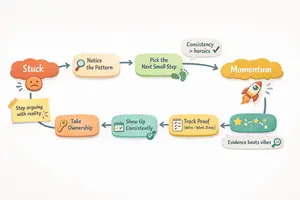
5 Steps To Create Meaning In Your Current Work
If
meaningful work is less about “saving the world” and more about changing your
story, here’s how to do it in a grounded, non-woo, actually-effective way.
Step 1: Identify the limiting story you keep living from
Pick the recurring inner script that shows up when you’re stressed,
responsible, or exposed.
Ask:
- What situation at work reliably triggers me?
- What do I tell myself in that moment?
- What identity label pops up?
Examples:
“I’m not a leader.”
“I’m bad with people.”
“I always mess up details.”
“I’m behind.”
“I can’t focus.”
Write it like this:
“When ______ happens, it proves I am ______, so I ______.”
That’s your operating system. And it’s trainable.
Step 2: Choose one close-to-home challenge (not a grand mission)
Skip the heroic life overhaul.
Pick one real friction point that affects your daily life.
Good candidates:
- avoiding a conversation
- inconsistent follow-through
- procrastination on uncomfortable tasks
- overcommitting, then resenting it
- not advocating for yourself
- disorganization that creates constant stress
Choose ONE that has some emotional heat—but won’t flatten you. A manageable
edge.
Step 3: Define a small 30-day experiment at work
Not a personality makeover.
An experiment.
Three parts:
1) The behavior: what you will do
2) The frequency: how often
3) The constraint: what makes it realistic
Example:
“I’ll spend 10 minutes at the end of each workday planning tomorrow, weekdays
only.”
More examples:
- “I’m not a leader” -> Open each meeting with a clear goal and a next step.
- “I can’t focus” -> One 25-minute deep-work sprint before messages.
- “Conflict ruins relationships” -> Have one honest, calm conversation you’ve been avoiding.
- “I’m disorganized” -> One task list, close 3 loops before noon.
The goal isn’t perfection.
It’s evidence. Proof that the old story isn’t the full truth.
Step 4: Track what changes in your narrative (not just outcomes)
Yes, track results.
But also track the identity shift.
For 30 days, track:
A) The facts
- Did I do the experiment today? Y/N
- What happened?
- What was the response?
B) The narrative
- What did I assume would happen?
- What actually happened?
- What might be becoming true about me now?
Look for upgrades like:
- “I’m terrible with follow-through” -> “I can be consistent with a simple system.”
- “I avoid hard things” -> “I can do hard things in small reps.”
- “This job is meaningless” -> “This job is training me to become someone I respect.”
That’s meaning. That’s identity change.
Step 5: Decide the next challenge (keep the blue-collar mindset)
After 30 days, don’t ask:
“Did I find my purpose?”
Ask:
- What did I learn about myself?
- What internal struggle loosened its grip?
- What responsibility am I now ready for?
Then choose your next challenge:
- Go deeper: same challenge, slightly harder version
- Go wider: apply the skill to another area (communication, money, health, leadership)
- Go upward: take on a responsibility the “old you” avoided
This is how meaningful work is built:
not by finding the perfect job,
but by becoming a bigger person in the job you have—until your next move is
obvious, grounded, and earned.
And that’s the real resolution to the search for meaningful work: you stop
hunting for a perfect calling and start becoming someone who can create meaning
wherever you are.
Related Posts:
Recent Articles


-
Biggest Change in Life
Dec 31, 25 06:53 PM
 How your career can offer the biggest change in life and why mindset is the hidden barrier
 -
Process of Becoming an Adult
Oct 05, 25 12:18 PM
A practical 5-pillar framework for the process of becoming an adult: build independence, income, resilience, emotional strength, and a reputation you can use. -
Did the results of the last election hurt your industry and career?
May 02, 25 03:20 PM
Career and elections. Some helpful perspective when results seemed to have hurt your career opportunities.