Meaningful Career: How to Define It
(and How to Measure If You’re Living It)
What “Meaningful Career” Actually Means (A Definition You Can Use)
A Meaningful career isn’t a fancy title you announce you
proudly share with your family on Thanksgiving and then magically feel
fulfilled forever. It’s a felt sense. A quiet “yes” in your body when your work
matches who you are, not who you’re trying to impress.
Here’s a definition you can actually use:
A meaningful career is a path you can live with integrity—right where you
are—because it reflects your values, uses your strengths, helps you connect,
and leaves you with enough energy to be a human after 5 p.m. It’s usually
something you feel rather than just intellectualize.
If you’re in your 20s and trying to build direction without burning out or copying someone else’s timeline, start here: Meaningful Career For Young Adults: Build Direction Without Losing Yourself.
Notice what’s missing: status symbols, hustle-as-a-personality, and the “one
perfect calling” myth. Meaning isn’t a limited resource (only for the lucky),
and it’s not graded on a universal scale. What’s meaningful to you might look
simple (even boring) to someone else—and that’s fine. Meaning is personal
significance, not cultural applause.
Also: meaningful doesn’t mean “escape.” It means honest inventory + grounded
strategy. You look at where you are, what you’ve learned, what you want next,
and you start building from there—one aligned move at a time.
Two paths to a meaningful career (choose on purpose)
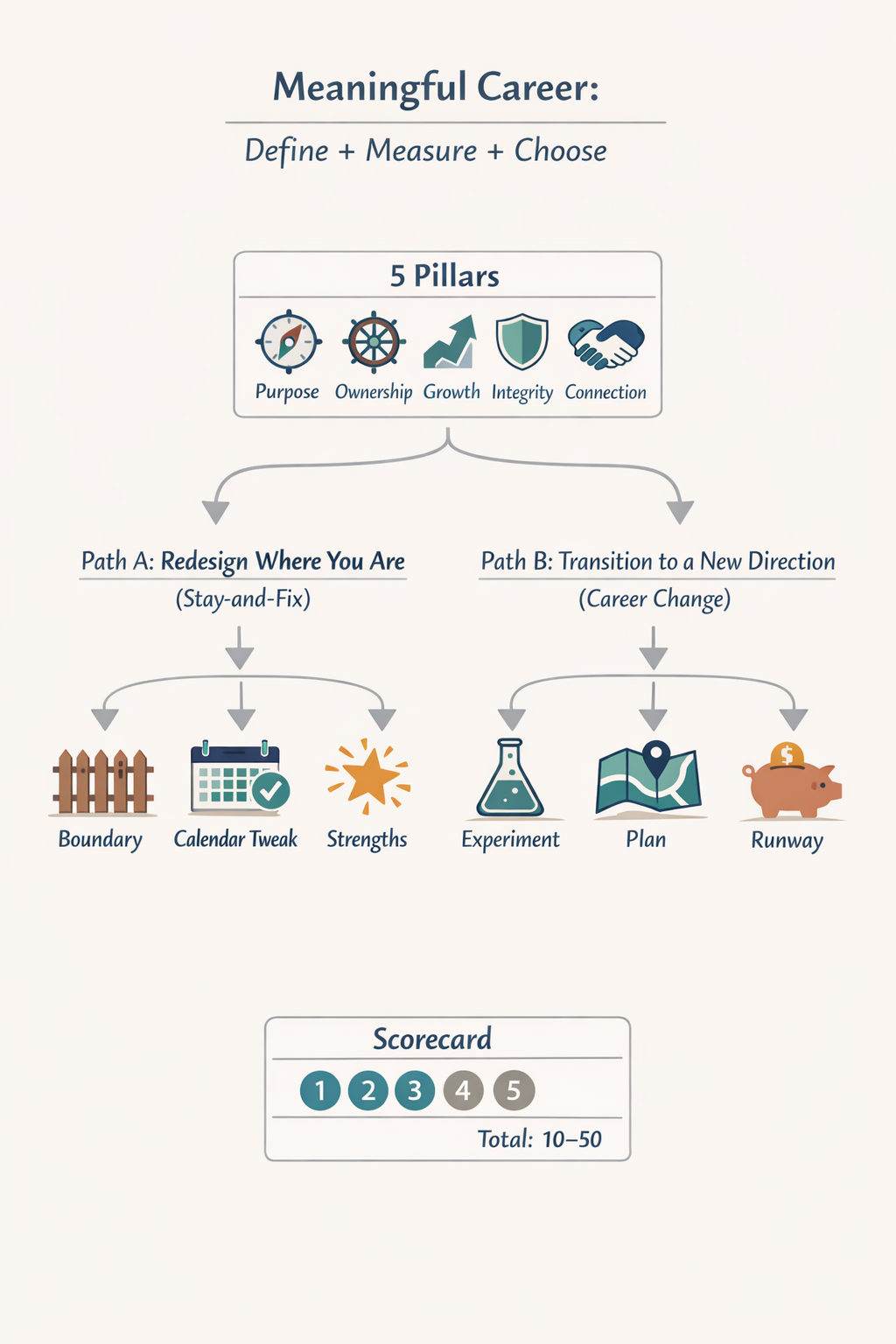
Most people assume “meaningful career” automatically means “new job.” Sometimes it does. Often, it doesn’t. There are two paths to a meaningful career. Instead of asking “What job will fix me?” Ask, “What choice fits the person I’m becoming?”
Path A: Redesign where you are (stay-and-fix)
Choose this when the foundation is mostly workable, but one or two pillars are dragging you down (often Ownership, Growth, or Connection). Your move is to lean in: renegotiate boundaries, reshape your role around strengths, build “earned satisfaction,” and run monthly check-ins instead of silently suffering.
Being Happy at work (and why that can feel so elusive)
Path B: Transition to a new direction (career change)
Choose this when Integrity and Purpose stay low even after honest experiments—when the work requires you to be someone you don’t respect. Your move is a deliberate pivot: values-first clarity, small tests, a stability plan, and a new standard for who you’re becoming.
When Career Satisfaction Becomes a Trap (Here’s the Upgrade)
See the Meaningful Career Scorecard below to measure your meaningful career alignment.
MEANINGFUL VS HAPPY VS SATISFIED: Which One Are You Really Chasing?
Most
people say they want a meaningful career… but what they’re really chasing is
either happiness or satisfaction. Those aren’t wrong goals. They’re just
different tools—and mixing them up is how ambitious people end up exhausted and
confused.
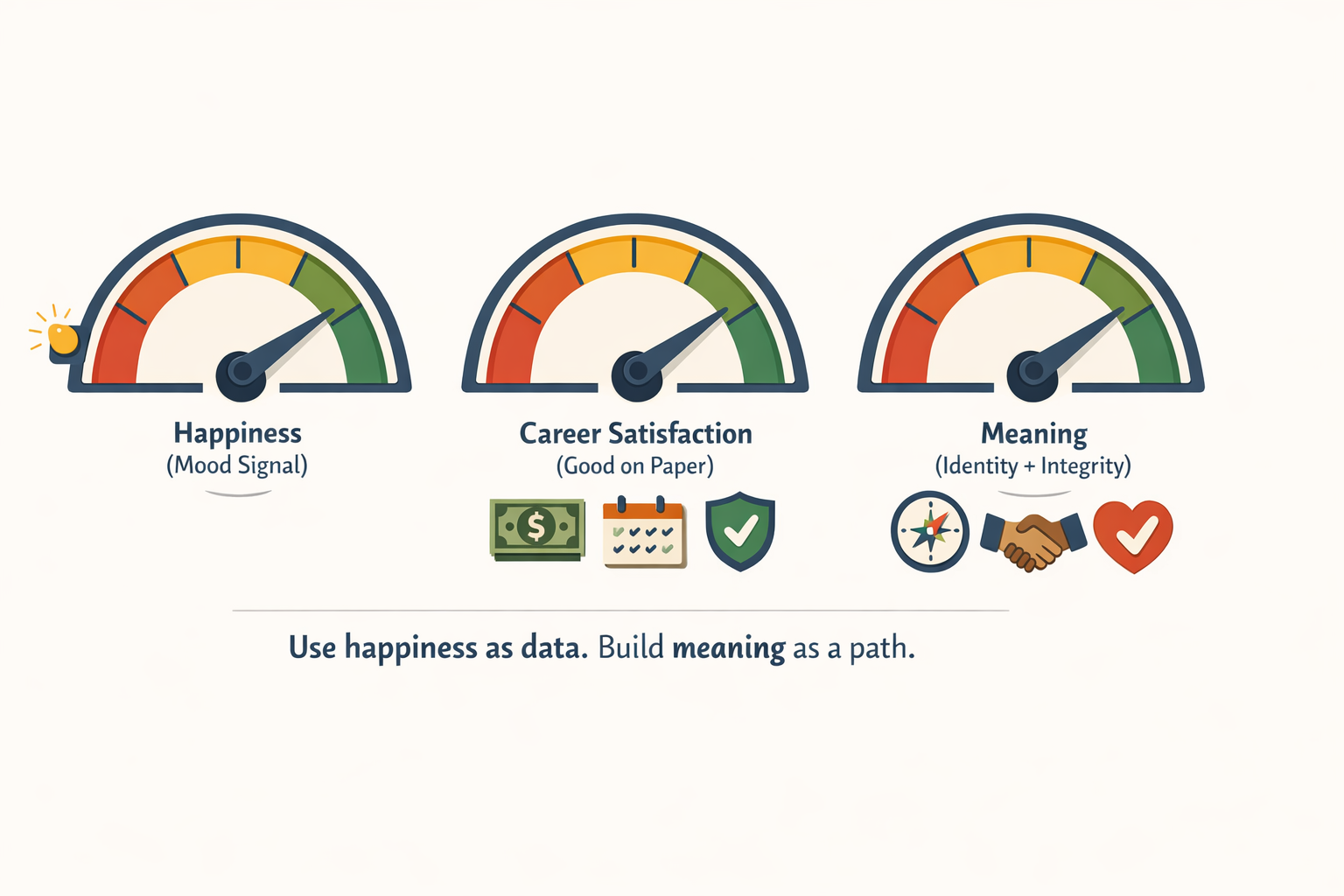
Happiness at work is a mood signal. It’s real, it matters, and it can be
weirdly elusive (especially when Tuesday is doing Tuesday things). Treat it
like a dashboard light: useful information, not a life sentence.
Career satisfaction is the “good on paper” metric—pay, stability,
predictability, benefits, a decent boss, a workload that doesn’t eat your
nervous system. Necessary foundation. Not always the point.
Meaning is deeper and quieter. It’s felt more than intellectualized. It’s
personal significance—no universal barometer, no status-score, no comparing
your path to someone else’s highlight reel. Meaning is often simple: integrity
over shortcuts, connection over performance, a life you can actually live. It
starts right where you are, with honest inventory and practical strategy—not
escape fantasies.
If you’re not sure which one you’re chasing, we’ll unpack “happy” with a quick
diagnostic (Being Happy at Work) and upgrade “satisfied” into something
identity-level (Career Satisfaction).
The Meaningful Career Framework: 5 Pillars (Purpose, Ownership, Growth, Integrity, Connection)
If
“meaningful” feels slippery, good—you’re normal. Meaning isn’t a universal
ranking system. It’s personal, felt, and built over time. So instead of chasing
a vibe, use five pillars you can actually work with (and measure).
1) Purpose
Can you name what your work is “for” in one sentence—and does it matter to you
(even if no one applauds)? Purpose is personal significance, not prestige.
2) Ownership
Do you have enough autonomy to do work you respect? Ownership is the power to
shape your week, lean into strengths, and stop living someone else’s script.
3) Growth
Are you improving at something that matters to you? Growth creates “earned
satisfaction”—the grounded kind that comes from progress, not comfort.
4) Integrity
Are you acting in ways you respect, even under pressure? Integrity is where
meaning lives when things are messy. It’s choosing standards over shortcuts.
5) Connection
Do you feel useful to real humans? Meaning expands when you build rapport,
serve well, and see people as similar—not as obstacles.
This framework works whether you stay-and-fix or career-change: strengthen one
pillar at a time, right where you are, with honest action—not escape plans.
Meaningful
Career Scorecard: Measure If You’re Living It (1–5 Ratings + Total Score)
If you want to measure meaningful career alignment without
spiraling into a 47-tab identity crisis, use this quick scorecard. Rate each
statement 1–5:
1 = Strongly disagree
2 = Disagree
3 = Neutral
4 = Agree
5 = Strongly agree
A) Purpose
1) I can explain (in one sentence) what my work is “for.”
2) My daily tasks connect to values that matter to me.
B) Ownership
3) I have enough control over how I work to do it with pride.
4) I can shape part of my week around my strengths.
C) Growth
5) I’m improving at something important each month.
6) I regularly do focused “deep work” that creates real progress.
D) Integrity
7) My work persona and real self are mostly the same person.
8) I protect my standards with boundaries (even when it’s inconvenient).
E) Connection
9) I feel useful to others more days than not.
10) I have at least one positive, supportive relationship at work.
Scoring:
Add your total (10–50). Also total each pillar (Purpose, Ownership, Growth,
Integrity, Connection). Your lowest pillar isn’t your flaw—it’s your next
strategy.
How to Read Your Score: Strong Foundation, Mixed Signals, Drifting, or
Misaligned
40–50: Strong foundation
You’re not chasing a feeling—you’re building a career you can stand inside.
Your job may still have “Tuesday moments,” but your pillars are mostly solid.
Protect what’s working: boundaries, deep work, relationships, and the values
you’re living. Don’t let busyness slowly steal your standards.
30–39: Mixed signals
You’ve got meaningful ingredients, but they’re not consistently showing up in
real life. Choose ONE pillar to strengthen first (usually Ownership or
Integrity). Small redesign moves—one boundary, one strengths shift, one monthly
check-in—can create a noticeable lift without a dramatic career plot twist.
20–29: Drifting
You’re likely running on obligation, comparison, or inertia. The fix isn’t “try
harder.” It’s get honest. Identify your lowest pillar and run a 2-week
experiment to rebuild it. Think: one conversation, one schedule change, one
skill-growth target.
10–19: Misaligned
Work is costing you more than it’s giving. Start with Integrity and Ownership:
protect your energy, name what’s not working, and stop normalizing what’s
unsustainable. If things don’t improve after 2–3 focused experiments, it’s
probably time to explore a deliberate transition—not as escape, but as an
identity-level upgrade.
If
You’re Not Happy at Work: Use This as a Signal (Not a Verdict)
If
you’re not happy at work, don’t treat that as proof you chose the “wrong
career.” Treat it as a signal. A dashboard light. Information—not a verdict on
you, your potential, or your entire life plan.
Happiness is a moving target. If you make “feel good every day” the goal,
you’ll end up chasing moods, comparing yourself to other people’s highlight
reels, and blaming yourself when Tuesday shows up acting like… Tuesday. The
better move is to ask: what’s underneath the unhappiness?
Is it misalignment (values), lack of ownership (no control), stalled growth,
compromised integrity, or disconnection? That’s why your scorecard matters: it
points to the real lever—not just the emotion.
From there, you get to lead with self-authority. Not by escaping, but by
choosing an experiment with purpose: one boundary that protects your standards,
one “earned satisfaction” task you complete daily, one act of service that
builds genuine connection, one monthly check-in that keeps you honest.
If you want a quick diagnostic plus practical fixes (without blowing up your
life), go here:
Being Happy at Work (and why that can feel so elusive)
If You Want More Career Satisfaction: Upgrade From “Good on Paper” to Identity-Level Meaning
If You Want More Career Satisfaction: Upgrade From “Good on
Paper” to Identity-Level Meaning
Career satisfaction is the “looks stable, pays the bills, decent benefits,
reasonable boss” layer. And that layer matters. If your work life is
financially shaky or chronically chaotic, it’s hard to think about purpose
without your nervous system filing a complaint.
But satisfaction is also a sneaky trap: it can keep you comfortable enough to
stay… while you quietly shrink. You can check every box—salary, title, predictability—and
still feel restless, bored, or like you’re living someone else’s script.
That’s your cue to upgrade the target.
Meaning isn’t a better job description. It’s an identity-level shift: choosing
who you are at work, what you stand for, and what standards you refuse to
abandon—especially when no one’s watching. It’s trading “What can this job give
me?” for “What kind of person am I becoming because of what I do every week?”
Use your scorecard here: if Purpose and Integrity are low (even when
Satisfaction is high), don’t gaslight yourself. That’s real information. Start
with one values-based boundary, one challenge worth pursuing, and one weekly
standard you track.
When Career Satisfaction Becomes a
Trap (Here’s the Upgrade)
Related Posts:
Recent Articles


-
Biggest Change in Life
Dec 31, 25 06:53 PM
 How your career can offer the biggest change in life and why mindset is the hidden barrier
 -
Process of Becoming an Adult
Oct 05, 25 12:18 PM
A practical 5-pillar framework for the process of becoming an adult: build independence, income, resilience, emotional strength, and a reputation you can use. -
Did the results of the last election hurt your industry and career?
May 02, 25 03:20 PM
Career and elections. Some helpful perspective when results seemed to have hurt your career opportunities.