When Career Satisfaction Becomes a
Trap (Here’s the Upgrade)
Stop chasing “good
on paper” comfort—build an identity-level career shift grounded in values,
resilience, and practical next steps.
Let’s talk about career satisfaction—the kind most of us were trained to chase like it’s the final boss of adulthood.
What Is Career Satisfaction (And Why It’s Not Enough)
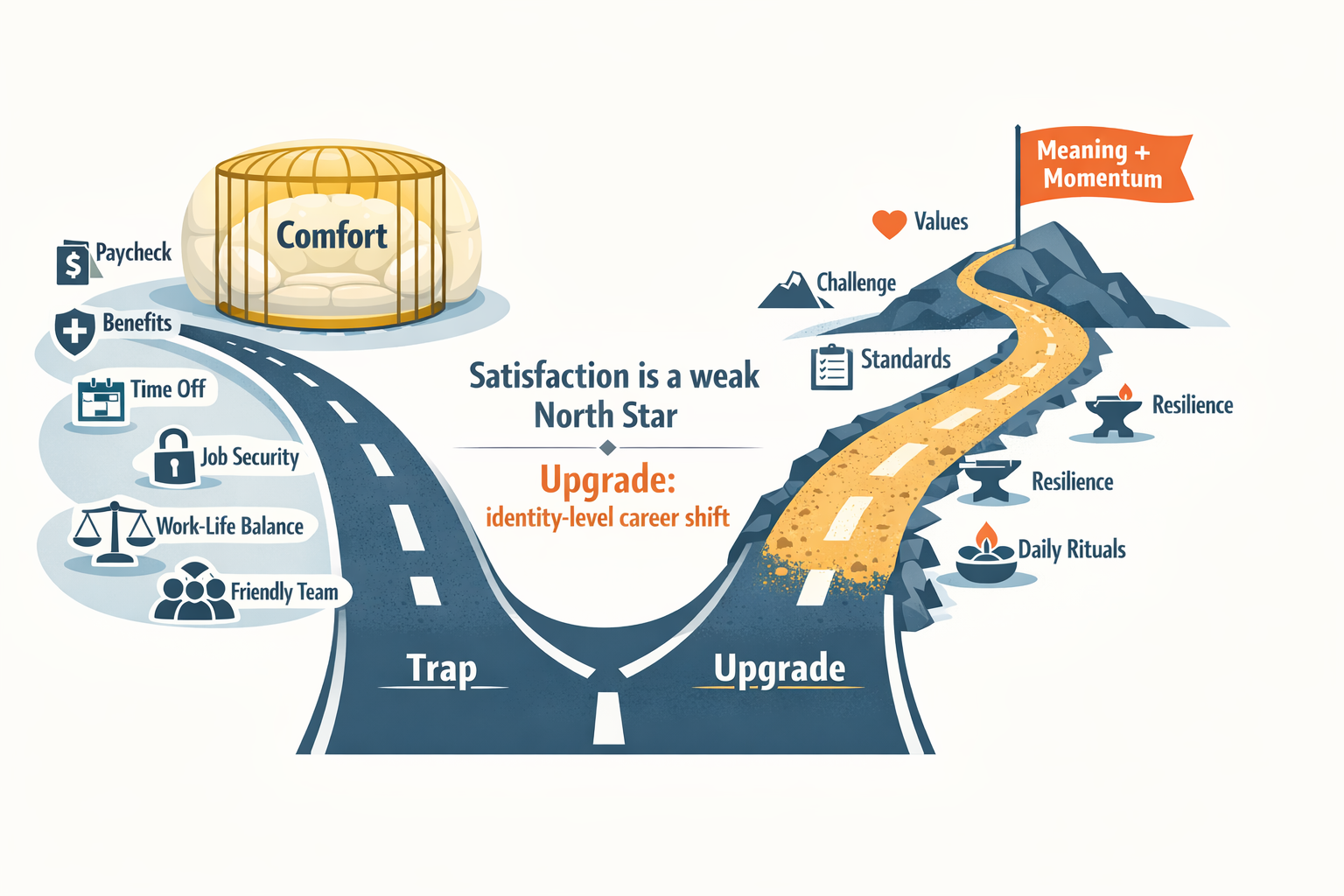
At its simplest, career satisfaction is how content you feel in your job, usually based on whether it feels stable, comfortable, and “looks good on paper.” It’s a useful metric (especially for surveys and HR dashboards), but it’s also a bit like grading a meal only on calories: technically relevant, emotionally… incomplete.
Here’s what people usually mean when they say they want more career satisfaction:
- Better pay and financial stability
- Solid benefits (healthcare, retirement, perks)
- More time off and flexibility
- Job security and predictability
- A reasonable workload and healthier work-life balance
- Good humans: a decent boss, team, and work environment
All of that matters. Truly. If your paycheck is shaky, your manager is chaotic, and you’re one surprise meeting away from stress-sweating through your shirt… “purpose” is going to feel like a luxury item.
But here’s the candid part: career satisfaction is a weak North Star.
One of the sneakiest ways satisfaction becomes a trap is “identity drift.” You start making choices that protect the version of you that looks responsible—stable salary, respectable title, clear next rung—until your calendar is full but your spirit is offline. You tell yourself you’re being strategic, and you are… but only in the short-term sense of reducing risk.
Over time, the real cost shows up as hesitation: you stop volunteering for stretch projects, stop learning things that don’t have an immediate payoff, stop speaking up in rooms where your opinion could sharpen the work. Satisfaction becomes a sedative: it quiets the discomfort that would have pushed you to evolve. And then one day you’re not “unhappy” enough to leave, but you’re not alive enough to stay. That’s not a time-management issue or a motivation issue—it’s a self-leadership issue. The upgrade isn’t quitting everything; it’s choosing a direction that makes you braver, more capable, and more aligned, even if it’s messier at first.
Why? Because satisfaction is often a comfort-and-security goal. It’s what we reach for when we’re tired, bruised, or trying to stop the bleeding after a rough season. And when you make “comfortable” the main target, you can land in a job that checks the boxes… while quietly shrinking you on the inside.
When “Satisfied” Starts to Shrink You (The Identity Drift Problem)
A lot of people approach their “life’s work” like it’s a shopping problem:
“What job gives me the most, while asking the least from me?”
That mindset is common. It’s also the quickest way to end up bored, restless,
and confused—because your work never asks you to become anyone new. And without
growth, challenge, and a personal code you actually respect, you can achieve
career satisfaction and still feel like something’s missing.
Also: the way we measure career satisfaction at scale can be oddly
dehumanizing. “Accountants report 7.2/10 satisfaction!” Cool. But you’re not a
data point in a lab experiment. You’re a person with a story, with standards,
with a nervous system, with a future.
And if you’re ambitious-but-burned-out, there’s a good chance you’re not just
looking for a different job.
You’re looking for a different self.
That’s the pivot: an empowered career change isn’t mainly about finding a role
that finally delivers career satisfaction like Amazon Prime. It’s a behavioural
shift—choosing who you are, what you stand for, and what kind of challenge
you’re willing to engage with on purpose.
Because meaning doesn’t come from a title. It comes from the standard you hold
yourself to—especially when it’s inconvenient.
How
to Create a Spirited Career Pursuit
1)
Define Your Values (Your “inner operating system”)
- Write 5–7 non-negotiable values and describe what each looks like as a behavior (not a vibe). Example: “Integrity = I address issues directly within 48 hours.”
- Spot 2 places your current work violates your values, then choose one boundary or conversation that would correct course.
2) Choose a Challenge Worth Pursuing (Not just a job to escape into)
- Pick a problem you genuinely want to help solve—something you’d still care about even if nobody clapped.
- Commit to a 30-day challenge sprint: one uncomfortable, skill-building responsibility (lead, pitch, publish, negotiate, ship).
3) Set a New Standard (Internal, not dependent on praise)
- Write one personal standard that follows you everywhere: “I do hard things daily,” “I create value before I seek comfort,” or “I tell the truth early.”
- Track it weekly with a simple scorecard: 3 behaviors, yes/no. No essays. No courtroom defense.
4) Reframe Adversity as Proof You’re In the Arena
- When resistance hits, label it: “This is the barrier before the next level,” then take the smallest next step you can complete in 10 minutes.
- Keep a two-week adversity log: challenge → response → lesson → next adjustment. You’re building resilience on paper, not just in your head.
5) Build Meaning From Within (Stop outsourcing your fulfillment)
- Replace “Which job will make me happy?” with: “How will I practice my values today—right where I am?”
- Create one daily ritual that reinforces identity (15 minutes learning, 10 minutes planning, one act of contribution)—whether you’re in the office or on a beach.
If you take nothing else: career satisfaction is nice, but it’s not the point.
The point is becoming the kind of person who can create meaning, momentum, and
pride—no matter what job title is on your email signature.
Related Posts:
Recent Articles


-
Biggest Change in Life
Dec 31, 25 06:53 PM
 How your career can offer the biggest change in life and why mindset is the hidden barrier
 -
Process of Becoming an Adult
Oct 05, 25 12:18 PM
A practical 5-pillar framework for the process of becoming an adult: build independence, income, resilience, emotional strength, and a reputation you can use. -
Did the results of the last election hurt your industry and career?
May 02, 25 03:20 PM
Career and elections. Some helpful perspective when results seemed to have hurt your career opportunities.