Phases
of Life: The Career Doors You Don’t See Opening (Until You Stop Headbutting the
Same One)
If you’re ambitious but tired and quietly wondering, “Is this it?”—you’re not broken. You’re not lazy. You’re not “bad at commitment.”
You’re likely in a transition.
And transitions almost always come packaged as phases of life: chapters that open certain doors, close others, and—if we’re paying attention—teach us the exact lessons we need to move forward.
I didn’t always understand this. In my early 20s, I had a signature move: I’d get hired, show up for a couple days, and then vanish. No call. No show. Just me and my highly refined avoidance strategy.
The jobs were entry-level: kitchens, labor, the unglamorous grind. And every shift felt like a sentence:
“I can’t do this day in and day out.”
At the same time, I wanted to start a small window-cleaning / home maintenance business. But I couldn’t get traction. So every “regular job” started to feel like proof my bigger dream had already failed.
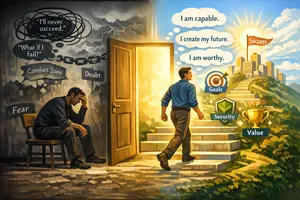
That’s what stuck phases do: they don’t just frustrate you. They narrate you.
Then one day—sitting in my car on yet another first day—I had a thought that changed everything:
“I can’t keep doing this.”
And for once, I didn’t mean the job.
I meant the pattern.
That moment was my first real clue that career change isn’t just about work. It’s about identity. It’s about who you become when you stop negotiating with the part of you that always wants to escape.
What “Phases” Really Are (And Why They Matter for Your Career)
We tend to think of life phases as age brackets: childhood, teen years, young adult, midlife, and so on.
But the more useful way—especially for career growth—is this:
A phase is a period of life defined by a dominant pattern.
A pattern of actions, beliefs, relationships, habits, and choices that either expands opportunity… or quietly shrinks it.
In other words, phases of life aren’t just “where you are.”
They’re “how you’re being.”
And that matters because how you’re being determines what doors you can even see—never mind walk through.
The 5-Phase Framework: From Stuck to Self-Authored
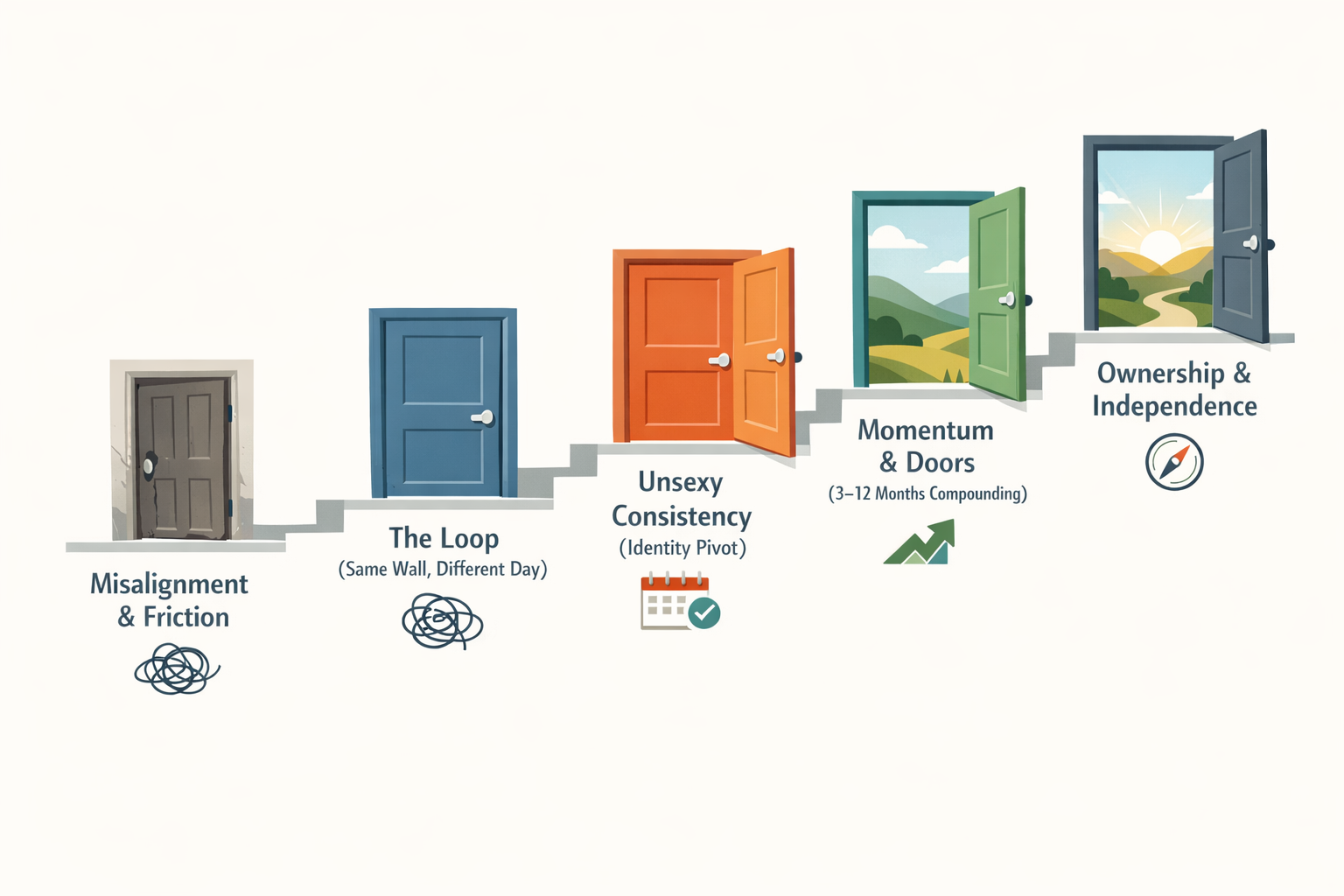
Below is a simple, teachable framework you can use to locate yourself, understand what you’re learning, and take grounded action to move forward.
This is the exact arc I lived through—over about two years of looping, followed by 3–12 months of momentum, and then a year later: a business that fully paid my bills and gave me financial and adult independence.
Phase 1: Misalignment & Friction (The “This Can’t Be My Life” Phase)
What’s happening:
You’re in work (or a life setup) that feels like a mismatch. It’s repetitive, uninspiring, or doesn’t reflect your potential. Your nervous system starts treating discomfort like danger.
Common signs:
- You feel bored, trapped, or resentful more days than not.
- You keep thinking, “I’m meant for more,” but can’t access the “more” yet.
- You interpret frustration as proof you’re on the wrong path.
- You want an exit before you’ve built a bridge.
Lesson of this phase:
You’re not being punished—you’re being trained.
This phase is often where you build capacity: stamina, reliability, humility, and follow-through. These are unglamorous traits… and they’re also the traits that make meaningful work possible.
Action steps (choose 2):
1) Do a quick “Capacity Audit”: What trait is this season trying to build in me—discipline, patience, communication, consistency?
2) Choose one micro-skill to master in 30 days (even in a job you don’t love).
3) Start a bridge plan: a savings target, a side-project schedule, or one new credential.
Phase 2: The Loop (Same Wall, Different Day)
What’s happening:
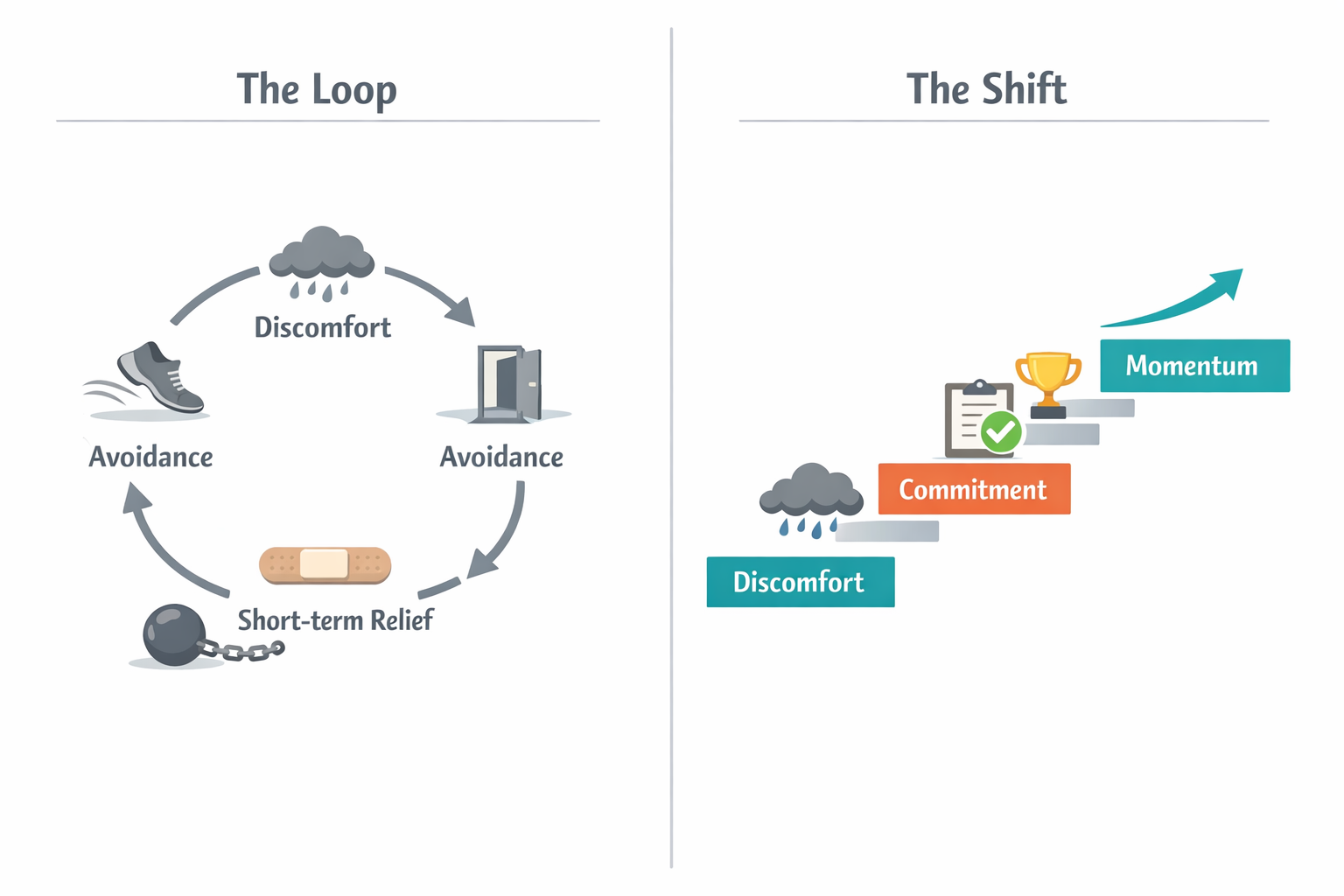
This is where time passes, but growth doesn’t. You keep bumping into the same problems. You might switch jobs, locations, relationships, routines… and somehow the same pattern shows up wearing a fake mustache.
This was my “ghost the job” era. For roughly two years, not much changed. I kept repeating the same mistakes without new opportunity—because I wasn’t becoming a new person inside the same circumstances.
Common signs:
- You keep quitting, avoiding, procrastinating, or “starting over.”
- You overthink your options but don’t move.
- You feel like your environment is the problem (sometimes it is), but your responses keep recreating the same result.
- You’re losing self-trust.
Lesson of this phase:
A stuck phase isn’t defined by the job.
It’s defined by the loop.
And here’s the good news: if the problem is a pattern, it’s changeable.
Action steps (choose 2):
1) Map the loop: “When I feel ___, I do ___, which leads to ___.” (Clarity kills confusion.)
2) Add accountability (a coach, a peer, a weekly check-in). Loops thrive in isolation.
3) Commit to a tiny finish line for 14 days: one daily habit you will not break.
Phase 3: Unsexy Consistency (The Identity Pivot)
What’s happening:
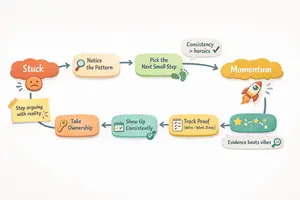
This is the phase where you stop hoping your way out and start behaving your way out.
For me, it was sticking it out through the term. A small decision. No fireworks. No applause. But it changed my identity from “someone who escapes” to “someone who follows through.”
And once I did that, something surprising happened: hope started coming back. Slowly. Quietly. Like a shy cat you stopped chasing.
Common signs:
- You’re showing up even when you don’t feel like it.
- You’re choosing process over mood.
- You’re starting to respect yourself again (because you’re keeping promises).
- You’re no longer waiting for “certainty” to take steps.
Lesson of this phase:
Consistency isn’t a personality trait. It’s a skill.
And every time you practice it, you’re not just building a resume—you’re building a self.
This is one of the most pivotal phases of life because it upgrades your “default settings.”
Action steps (choose 2):
1) The 80% Rule: ship at 80% instead of perfecting at 0%.
2) Minimum Daily Deposit: 30–60 minutes a day toward your next chapter (skill-building, portfolio, outreach).
3) Weekly Proof Score: list promises kept and broken; adjust one thing for next week.
Phase 4: Momentum & Doors (3–12 Months of Compounding)
What’s happening:
This is where the world starts responding differently because you’re operating differently.
After I recommitted, the next 3–12 months weren’t magically easy—but my outlook improved. I felt potential again. I started believing I could author my future in a way that honored what I actually wanted.
That inner shift matters more than people realize. It changes how you speak, how you show up, what you tolerate, what you attempt.
Common signs:
- You’re seeing options you didn’t see before.
- Your energy returns in pockets, then patterns.
- People start offering help, introductions, opportunities.
- You’re still scared—but you’re moving.
Lesson of this phase:
Momentum is a door-opener.
But it needs structure, or it turns into chaos.
Action steps (choose 2):
1) Protect fundamentals: sleep, movement, weekly planning (boring; life-changing).
2) Use an opportunity filter: only say yes to things that match 2 of 3—money, mastery, meaning.
3) Build your “network flywheel”: 2 genuine reach-outs per week.
Phase 5: Ownership & Independence (The Builder Chapter)
What’s happening:
A year after I recommitted, I had a business that fully paid my bills. That was the external milestone—but the internal milestone happened first: I became someone who could carry responsibility without collapsing or running.
This is what many ambitious professionals are really chasing—not just a new job, but freedom and authorship.
Common signs:
- Your income and options are less fragile.
- You’re making decisions from values, not panic.
- You’re building systems instead of relying on willpower.
- You feel like an adult in the best sense: capable, self-directed, grounded.
Lesson of this phase:
Independence is maintained the same way it’s built:
unsexy consistency + periodic brave upgrades.
And yes—new challenges will show up. That’s not failure; that’s the next set of phases of life arriving with new curriculum.
Action steps (choose 2):
1) Systemize one thing per month (lead flow, onboarding, finances, delivery).
2) Upgrade your positioning (niche clarity, better offer, raise rates).
3) Maintain identity practices: weekly review, learning plan, accountability.
Why This Matters (Especially If You’re Burned Out in Different Phases of Life)
Burnout often convinces smart people they need a total reset: quit everything, move to the mountains, become a different species.
Sometimes you do need a big change.
But more often, you need a phase change—because phases of life don’t shift when you “think harder.” They shift when you become the kind of person who can hold a new level of opportunity.
Career growth is personal growth with a paycheck.
A Simple Self-Check (Steal This)
Answer these in 5 minutes:
1) What phase am I in right now?
2) What’s the loop that keeps me here?
3) What are my next 2 actions for the next 14 days?
4) What will count as “proof” I’m progressing?
5) Who will keep me honest?
A Quick Note on “My Story” (And Why I’m Sharing It)
I’m not telling you my early-20s job-vanishing saga because it’s heroic. It wasn’t. It was messy.
I’m sharing it because it’s normal to get stuck inside phases of life that shrink your sense of possibility—and it’s also normal to change that through small, repeated, grounded actions.
That’s the whole game:
less dramatic reinvention,
more strategic follow-through.
Related Posts:
- Meaningful Career: How to Define It (and How to Measure If You’re Living It)
- Process of Becoming an Adult (When you don’t want your career to be just a box you fit in)
- Career Coach for Young Adults: Turn Confusion Into Clarity (and a Real Plan)
- A Life Lesson in Conflict: Break the Pattern, Build Your Power
- Meaningful Career For Young Adults: Build Direction Without Losing Yourself
- Career Myths: The Sneaky Beliefs Keeping You Stuck (and How to Rewrite Your Next Chapter)
- The Search For Meaningful Work: Stop Chasing Purpose—Start Building It (Reps, Not Revelations) (hub)
Recent Articles


-
Biggest Change in Life
Dec 31, 25 06:53 PM
 How your career can offer the biggest change in life and why mindset is the hidden barrier
 -
Process of Becoming an Adult
Oct 05, 25 12:18 PM
A practical 5-pillar framework for the process of becoming an adult: build independence, income, resilience, emotional strength, and a reputation you can use. -
Did the results of the last election hurt your industry and career?
May 02, 25 03:20 PM
Career and elections. Some helpful perspective when results seemed to have hurt your career opportunities.