Meaningful Career For Young Adults: Build Direction Without Losing Yourself
If you’re a young adult who’s ambitious, capable, and quietly exhausted by vague advice like “just follow your passion”… you’re not broken. If you’re looking for a meaningful career for young adults, you’re also not asking for too much—you’re asking for direction you can actually live with.
You’re in a real (and honestly pretty intense) life season: becoming an adult in public, while trying to make good decisions with limited information, limited experience, and a job market that occasionally feels like it was designed by a raccoon.
This page is your hub.
Not a “figure your whole life out in one sitting” hub. A “take the next grounded step, become someone you respect, and stop spiraling” hub.
What you’ll get here:
- A clear definition of what “meaningful” actually means (so you stop chasing a vibe)
- A simple framework you can use to find direction (without burning out)
- A set of paths you can choose based on your real life (not someone else’s highlight reel)
- Links to deeper pages depending on what you’re stuck on right now
If you want the quick version:
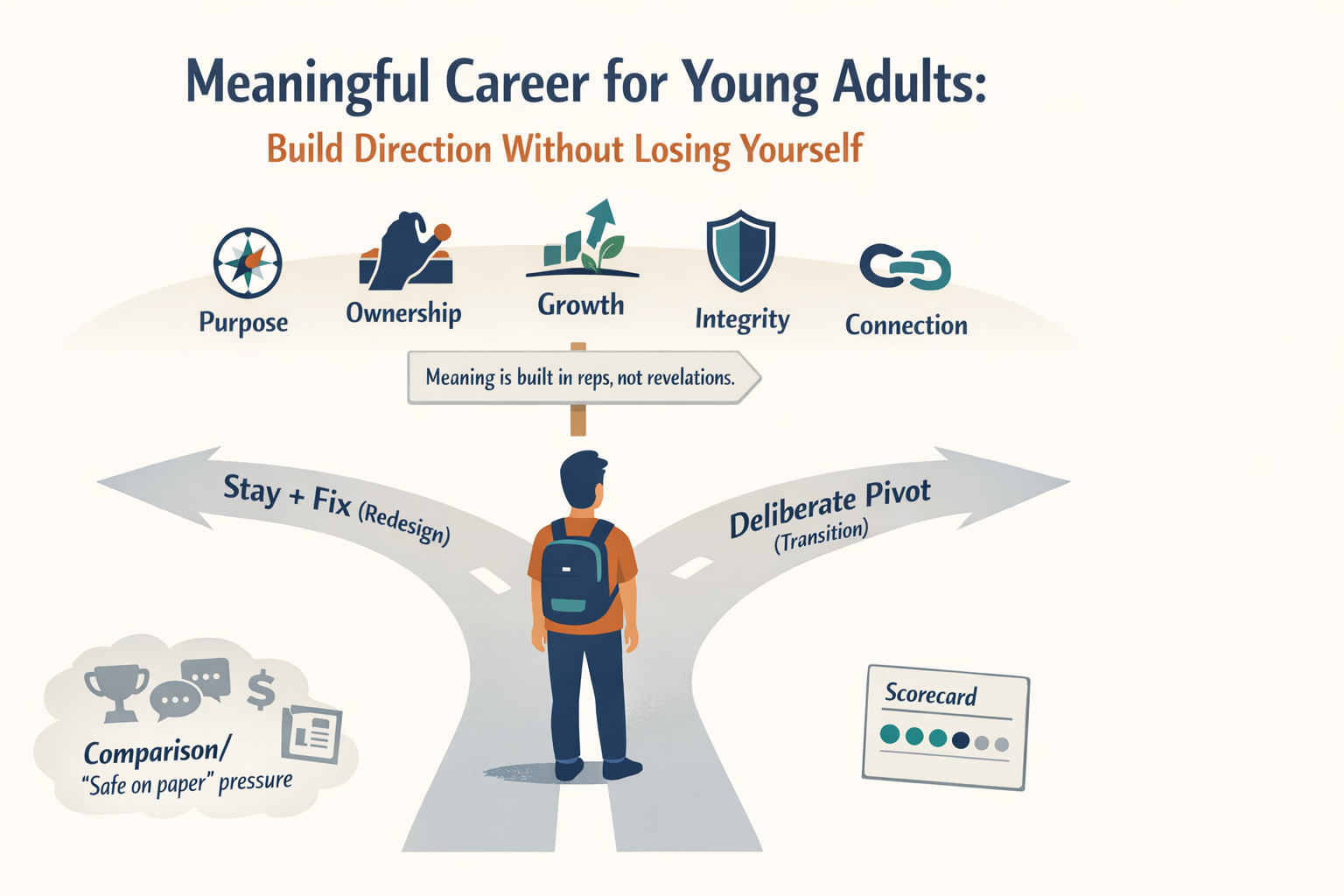
Meaning is built. In reps. Not revelations.
If you want a meaningful career for young adults, the fastest path is simple: pick one pillar, run one experiment, and let real-world evidence shape your next move.
START HERE (2 buttons)
Button: Take the Meaningful Career Scorecard
Button: Career Coaching for Young Adults
Why Meaning Feels So Hard In Your 20s (And Why You're Not Behind)
Early adulthood is weird.
You’re expected to make “adult” decisions (money, work, relationships, direction) while still building the basic internal skills that make adulthood feel stable (confidence, self-trust, boundaries, consistency).
So when you feel uncertain, restless, or like you’re doing it “wrong,” that’s not a character flaw. That’s the season.
Here’s what makes this stage uniquely challenging:
- You don’t have a long track record yet, so self-doubt feels louder
- You’re exposed to constant comparison (friends, siblings, LinkedIn, “day in the life” videos that are… curated, to put it gently)
- You’re often balancing independence goals with money pressure
- You’re still untangling what you want from what you were trained to want
This is also when the “safe on paper” path shows up with a clipboard and a stern expression.
And look—stability matters. Paying rent matters. Not living in panic mode matters.
But if you keep choosing “safe” at the expense of your integrity, energy, health, curiosity, and self-respect… you don’t get a stable life.
You get a quiet slow leak.
Meaningful career work is learning to plug the leak early—before you wake up one day thinking, “Wait… whose life is this?” That’s the real point of building a meaningful career for young adults: you’re designing your direction early enough that you don’t have to “undo” it later.
A QUICK DEFINITION (SO WE’RE NOT CHASING A VIBE)
Let’s define meaningful clearly, because “meaningful career” can become this misty, pressure-filled idea that makes you feel like you need to go live in a cabin and reinvent yourself.
A meaningful career is a path you can live with integrity—right where you are—because it reflects your values, uses your strengths, helps you connect, and leaves you with enough energy to be a human after 5 p.m.
Meaning isn’t a fancy title.
It’s not “the one perfect calling.”
And it’s definitely not “hustle until you earn worthiness.”
Meaning is personal significance. No universal scoreboard. No cultural applause required.
If you want the full framework + scorecard (so you can measure alignment without launching a 47-tab identity crisis):
Meaningful Career (Definition + Scorecard)
COMMON YOUNG ADULT CAREER TRAPS (AND THE SMALL FIX THAT BREAKS THEM)
You don’t need a dramatic reinvention. You need traction.
Here are the most common traps I see—and the simplest “start breaking the spell” moves.
1) “I need to find my passion first.”
The trap:
You try to think your way into clarity. You end up with anxiety and a headache.
The small fix:
Run a 2-week experiment. Pick one pillar and do one small daily action. Clarity follows action more reliably than rumination.
2) “I’m behind.”
The trap:
You measure yourself against louder people, cleaner stories, or timelines that aren’t yours.
The small fix:
Build evidence. One skill, one output per week. Consistency is how you get self-trust back.
3) “My parents/friends don’t support my choices.”
The trap:
You either comply and resent it, or rebel and panic.
The small fix:
Earn support through clarity + follow-through:
“Here’s what I’m choosing. Here’s why. Here’s my 30–90 day plan. Here’s the next step I’m taking this week.”
4) “I keep starting over.”
The trap:
Same wall, different day.
The small fix:
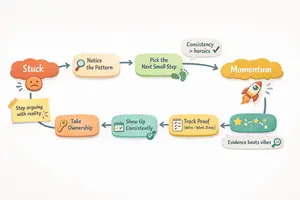
Name the loop:
“When I feel ____, I do ____, which leads to ____.”
Then choose one non-negotiable daily deposit (15–30 minutes).
5) “I’m already burned out.”
The trap:
You assume burnout means you’re weak or lazy.
The small fix:
Treat burnout as information: low ownership, weak boundaries, stalled growth, or disconnection.
Reduce energy leaks first—then build momentum.
6) “I’m doing it wrong because my path isn’t normal.”
This one is sneakier, because it doesn’t feel like a thought. It feels like a fact.
The small fix:
Audit the beliefs running in the background. A lot of “stuckness” is just unchallenged career mythology.
Link: Read: Career myths (and how to rewrite them)
THE MEANINGFUL CAREER FOR YOUNG ADULTS FRAMEWORK: THE 5 PILLARS
If “meaning” feels slippery, you’re normal. That’s why we use pillars—things you can actually work with.
Think of these as five levers. You don’t have to fix everything at once. You strengthen one pillar at a time, and your life starts to feel more like yours.
1) PURPOSE (personal significance, not prestige)
Purpose is being able to say what your work is “for” in one sentence—and actually caring, even if nobody claps.
Young adult translation:
“What do I want my work to be for right now?”
Not forever. Not for the rest of your life. Right now.
Micro-action:
Write a 1-sentence purpose statement:
“My work is for ______, by helping ______, so that ______.”
2) OWNERSHIP (agency + autonomy)
Ownership is the power to shape your week, lean into strengths, and stop living someone else’s script.
Young adult translation:
Stop outsourcing your direction to:
- your parents
- your professors
- your anxious inner “responsible voice”
- the internet’s loudest opinions
Micro-action:
Pick one part of your week you can shape (even small):
- your first hour of the day
- one boundary around availability
- one project you request or initiate
3) GROWTH (earned satisfaction)
Growth is “earned satisfaction”—confidence that comes from progress, not just comfort.
Young adult translation:
You don’t need perfect clarity. You need reps.
Skill reps. Courage reps. Follow-through reps.
Micro-action:
Choose one skill to improve for 30 days (and define what “better” means).
4) INTEGRITY (be the same person under pressure)
Integrity is when your work persona and your real self aren’t strangers.
It’s choosing standards over shortcuts, even when things get messy.
Young adult translation:
Set your standards early. Don’t normalize what drains you.
You are training your “default settings” right now.
Micro-action:
Name one boundary you will protect this month:
“I don’t answer messages after ____.”
“I don’t tolerate ____ in my role.”
“I communicate timelines in writing.”
5) CONNECTION (real humans, real rapport)
Meaning expands when you feel useful to real people and build relationships that make work feel less like a solo survival mission.
Young adult translation:
Your network isn’t a performance. It’s a skill.
Build rapport. Be helpful. Follow through.
Micro-action:
Strengthen one relationship:
- schedule one coffee chat
- send one thank-you note
- ask one smart question and listen like a grown-up
Want to measure these pillars quickly?
Take the Meaningful Career Scorecard
Think of the scorecard as your dashboard for building a meaningful career for young adults—clear signals, no guesswork, and no spiraling.
TWO PATHS TO MEANING: STAY-AND-FIX VS DELIBERATE PIVOT
Most people assume “meaningful career” automatically means “new job.”
Sometimes it does.
Often, it doesn’t.
A better question than “What job will fix me?” is:
“What choice fits the person I’m becoming?”
PATH A: REDESIGN WHERE YOU ARE (STAY-AND-FIX)
Choose this when:
- the foundation is mostly workable
- but 1–2 pillars are dragging you down (often Ownership, Growth, or Connection)
What it can look like:
- renegotiating boundaries
- reshaping your role around strengths
- building “earned satisfaction” through focused growth
- doing monthly check-ins instead of silently suffering
This is not settling. This is training. Sometimes the most meaningful upgrade is learning to lead your life inside the situation you already have.
PATH B: TRANSITION TO A NEW DIRECTION (DELIBERATE PIVOT)
Choose this when:
- Integrity and Purpose stay low even after honest experiments
- the work requires you to be someone you don’t respect
What it can look like:
- values-first clarity
- small tests (not fantasy leaps)
- a stability plan (because nervous systems like rent paid)
a new standard for who you’re becoming
If you’re unsure, the scorecard helps you find the real lever:
Meaningful Career (Definition + Scorecard)
This “stay-and-fix vs pivot” choice is a core skill in a meaningful career for young adults, because it prevents two common mistakes: staying too long out of fear, or leaving too fast out of frustration.
Start Here: Pick Your Next Step
If you’re in your 20s and you want a meaningful career without the pressure-cooker vibe, choose the path that matches what you’re facing right now.
1) Build real independence (adulthood skills that create freedom)
Title: The Process of Becoming an Adult (A 5-Pillar Framework)
Blurb: Career isn’t a personality. It’s how you build independence: responsibility, financial discipline, emotional intelligence, resilience, and a reputation you can leverage.
Link: Read: Process
of Becoming an Adult (When you don’t want your career to be just a box you fit
in)
2) Figure out what phase you’re in (and stop repeating the same loop)
Title: Phases of Life: The Career Doors You Don’t See Opening (Until You Stop Headbutting the Same One)
Blurb: If you keep hitting the same wall—different job, same frustration—this helps you name the phase, spot the pattern, and take the next grounded step.
Link: Read: Phases of life (and what to do next)
3) Learn the life lesson that expands your options fastest: emotional intelligence
Title: A Life Lesson in Emotional Intelligence (How to Break Repeating Conflict Patterns)
Blurb: Most career ceilings are people ceilings. This page gives you a practical way to handle tension without avoiding, escalating, or people-pleasing—so trust (and opportunities) compound.
Link: Read: A Life Lesson in Conflict: Break the Pattern, Build Your Power
4) Want a plan and accountability? (coaching)
Title: Career Coach for Young Adults (Transformational Upgrade, Not Just a New Job)
Blurb: If you’re ambitious and quietly exhausted, we’ll turn confusion into clarity—and clarity into a step-by-step plan you can execute without burning out.
Link: Work with me: Career Coach for Young Adults: Turn Confusion Into Clarity (and a Real Plan)
5) Clear the mental clutter (career myths you inherited and accidentally believed)
Title: Career Myths Keeping You Stuck (and How to Rewrite Your Next Chapter)
Blurb: If you feel stuck, behind, or pressure-cooked by “the normal path,” you may be living by invisible rules. This page helps you spot the myths, reality-check them, and define success on your terms.
Link anchor text: Read: Career Myths: The Sneaky Beliefs Keeping You Stuck (and How to Rewrite Your Next Chapter)
THE 7-DAY “STEP AT YOUR FEET” PLAN (TRACTION WITHOUT A LIFE OVERHAUL)
If you want a simple reset that doesn’t require a brand-new personality, try this:
Day 1: Take the Meaningful Career Scorecard
Pick your lowest pillar.
Day 2: Make one Ownership move
A boundary. A schedule change. A strengths-based shift.
Day 3: Make one Growth move
One hour of focused skill practice (or a micro-project you can finish).
Day 4: Make one Connection move
Reach out to one person:
a question, a thank-you, a coffee chat, a supportive check-in.
Day 5: Make one Integrity move
Choose one standard you will protect, even when it’s inconvenient.
Day 6: Make one Purpose move
Write your 1-sentence “what my work is for right now.”
Day 7: Review + choose a 2-week experiment
Keep it small. Keep it real. Track proof.
Meaning is built in reps, not revelations—and this is exactly how a meaningful career for young adults gets built in the real world.
Want Support? Career Coaching For Young Adults
If you’re reading this and thinking, “Okay, yes… but I want help applying this to my actual life,” that’s exactly what coaching is for.
Career coaching for young adults is a blend of:
- clarity (what you actually want, not what you’ve been trained to want)
- strategy (a plan you can execute without burning out)
- identity work (changing the patterns that keep shrinking your options)
- accountability (so the plan becomes reality)
If you want your next move to be a transformational upgrade—not just a new job title:
Work with me: Career Coaching for Young Adults
If you’re trying to build a meaningful career for young adults while juggling pressure, money, and uncertainty, coaching can help you turn the framework into a plan you’ll actually follow through on.
FAQ: MEANINGFUL CAREER FOR YOUNG ADULTS
What if I don’t know what I want yet?
Normal. Start with the scorecard and pick one pillar to strengthen. Direction becomes clearer when you build evidence.
Is it normal to worry I’ll pick the “wrong” path?
Yes. The goal isn’t a perfect choice—it’s a smart next step plus the ability to adjust. You’re building a decision-making skill, not guessing your destiny.
Should I change jobs or redesign my current one?
If Purpose and Integrity are low even after honest experiments, explore a deliberate pivot.
If the foundation is workable but Ownership/Growth/Connection are low, redesign is often the fastest win.
Can I want meaningful work and still care about stability and money?
Yes. Stability isn’t shallow—it’s a foundation. Meaning doesn’t require financial chaos. It requires alignment, standards, and progress.
What’s the fastest way to feel less stuck?
Pick one “step at your feet” and do it within 24 hours. Stuckness thrives in vagueness. Momentum thrives in action.
Related Posts
- Meaningful Career: How to Define It (and How to Measure If You’re Living It)
- Process of Becoming an Adult (When you don’t want your career to be just a box you fit in)
- Career Coach for Young Adults: Turn Confusion Into Clarity (and a Real Plan)
- Phases of Life: The Career Doors You Don’t See Opening (Until You Stop Headbutting the Same One)
- A Life Lesson in Conflict: Break the Pattern, Build Your Power
- Career Myths: The Sneaky Beliefs Keeping You Stuck (and How to Rewrite Your Next Chapter)
- The Search For Meaningful Work: Stop Chasing Purpose—Start Building It (Reps, Not Revelations) (hub)
Recent Articles


-
Biggest Change in Life
Dec 31, 25 06:53 PM
 How your career can offer the biggest change in life and why mindset is the hidden barrier
 -
Process of Becoming an Adult
Oct 05, 25 12:18 PM
A practical 5-pillar framework for the process of becoming an adult: build independence, income, resilience, emotional strength, and a reputation you can use. -
Did the results of the last election hurt your industry and career?
May 02, 25 03:20 PM
Career and elections. Some helpful perspective when results seemed to have hurt your career opportunities.