Career Myths: The Sneaky Beliefs Keeping You Stuck (and How to Rewrite Your Next Chapter)
Ditch the career myths, the “normal” path, and redefine success on your terms.
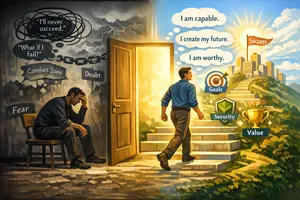
Most of us go through the same “career boot-up sequence”: school, interests, first jobs, rinse and repeat. And somewhere along the way, we accidentally install a few assumptions about work—those sneaky little career myths that run quietly in the background and make choices for us.
They’re like mental pop-ups you didn’t ask for. Even when you know they’re questionable, you still catch yourself clicking “accept” and living as if those assumptions are facts.
Left unchallenged, career myths can quietly shrink your options and keep you looping in the same safe choices—long after they’ve stopped fitting who you are.
The goal isn’t to find the “perfect path.” It’s to build an empowering one—work that creates meaning, supports your life, and stretches you into a version of yourself you respect. And yes, that usually starts by spotting the beliefs you’ve been carrying around like they’re personal rules.
Career Myth #1
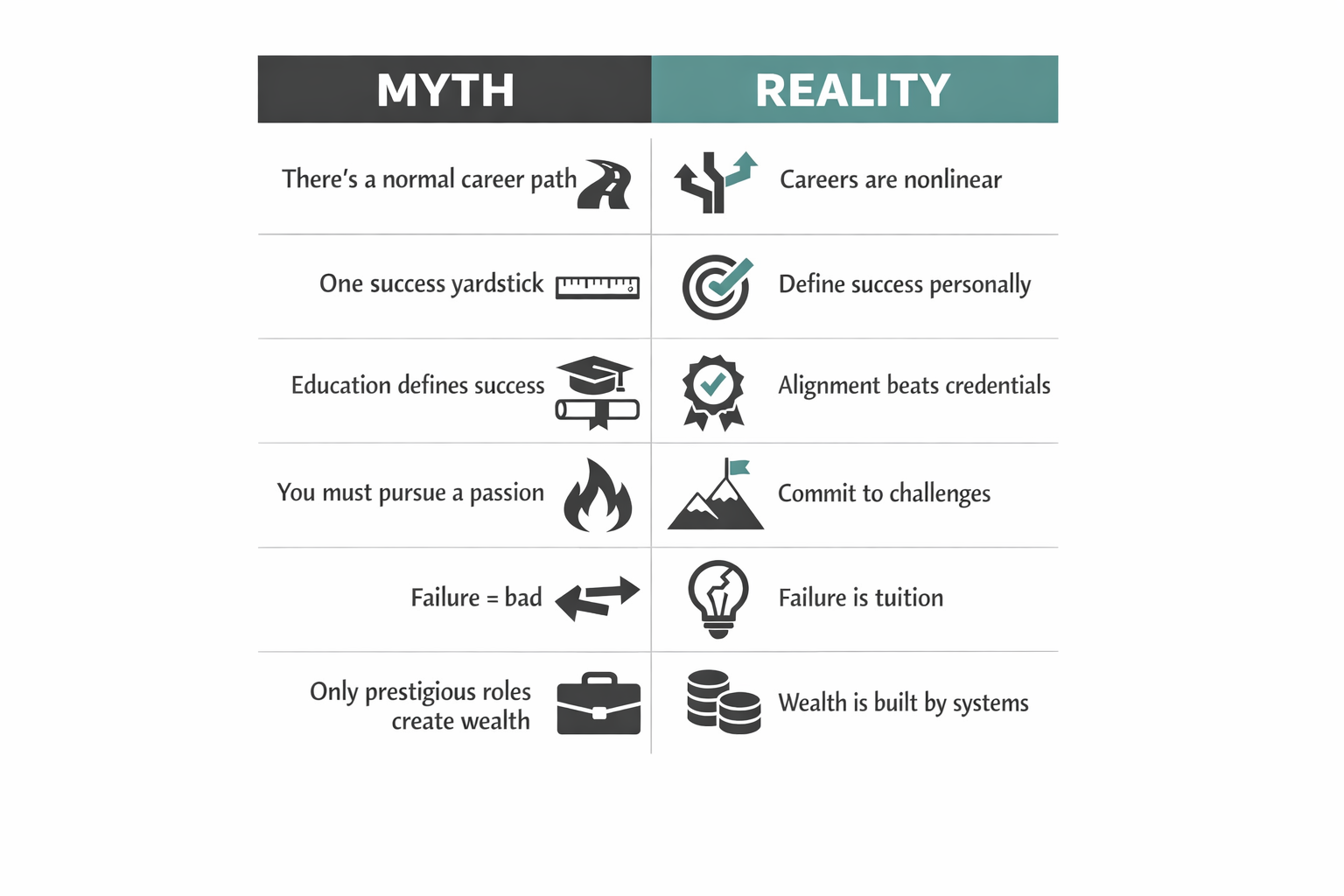
CAREER MYTH #1: There’s a “normal” career path
The myth: There’s a clean, standard trajectory you’re supposed to follow. Degree → title → one lane forever → retire. Deviating means you’re doing it wrong (or being “dramatic”).
Reality check:
- Your career is one piece of a much bigger life.
- Your career should serve you—not the other way around.
- Success isn’t a flawless path. It’s the character you build while walking it.
That “standard path” is usually just an idealized version of what you saw growing up. Real careers are messy, human, nonlinear—and honestly? That’s not a bug. That’s the point. You get to develop self-authority and change course when your life asks you to.
Grounded action:
Write a one-paragraph “life vision,” not a career plan. Then ask: “What kind of work supports this?”
CAREER MYTH #2: There’s one success yardstick
The myth: Success can be measured with one universal ruler—title, salary, house, vacations, status.
Reality check:
- If you play the comparison game, “enough” will always move farther away.
- Real success is often invisible to outsiders: peace, purpose, health, alignment, pride in your choices.
When you stop chasing culturally approved wins, you can start building personal wins—work that creates meaning you can actually feel, and impact you can actually stand behind.
Grounded action:
Define 3 “wins” that can’t be posted on LinkedIn. (Examples: “I have energy after work,” “I’m proud of how I treat people,” “My work aligns with my values.”)
CAREER MYTH #3: Education defines success
The myth: More credentials automatically equal more worth and more success.
Reality check:
- Fulfillment comes from alignment—not from collecting certificates.
- Education is a tool, not a status badge.
Education is powerful when it opens a door you intentionally want to walk through. It’s expensive (time, money, energy) when it’s used as a way to feel “good enough.”
Grounded action:
Before enrolling in anything, answer: “What specific role/opportunity does this unlock for me?” If you can’t name the door, don’t buy the key yet.
CAREER MYTH #4: You must pursue a passion
The myth: You have to find your One True Passion, and then everything will click.
Reality check:
- “Find your passion” can turn into a fancy form of procrastination.
- A solid career path doesn’t have to look glamorous—it has to grow you.
- Passion isn’t something a job hands you. Passion is what you generate when the work changes your story.
Instead of asking “What am I passionate about?” ask “What challenges am I willing to commit to?” That answer is usually more practical—and more honest.
Grounded action:
Choose a direction based on growth potential: “What kind of work would build skills, confidence, and options—even if it isn’t my dream job yet?”
CAREER MYTH #5: Failure = bad
The myth: If you fail, you’re behind, exposed, or permanently disqualified.
Reality check:
- “Failing” usually means you had the courage to try.
- Careers are human constructs; humans are imperfect.
- Avoiding failure often means avoiding success, too.
Sometimes what you call “failure” is actually tuition. You paid to learn the terrain. Now you’re smarter, more prepared, and less naive—which is a competitive advantage, by the way.
Grounded action:
Turn one “failure” into a debrief: What did I learn? What would I do differently? What skill do I need next?
CAREER MYTH #6: Only prestigious roles create wealth
The myth: Wealth belongs to certain job titles, and anything “humble” equals struggle.
Reality check:
- Wealth is strongly shaped by habits: spending, saving, investing, consistency.
- Plenty of high earners stay broke; plenty of modest earners build real stability.
- Money is a system, not a personality trait and not a title.
If you’re scared a career shift will ruin you financially, don’t guess—plan. Fear gets quieter when numbers get clearer.
Grounded action:
Talk to a financial expert (or at minimum, make a 12-month plan): baseline expenses, savings rate, and a realistic transition runway.
CAREER MYTH #7: Dropping out means your career is doomed
The myth: If you leave school, you’ve permanently damaged your future.
Reality check:
- Staying or leaving is personal and circumstantial.
- The key isn’t the choice—it’s the strategy you build afterward.
- You’re allowed to be gentle with yourself while still moving forward.
There’s rarely one “correct” decision—just decisions followed by responsible actions. A strong plan beats a perfect narrative.
Grounded action:
If you stay: clarify your end goal and timeline.
If you leave: outline your next 3 steps (skills, income, network). No spiraling—just sequencing.
CAREER MYTH #8: “I feel incapable”
The myth: Feeling stuck means you are stuck. Feeling behind means you are behind.
Reality check:
- You often feel incapable because you haven’t found your strategy yet—not because you can’t do it.
- There’s usually a route that fits your strengths better than the obvious one.
Big goals take longer than your nervous system would prefer.
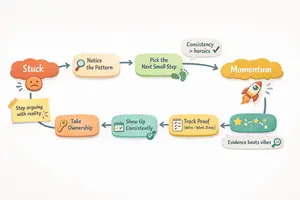
Feelings are data, not destiny. Confidence usually shows up after you start stacking small wins—not before.
Grounded action:
Shrink the goal: What’s the smallest credible next move? (One conversation, one application, one portfolio piece, one class, one experiment.)
CAREER MYTH #9: I must follow my family’s wishes
The myth: Keeping the peace requires choosing what they want.
Reality check:
- You can pick your battles and still choose yourself.
- Family pressure often hooks into your own internal doubts.
- As you build a track record of following through, the noise often decreases.
- You can learn to stay calm around pressure without letting it steer the wheel.
Family dynamics are their own curriculum—no textbook, lots of emotion, and plenty of “well-meaning” opinions. The skill is staying grounded: respectful, clear, and not pulled into fight-or-flight every time someone panics about your future.
Grounded action:
Practice one boundary script: “I hear you. I’m thinking this through carefully. I’ll share updates when I’m ready.” Repeat as needed.
Bottom line
You’re not “late.” You’re not “broken.” You’re not “too old” or “too scattered.”
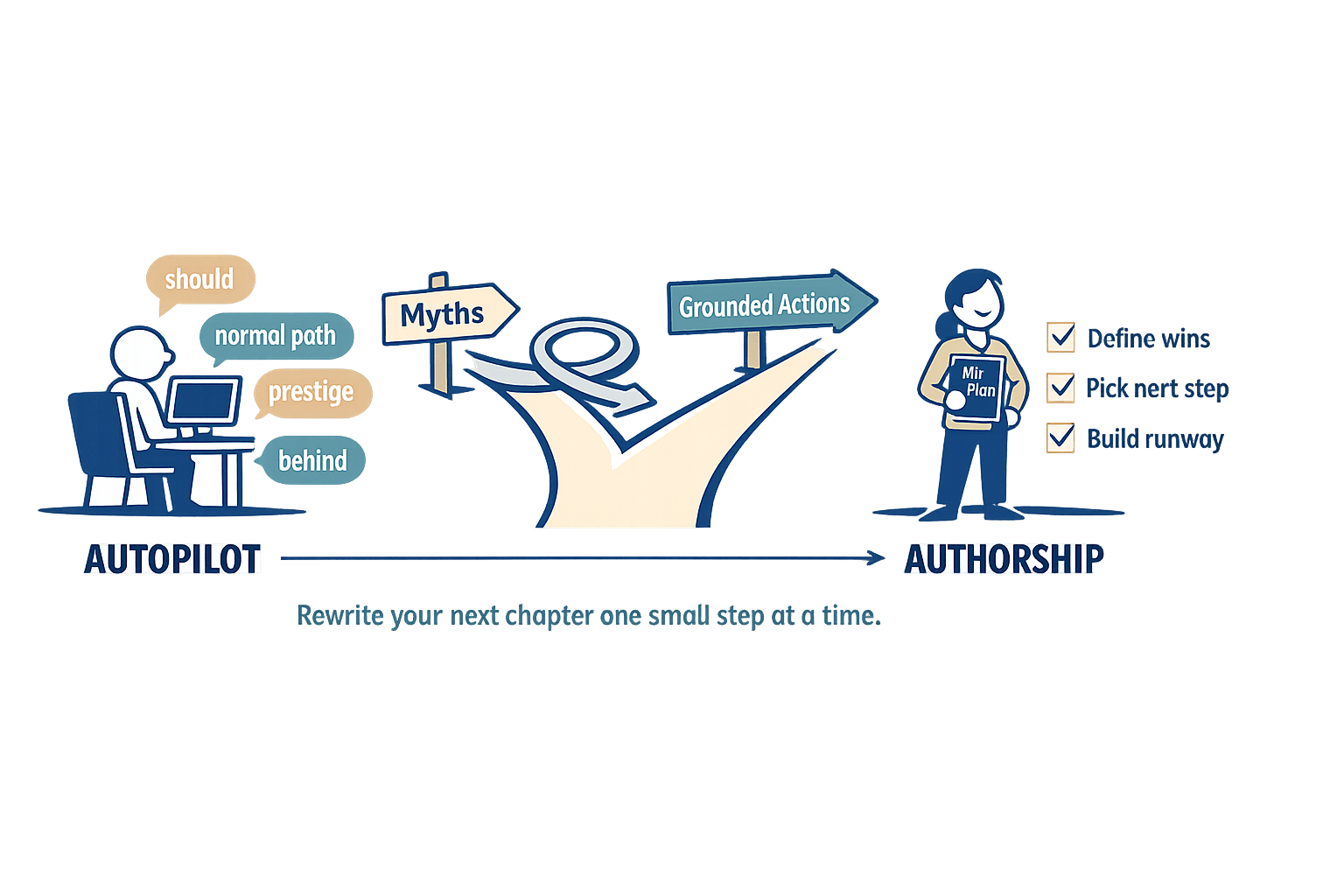
You’re in a transition—one that’s asking you to upgrade from autopilot to authorship.
Drop the career myths. Choose a direction that supports your life. Build a plan you can execute while tired. And take the next grounded step—even if it’s small. Small steps compound. So does self-trust.
Related Posts:
- Meaningful Career: How to Define It (and How to Measure If You’re Living It)
- Process of Becoming an Adult (When you don’t want your career to be just a box you fit in)
- Career Coach for Young Adults: Turn Confusion Into Clarity (and a Real Plan)
- Phases of Life: The Career Doors You Don’t See Opening (Until You Stop Headbutting the Same One)
- A Life Lesson in Conflict: Break the Pattern, Build Your Power
- Meaningful Career For Young Adults: Build Direction Without Losing Yourself
- The Search For Meaningful Work: Stop Chasing Purpose—Start Building It (Reps, Not Revelations) (hub)
Recent Articles


-
Biggest Change in Life
Dec 31, 25 06:53 PM
 How your career can offer the biggest change in life and why mindset is the hidden barrier
 -
Process of Becoming an Adult
Oct 05, 25 12:18 PM
A practical 5-pillar framework for the process of becoming an adult: build independence, income, resilience, emotional strength, and a reputation you can use. -
Did the results of the last election hurt your industry and career?
May 02, 25 03:20 PM
Career and elections. Some helpful perspective when results seemed to have hurt your career opportunities.