Feeling Lost in Your Career? When Life Passed You By at Work
From “Is this it?” to “Here’s what’s next.” (Without burning it all down.)
If it feeling lost in your career and like the best parts of you are in the past—the motivated version, the achiever, the conqueror—and now you’re just… existing on autopilot, I want you to hear this clearly:
You’re not lazy.
You’re not broken.
You’re not “past your prime.”
You’re probably exhausted, overdue for a reset, and waking up to the fact that the life you built (or fell into) doesn’t fit the person you are now.
This page is for the high-functioning professional who can still perform competence on cue, but privately feels lost in their career. The days blur. The spark is gone. You keep thinking, “Is this really it?”—and then you answer another email like it didn’t hurt a little.
Let’s talk about what’s actually happening—and what to do next, in a way that’s warm, grounded, and practical (because panic-googling “how to reinvent my life” at 1:00 a.m. is not a plan).
Quick check: does any of this sound like you?
- You’re doing “fine” on paper, but you feel oddly disconnected from your own life.
- You can’t access your old ambition, and you don’t know how to get it back.
- You keep telling yourself you should be grateful, but you’re also quietly miserable.
- You’re tired of being the capable one.
- You fantasize about quitting… but you don’t actually know what you’d do instead.
If yes, keep going. This is workable.
Autopilot isn’t laziness. It’s adaptation.
Most people don’t end up on career autopilot because they’re unmotivated.
They get there because they adapted.
You adapted to:
- pressure
- expectations
- family needs
- bills
- the “safe” path
- workplaces that rewarded over-functioning
- identities that kept you loved, respected, or needed
Autopilot is what happens when you’ve been carrying the load for too long with
too little room to be a full human.
It’s a nervous-system thing.
It’s an identity thing.
And yes, it’s also a career thing.
So if you’ve been thinking, “What is wrong with me?”—I want to gently redirect
you to a more useful question:
What has my life required me to become… and is that still who I want to be?
You didn’t lose yourself. You outgrew an old version.
A lot of burned-out, disillusioned professionals are mourning a past self.
The version who could:
- grind for goals
- chase achievement like it was oxygen
- push through anything
- outwork doubt
- “handle it”
That person might have been impressive.
They also might have been running on adrenaline, approval, and sheer will.
If your old achiever-self feels far away, it doesn’t automatically mean you’re
failing.
It can mean:
- your values changed
- your capacity changed
- your priorities matured
- your tolerance for nonsense evaporated (honestly, congratulations)
Sometimes the “loss of motivation” is actually your inner system refusing to
keep feeding a life that doesn’t feel like yours anymore.
That’s not a character flaw.
That’s information.
Signs you’re feeling lost in your career (so you can stop gaslighting yourself)
Here
are some common signals that you’re not just “having a week,” you’re in career
autopilot:
Emotional signs
- numbness or flatness (“I feel nothing”)
- irritability or low-grade rage
- cynicism, “what’s the point?”
- restlessness, even when you’re tired
Mental signs
- indecision and second-guessing everything
- brain fog
- fantasizing about escape
- spiraling when you try to think long-term
Behavioral signs
- doing the minimum to get by (and feeling guilty about it)
- procrastinating things you used to handle easily
- doom scrolling between tasks
- staying busy to avoid feeling
Physical signs
- exhaustion that sleep doesn’t fix
- headaches, tension, gut issues
- sleep disruption
- feeling “wired and tired”
If you’re nodding along, here’s the key: you don’t need more self-discipline.
You need reconnection, capacity, and direction—because when you’re feeling lost in your career, “push harder” usually just makes the numbness louder.
Why “life passed you by at work” happens (without blaming you)
This feeling usually comes from a few overlapping causes. Not because you messed up—because you’re human, and life moves fast.
1) Burnout and chronic stress
When your system is depleted, desire gets quieter. Your job becomes “get through the day.” It’s hard to dream from survival mode.
2) Values drift
What mattered at 25 might not matter at 35 or 45. If you keep living by old values, your life starts to feel strangely empty—like you’re succeeding in someone else’s game.
3) Success scripts
You followed the plan:
get the degree, get the role, get the promotion, keep climbing.
But nobody paused the script to ask, “Do you actually want this?”
4) Under-autonomy
You can tolerate a lot if you have choice.
You crumble faster when you’re capable, responsible, and trapped.
5) Grief (yes, grief)
Sometimes you’re grieving time, energy, or dreams you postponed.
That “life passed me by” feeling is often grief plus awakening—one of the most common roots of feeling lost in your career.
None of this means you need to throw your life into a bonfire and start over tomorrow.
It means you’re ready to stop living on default.
The
Career Autopilot Reset Framework (warm + practical)
Here’s
the framework I use to help ambitious professionals find themselves again when
they feel lost in their career.
It’s simple on purpose. When you’re fried, complexity is not helpful.
Step 1: Stabilize (get your capacity back)
Before you make big decisions, we reduce the noise.
Ask yourself:
- Am I sleeping enough to think clearly?
- Do I have any recovery time at all, or am I booked from wake to bed?
- Is my body quietly screaming for care?
- Is work consuming my entire identity?
Pick one stabilizer you can do this week:
- Put one “white space” block on your calendar (even 30 minutes)
- Take a 10-minute walk without your phone
- Eat an actual meal during the workday
- Reduce input (no career content bingeing for 48 hours)
- Move one nonessential meeting off your calendar
This isn’t a personality makeover. It’s nervous system first aid—especially when feeling lost in your career is tied to chronic stress, not a lack of ambition.
Step 2: Tell the truth (name what’s no longer working)
Autopilot thrives on avoidance.
Truth breaks the spell.
Try these prompts:
- The part I’m pretending is fine is: ________
- The thing I dread most in my workweek is: ________
- What I’m no longer available for is: ________
- If I’m honest, I stay because: ________ (money? fear? identity? loyalty?)
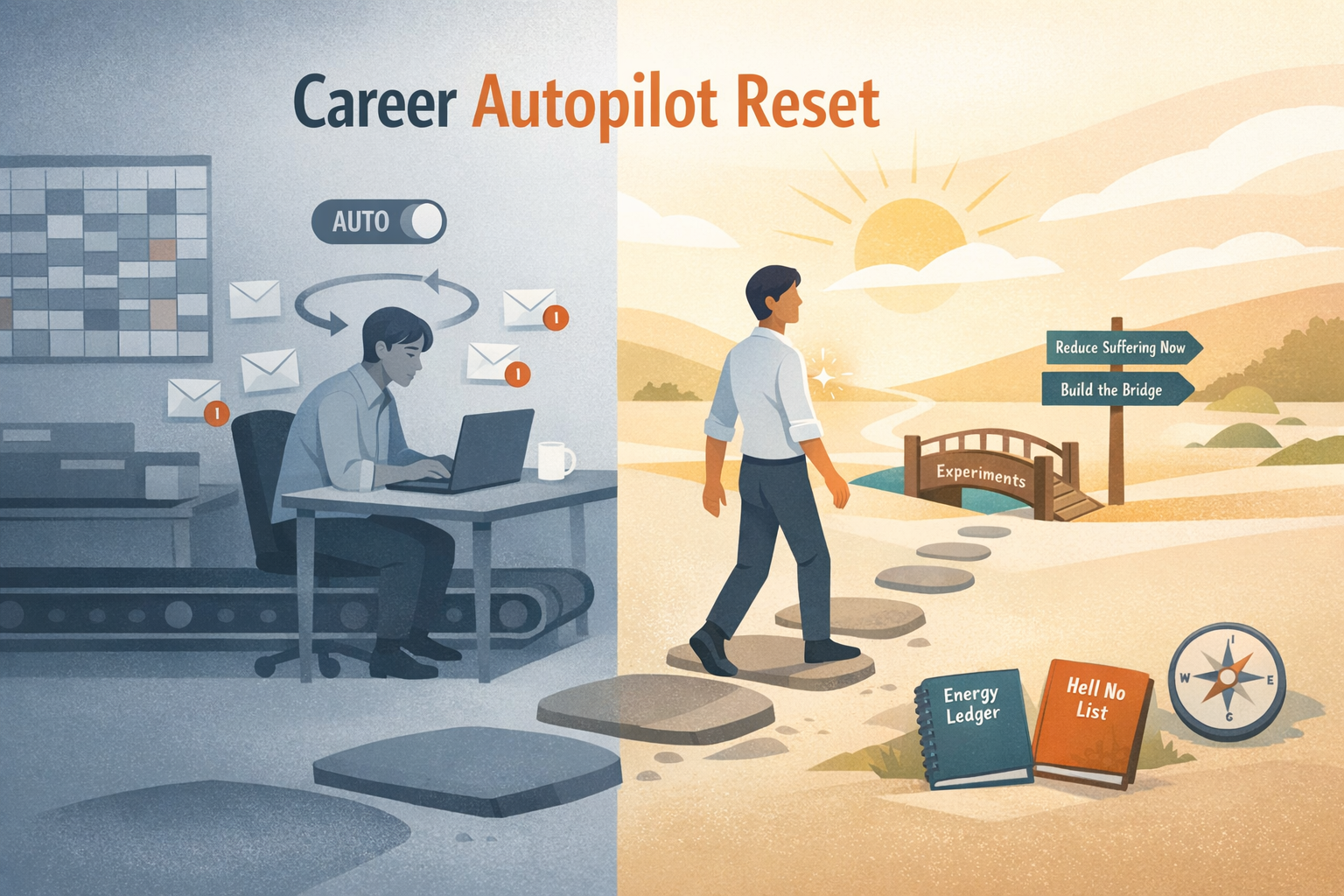
Now make your Hell No list.
These are your dealbreakers—the conditions you’re no longer willing to live
inside.
Examples:
- “Back-to-back meetings all day”
- “Being on call 24/7”
- “A culture that rewards martyrdom”
- “Work that requires me to be someone I don’t like”
This list is a compass. It shows you what your next chapter cannot include.
Step 3: Reconnect (find sparks, not “your passion”)
You don’t need to find your one true calling right now.
You need evidence that you’re still in there.
Use an energy ledger for 7 days:
Twice a day, jot:
- What did I do?
- Did it drain me, energize me, or feel neutral?
- Did I feel more like myself afterward—or less?
Also ask:
- What do I Google when no one’s watching?
- What do people come to me for (that I dismiss as “easy”)?
- When do I forget to check the clock?
You’re collecting spark data. Not life answers.
At the end of the week, look for 3–5 themes, like:
- mentoring/teaching
- building systems
- writing/communicating
- strategy/problem-solving
- creativity/design
- facilitation/leading groups
- research/deep work
Spark themes become experiment ideas (we’ll get there).
Step 4: Rebuild identity (from achiever to aligned builder)
This is the part no resume can do for you.
If your identity has been “I achieve, therefore I am safe/lovable/valuable,”
then of course you begin feeling lost in your career when achievement stops satisfying you.
Your new identity isn’t “less ambitious.”
It’s more aligned.
Try on a few identity shifts:
- From “I prove my worth” to “I build a life that fits.”
- From “I push through” to “I choose intentionally.”
- From “I do what’s impressive” to “I do what’s sustainable.”
- From “I can handle it” to “I’m allowed to have limits.”
Then do a simple values check:
Pick 5 values you want to live by now (not the values you think you should
have).
Examples: autonomy, integrity, creativity, stability, impact, calm, excellence,
freedom, service, growth.
Define them in plain language.
“Autonomy” might mean “I control my calendar.”
“Impact” might mean “I can see my work helping real people.”
“Calm” might mean “I’m not living in constant urgency.”
Values turn vague dissatisfaction into actionable filters.
Step 5: Create direction through experiments (clarity comes from contact)
When you’re feeling lost in your career, your brain will beg you to “figure it
out.”
But clarity rarely comes from thinking harder.
It comes from testing reality.
Pick 2–3 career hypotheses:
- “I might want to move into X kind of role.”
- “I might want the same work but in a healthier environment.”
- “I might want to build something of my own alongside my job.”
- “I might want a role with more autonomy and fewer stakeholders.”
Then run small experiments:
- 3 informational interviews in 2 weeks (ask about day-to-day reality, not job titles)
- a mini project (2 hours) to try the work
- a low-stakes class where you produce something, not just consume content
- a conversation with your manager about role redesign (if your workplace is safe enough)
- apply to 5 roles using your new filters (values + non-negotiables)
Measure what matters:
- Do I feel more alive doing this?
- Would I do it again?
- Does it fit my non-negotiables?
- Does it respect my capacity?
- Am I curious enough to keep going?
You’re not trying to pick “forever.”
You’re trying to choose the next true step—because feeling lost in your career doesn’t get resolved by one giant decision, but by a series of honest experiments.
Practical tools (for when you want direction but your brain is mush)
Tool
1: The 3-minute clarity check-in
Set a timer. Write fast. No editing.
1) What am I feeling about work right now?
2) What do I need that I’m not getting?
3) What is one 10% step that would help?
A 10% step might be:
- updating your LinkedIn headline
- reaching out to one person
- blocking time for recovery
- saying no to one unnecessary obligation
- researching one role (then stop)
Tool 2: The “Two Lanes” plan (so you don’t wait for perfect clarity)
Lane 1: Reduce suffering now
- boundaries
- workload adjustments
- recovery
- support (therapy, coaching, medical care)
Lane 2: Build the bridge
- experiments
- networking
- skills
- applications
- portfolio
You can do both at once. That’s how you change without imploding.
Tool 3: The regret reframe
If you’re stuck in “I wasted years,” try this:
“I didn’t waste time. I collected data.”
Now I get to use that data to choose differently.
Regret can be a teacher, but it’s a terrible life partner.
Common
traps (and the reframe that gets you unstuck)
Trap: “I need motivation first.”
Reframe: Motivation is often a result of capacity + meaningful movement. Start
with small steps and let motivation catch up.
Trap: “It’s too late for me.”
Reframe: You’re not late. You’re awake. Awareness is the start of change, not
proof you failed.
Trap: “I should be grateful.”
Reframe: Gratitude doesn’t cancel truth. You can appreciate what you have and
still want more alignment.
Trap: “I need to burn it all down.”
Reframe: Sometimes the bravest thing is a staged pivot: stabilize, experiment,
then decide.
Trap: “I need to be my old self again.”
Reframe: Your job isn’t to resurrect the old achiever. Your job is to build a new version of ambition that doesn’t cost you your life—especially if you’ve been feeling lost in your career and equating that with “something is wrong with me.”
A 7-day “come back to yourself” plan
Day
1: Stabilize
Do one recovery action. Put it on the calendar like it matters (because it
does).
Day 2: Tell the truth
Write your Hell No list. Choose one boundary you can set this week.
Day 3: Start the energy ledger
Two check-ins today: midday and evening.
Day 4: Find your spark themes
List 10 moments (big or tiny) when you felt more like yourself in the last
year.
Day 5: Choose 2 experiments
One social (a conversation). One practical (a small task).
Day 6: Take one outward step
Message two people. Schedule one informational interview.
Day 7: Pick a next step + set a review date
Decide what you’ll do in the next 30 days and when you’ll reassess.
Progress, not panic.
FAQ
Is
this burnout or am I in the wrong career?
Sometimes it’s burnout inside a decent career. Sometimes burnout is a symptom
of chronic misfit. Stabilize first, then test with experiments. Your data will
get clearer when your system isn’t in constant overdrive.
What if I don’t know what I want at all?
Start with what you don’t want (Hell No list) and what gives you even a small
spark (energy ledger). “Not knowing” is often a sign you’ve been disconnected
from yourself—not a sign you’re incapable.
Do I have to quit to find myself again?
No. Many people begin the identity shift and rebuild autonomy while still
employed. In fact, a staged approach is often safer and more sustainable.
How long does it take to feel like myself again?
It depends on how depleted you are and how stuck your environment is. But most
people feel relief quickly when they stop gaslighting themselves and start
taking small aligned actions consistently.
Closing: You don’t need a new life overnight. You need a truer next step.
If
life passed you by at work, the solution isn’t to shame yourself into
motivation.
It’s to come back to yourself—one honest choice at a time.
You don’t have to become the old conqueror again.
You get to become someone wiser: a person who can still build, achieve, and
grow—without abandoning themselves to do it.
Next step (choose one)
- Do the 3-minute clarity check-in now.
- Start the energy ledger today (two check-ins, that’s it).
- Pick one experiment and schedule it this week.
Related Posts
Recent Articles


-
Biggest Change in Life
Dec 31, 25 06:53 PM
 How your career can offer the biggest change in life and why mindset is the hidden barrier
 -
Process of Becoming an Adult
Oct 05, 25 12:18 PM
A practical 5-pillar framework for the process of becoming an adult: build independence, income, resilience, emotional strength, and a reputation you can use. -
Did the results of the last election hurt your industry and career?
May 02, 25 03:20 PM
Career and elections. Some helpful perspective when results seemed to have hurt your career opportunities.