Feeling
Guilty About Quitting Job? How to Leave with Integrity (Without Second-Guessing
Yourself)
Understand why the guilt shows up, reframe it as part of
growth, and follow a clean, professional exit plan you can feel proud of.
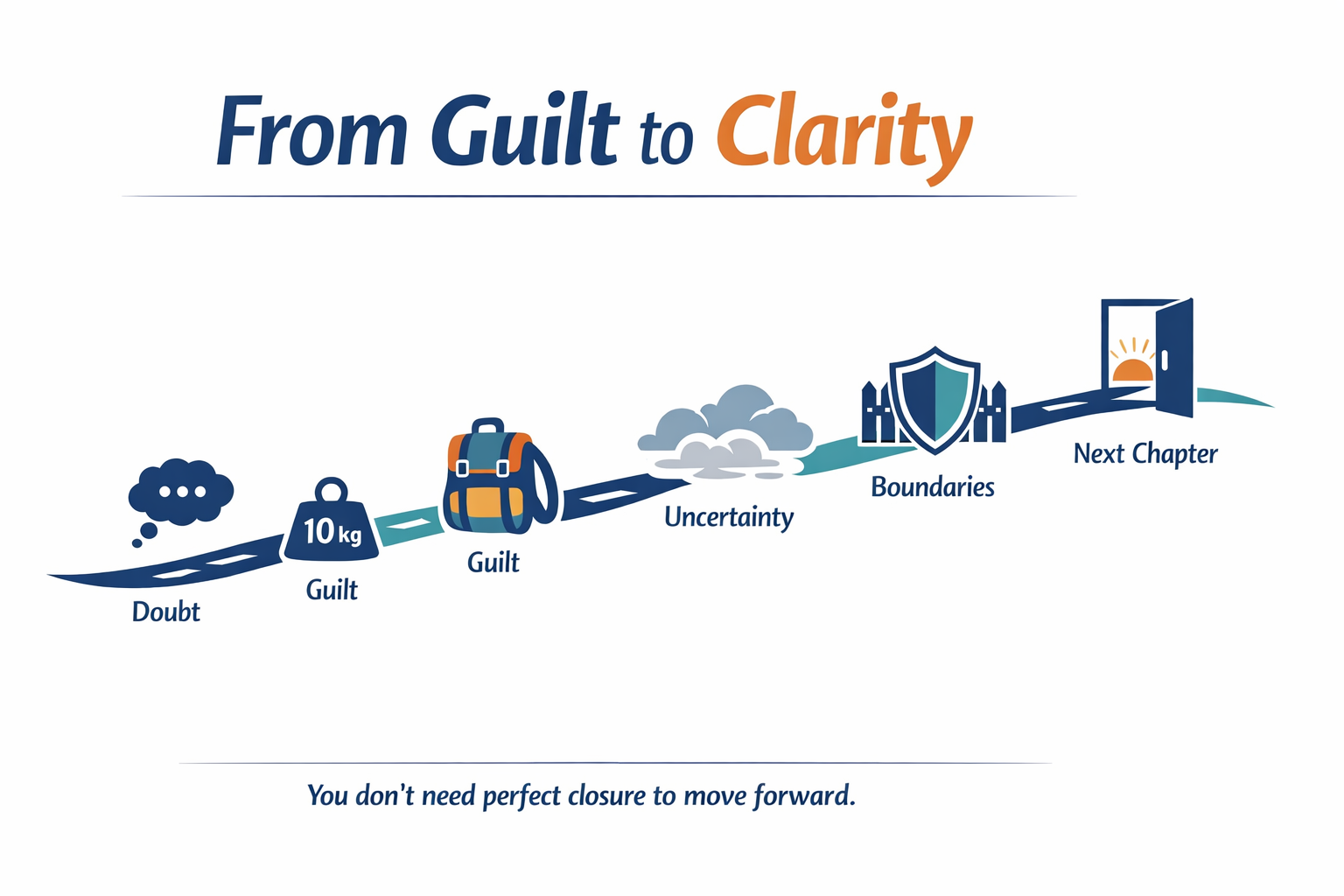
t might be time to quit your job. And yes—on paper, it should feel exciting. Fresh. Empowering. Like you’re stepping into a cleaner, truer version of your life. But if you’re feeling guilty about quitting job, you’re not alone—and it doesn’t mean you’re making a bad decision. It usually means your nervous system is registering change, uncertainty, and the weight of an identity shift.
Quitting
Is a Powerful Decision (Even When It Feels Wrong)
Welcome
to the very real (and wildly common) feeling guilty about quitting job
experience. It’s the emotional speed bump that shows up right when you’re ready
to move—like your nervous system is tapping the brakes and whispering, “Are we
sure we’re allowed to do this?”
Here’s how it usually goes: you’ve thought it through. You’ve made the pro/con
list. You’ve had the late-night conversations with yourself. You know you’re
done.
Maybe you want to start a business. Maybe you want to travel. Maybe you want a
reset. Maybe you’re just cooked—burnt out, crispy, and running on fumes.
But the moment it gets “real real” (as in: calendar invite, resignation email,
telling your manager), the doubts get loud:
“Am I making a mistake?”
“Is this irresponsible?”
“What will people think?”
“Why can’t I just be grateful?”
That’s not a sign you’re weak. That’s a sign you’re human. And yes—feeling
guilty about quitting job tends to show up precisely when you’re about to
outgrow an old identity.
Because this isn’t just a career move. It’s an identity-level shift.
You’re not only leaving a role—you’re leaving a version of you who tolerated,
complied, and stayed “reasonable” even when it cost you.
You’re not a bad person for wanting to leave
- Wanting to quit doesn’t make you ungrateful—it means you’re paying attention.
- You don’t owe a job your health, happiness, or future; leaving can be an act of self-respect.
- Guilt is common, but guilt isn’t proof you’re wrong—it’s often proof you’re changing.
- Quitting isn’t “giving up”; it’s choosing a path that fits who you’re becoming.
- You can appreciate what the job gave you and still decide it’s time to move on.
Feeling Guilty About Quitting Job? Why It Happens (and What It’s Really Telling You)
1)
You’re Burnt Out but Feel Obligated
You keep going because you’re capable—and because people rely on you. But
capability isn’t consent. If you’re feeling guilty about quitting job because
you’re “the reliable one,” remember: reliability without boundaries turns into
self-abandonment.
2) You Like Your Team but Need to Grow
You can love the people and still outgrow the role. The guilt here often sounds
like, “I’m letting them down.” But growing up professionally sometimes means
disappointing the version of you that tried to make everyone comfortable.
3) You’re Leaving to Start a Business (or Go All-In on a New Path)
This is where guilt dresses up like practicality. “Who am I to take this risk?”
“Shouldn’t I just keep it safe?” That feeling guilty about quitting job loop is
often your ambition colliding with old programming about security and approval.
4) You’ve Been There a Long Time and Feel Like You “Should” Stay
Tenure creates invisible handcuffs: loyalty, identity, sunk costs, and fear of
being “the one who left.” If you’re feeling guilty about quitting job because
“they’ve invested in me,” remember: you can be grateful and still be complete.
A powerful decision (even if it feels wobbly)
Quitting your job is powerful because it’s an intentional act of authorship. You’re stepping out of default mode and choosing on purpose.
When you quit, you’re making a declaration:
“I choose to do something else.”
And underneath that, something even braver:
“I don’t know exactly how it will unfold, but I trust myself to figure it out.”
That’s not just strategy. That’s identity.
Why Endings Feel Messy—and Why That’s Normal
In
adulthood, we still crave that tidy “and then everything made sense” ending.
But quitting a job doesn’t always offer closure on a silver platter. Sometimes
the ending is awkward. Sometimes it’s messy. Sometimes it’s emotionally
anticlimactic.
And that’s normal.
We have to let go of the idea that every bold decision comes with a
comfortable, clean finish. Most of the time, you create closure by choosing an
ending—and walking through it anyway.
Quitting can be a bit messy (and that’s okay)
When you alter your circumstances, there’s no guarantee how it plays out. You
take the first step, and the second step tends to appear once you’re moving.
Of course guilt will show up. It’s part uncertainty, part conditioning, part
“I’ve never done it this way before.” Feeling guilty about quitting job doesn’t
mean you’re making the wrong call. It often means you’re doing something new.
I’ve been there.
After years of dissatisfaction, I shut down my window cleaning business. I
wanted the exit to be neat and inspiring—cue the sunset, roll the credits.
Instead? Messy ending. Loose threads. A sense of unfinished business.
And yes, a full-on case of the feeling guilty about quitting job syndrome.
I thought quitting would instantly bring clarity. Like I’d drop the weight and
suddenly feel light, certain, and wildly motivated.
But that’s not always how it works.
Sometimes you quit and the fog doesn’t clear immediately. Sometimes it clears
slowly—after your nervous system stops bracing for impact.
If you’re in this stage, watch for the urge to delay until the ending feels
“clean” and certain—because that moment may never arrive. Ask yourself: “Am I
staying because it’s right, or because I’m waiting for permission, closure, or
clarity that only shows up after I leave?”
HOW TO QUIT WITH INTEGRITY SO YOU FEEL AT PEACE (OUTLINE)
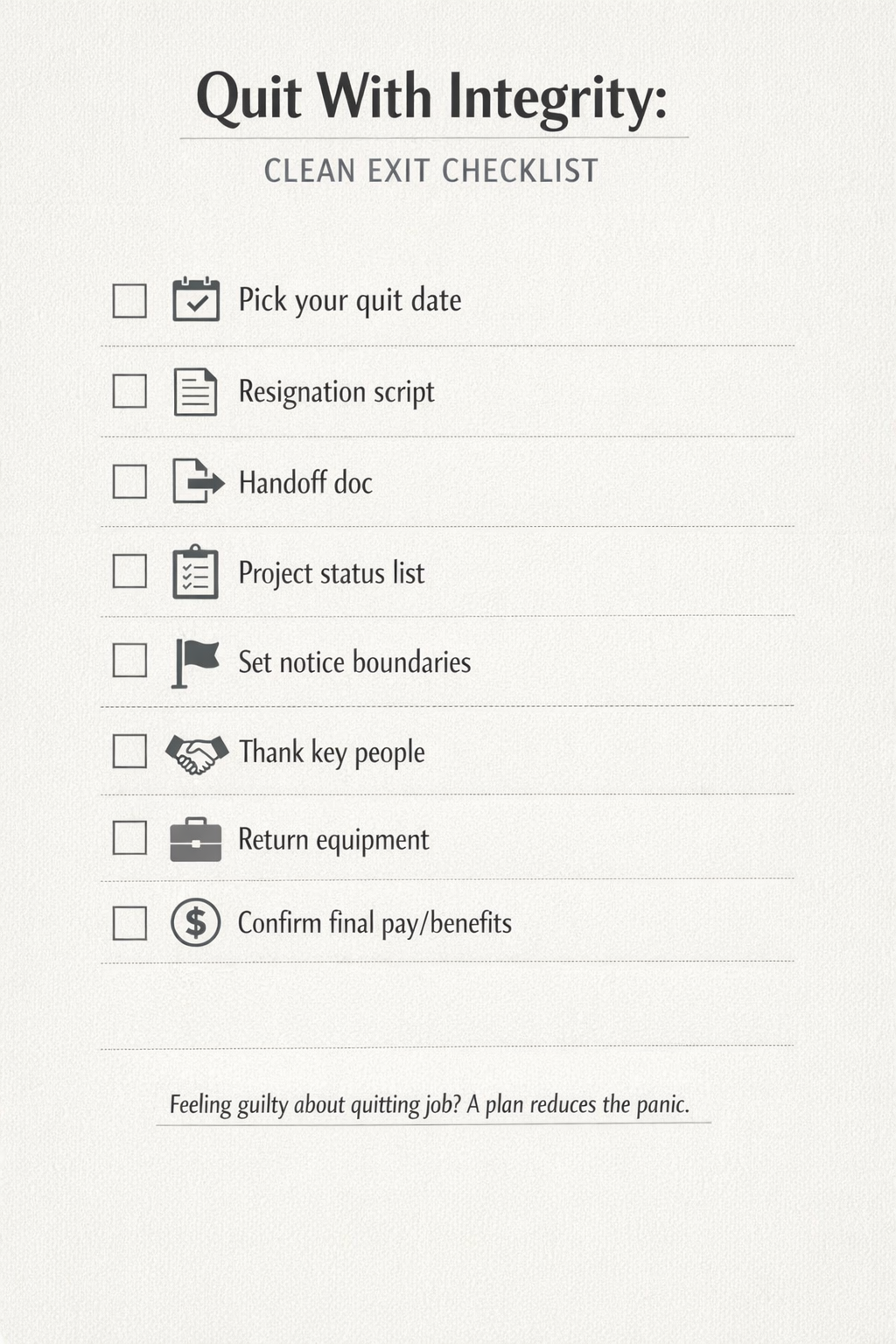
1)
Decide with clarity (before you announce it)
- Define your real reason in one sentence (no blaming).
- Confirm your non-negotiables: health, values, schedule, growth, pay,
location.
- Choose your exit type: standard notice, extended notice, immediate exit (if
unsafe/toxic).
- Set your quit date + last working day in writing.
2) Prepare your “clean exit” plan
- List every active project and its status (what’s done, what’s blocked, what’s
next).
- Identify owners for each responsibility (who will take what).
- Create a simple handoff doc: links, files, logins/process notes (only what
you’re authorized to share).
- Decide what you will and won’t do during notice (boundaries, hours, scope).
3) Resign professionally (short, calm, clear)
- Schedule a private conversation with your manager first.
- Use a concise script: appreciation + resignation + last day.
- Don’t over-explain. Don’t negotiate against yourself.
- Follow up immediately with a brief resignation email for documentation.
4) Work the notice period like a pro (without people-pleasing)
- Prioritize finishing or documenting the highest-impact tasks.
- Communicate daily/weekly: what you completed, what’s next, where you’re
stuck.
- Say “no” to new long-term commitments; offer transition-friendly
alternatives.
- Stay out of gossip, venting, and exit drama.
5) Protect relationships (without making promises you can’t keep)
- Thank key people directly (short message; be specific about what you
appreciated).
- Share a personal email/LinkedIn only if you genuinely want to stay in touch.
- Avoid trash-talking the company on your way out (or online).
- If asked why you’re leaving, use a neutral line: “I’m moving toward a better
fit.”
6) Handle logistics cleanly
- Return equipment, badges, and documents on time.
- Save copies of allowed personal work artifacts (portfolio items, contacts
you’re permitted to keep).
- Confirm benefits end dates, PTO payout, final paycheck timing, and any
non-compete terms.
- Update passwords/access per policy; don’t “lock” anyone out.
7) Leave on a final note you’re proud of
- Deliver your handoff materials and confirm the team can access everything.
- Ask: “Is there anything critical you need from me before my last day?”
- Send a brief goodbye note on your final day (gratitude + how to stay in
touch, if desired).
- Walk out without needing everyone’s approval.
8) Make peace afterward (so guilt doesn’t follow you)
- Expect emotional whiplash: relief, guilt, fear, grief.
- Replace rumination with a reset plan: rest, routines, next project timeline.
- Capture lessons learned: what you want more of, less of, and never again.
- Close the chapter intentionally (one small ritual: journal, walk, dinner, day
off).
How to Move Through the Guilt and Into Your Next Chapter
New
beginnings are often disguised as painful endings
Sometimes you just have to say, “This isn’t working,” and stop negotiating with
reality.
Leaving a job is a boundary. It’s you deciding, “I’m not doing this version of
my life anymore.”
It won’t come with total certainty. It may come with guilt, discomfort, and a
few “what am I doing?” moments. That’s included in the package.
But what makes it a successful decision is what you build next—the future where
quitting becomes the turning point, the plot twist, the moment you stopped
sleepwalking and started steering.
A humble new beginning
Be willing to take a humble step back. Sometimes the next level costs you some
comfort: security, prestige, predictability.
There’s no purposeful change without uncertainty. The goal isn’t to eliminate
the wobble—it’s to build the self-trust to move with it.
You can drown in the shame of what you’ve left behind.
Or you can turn it into evidence: “I am the kind of person who chooses
integrity over inertia.”
There isn’t one correct answer. The power is in who you become by choosing.
Take the path of integrity. Make the choices that require you to say, “I can
and will do better.”
That’s how a career decision becomes a trajectory-altering life change.
NEXT 5 ACTION STEPS
1. Write your “why I’m leaving” in 5 sentences.
Focus on facts (burnout, values mismatch, growth ceiling, health, schedule),
not blame.
2. Pick a realistic quit date and back it up.
Choose a date 2–6 weeks out and mark two milestones: “tell manager by” and
“final day.”
3. Build a 30-day money runway plan.
List your bare-minimum monthly expenses, cut 3 non-essentials, and set a
savings target (even if it’s small).
4. Draft your resignation message (and keep it short).
Prepare a 3–5 sentence resignation email + a one-line reason (“I’m moving on to
a new opportunity”) and don’t over-explain.
5. Create a clean handoff checklist.
Make a simple doc with: current projects, key contacts, passwords/access notes,
and “next steps” so you can leave with integrity.
Feeling guilty about quitting your job doesn’t
mean you’re making the wrong move—it usually means you’re doing a brave one
without a clean plan yet.
If you’re in Calgary and you want to quit with integrity (and without panic,
people-pleasing, or burning bridges), book a Quit With Confidence Strategy
Session with a local career strategist.
In one focused session, we’ll:
- clarify whether it’s time to go (or time to adjust first)
- set a realistic quit date and “tell your manager by” timeline
- build your clean exit plan (handoff checklist, boundaries during notice,
logistics)
- write a short, professional resignation script + email you can actually send
- map your first 30 days after leaving so guilt doesn’t turn into regret
You’ll leave with a clear plan and the calm that comes from knowing you’re
handling this like a pro.
Related Posts
- Should I Quit My Job? How To Decide When It’s Time to Leave or Switch Careers (hub)
- Signs You Should Quit Your Job: Reasons, Red Flags, and the Emotions You Can’t Ignore
- Reasons for Quitting a Job: 7-Question Checklist to Know When It’s Time
- Burnout at Work: When “Just Keep Going” Stops Working
- The "I Keep Quitting Jobs" Phase (And Why It's Not the End of Your Story)
- I Regret Quitting My Job: What to Do Next When the “Fresh Start” Feels Like Free-Fall
Recent Articles


-
Biggest Change in Life
Dec 31, 25 06:53 PM
 How your career can offer the biggest change in life and why mindset is the hidden barrier
 -
Process of Becoming an Adult
Oct 05, 25 12:18 PM
A practical 5-pillar framework for the process of becoming an adult: build independence, income, resilience, emotional strength, and a reputation you can use. -
Did the results of the last election hurt your industry and career?
May 02, 25 03:20 PM
Career and elections. Some helpful perspective when results seemed to have hurt your career opportunities.