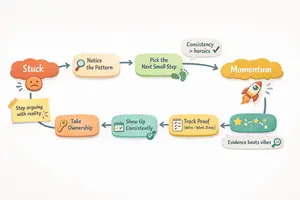
How to Change Your Career (Without Burning Your Life Down): The Identity-Level Shift That Actually Sticks
A grounded, step-by-step guide to stop spinning, rebuild clarity and confidence, and take small actions that create real momentum—even if you don’t have a “perfect plan” yet.
Figuring
out when and how to change your career can feel a lot like realizing you’ve
been in the wrong relationship for a while. Not the dramatic, movie-scene
breakup. More like the slow, quiet knowing. You don’t leave the second it stops
fitting. You try to fix it. You rationalize it. You tell yourself, “It’s not
that bad,” while you’re also secretly Googling “is it normal to dread Monday”
at 11:47 p.m.
Most ambitious, capable people don’t just quit. They *attempt repairs*. They
oscillate between the comfort of the familiar (steady paycheck, predictable
identity, “I know how to do this”) and the inevitability of knowing there has
to be something more aligned out there.
Here’s the reframe that changes everything: learning how to change your career
isn’t primarily about finding a new job. It’s about becoming a new version of
yourself—and building a life that can actually hold that new version.
Because if you only approach this from the “job outward” (titles, companies,
LinkedIn scrolling until your eyes blur), you’ll keep hitting the same wall in
different wallpaper. The external shift won’t stick unless the internal
patterns shift too.
A real career transition is a lifestyle-level change. An identity-level change.
The kind where, months from now, people who love you say something like, “You
seem lighter,” or “I’m so proud of you,” and you realize they’re not just
complimenting your new role—they’re noticing your new *energy*.
So yes: you can absolutely look for a new job. Practical strategy matters. But
the deeper work—the stuff that makes the change sustainable—is about rewriting
the story you’ve been living inside.
How To Change Your Career (7 Grounded Steps)
1) Recognize
when your current career no longer fits
Pay attention to your patterns, not just your bad days.
- When do you feel most drained or resentful—and what’s usually happening?
- If nothing changed for the next 2–3 years, how would that future feel in your body?
- What still feels meaningful (if anything), and what feels like you’re pretending?
One mildly quirky but wildly effective exercise: write a short “breakup letter”
to your current career. Not to be dramatic—just to be honest. Clarity loves
honesty.
2) Treat this as a life transformation, not a job swap
A new job can absolutely help—but it won’t fix the life patterns that made
you burn out in the first place. If you’re using this moment wisely, you’ll ask
bigger questions like:
- What am I done tolerating?
- What habits do I need to retire (overworking, undercharging, people-pleasing, staying small)?
- What’s the new story I’m stepping into?
And heads up: one of the biggest myths about how to change your career is that
you need a perfectly clear vision before you begin. You don’t. You need a *next
step* and the willingness to course-correct as you learn.
Also, chasing “happiness” is a trap (it’s slippery). Chasing meaning,
usefulness, growth, and integrity? That’s sturdy. That builds a life.
3) Heal and upgrade the relationships that shape you
This one is sneaky-important. Your self-esteem and your career decisions are
influenced by the people you’re around. So take inventory:
- Who expands you?
- - Who drains you?
- Who keeps trying to recruit you back into the “old you”?
Sometimes how to change your career is also how to change your environment—one
boundary, one conversation, one supportive connection at a time.
4) Have the mirror moments (without the shame spiral)
This is where you trade guilt for power. Ask:
- “How have I contributed to staying stuck?”
Not to blame yourself—just to reclaim agency.
Pick one recurring behavior that keeps you looping (procrastinating, not
networking, waiting for confidence) and do the opposite in one tiny way this
week. Micro-actions create macro-momentum.
5) Leave a positive wake (integrity pays interest)
If you’re exiting a role, do it with as much grace as the situation allows.
Document things. Finish strong where you can. Be the person people want to root
for. Not because you “owe” anyone—but because integrity keeps your path clean.
6) Take small, circumstance-changing actions—even imperfectly
Momentum is a strategy. If nothing changes, nothing changes.
Book the call. Update the resume for 30 minutes. Attend the meetup. Apply for
one role. Enroll in the course. Schedule the informational interview.
You’re not trying to be perfect—you’re trying to be in motion. That’s often the
missing piece in how to change your career: action that creates new data, new
confidence, and new options.
7) Build a support system that can see your blind spots
You cannot read the label from inside the jar. Get mirrors.
Ask 2–3 trusted people:
“What do you see as my strengths—and what patterns might be holding me back?”
If your current circle can’t support the direction you’re heading, expand
it—communities, mentors, or a coach. The right support shortens the messy
middle.
Bottom line: your career change isn’t just a new paycheck or a new title. It’s
a vote for the person you’re becoming. And you don’t have to leap off a
cliff—you just have to take the next grounded step, then the next. That’s how
the wheels stop spinning and start catching traction.
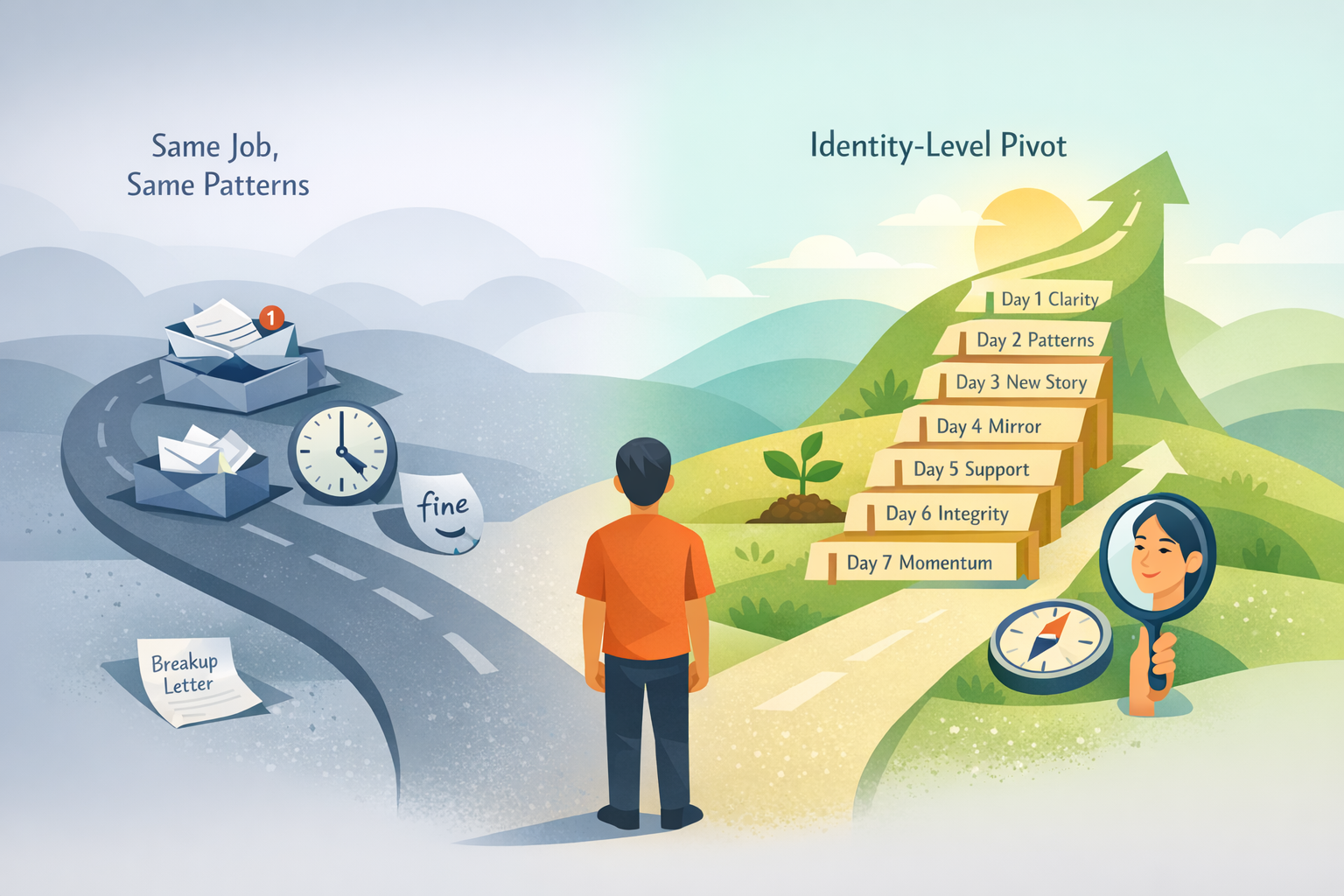
7-DAY CAREER SHIFT STARTER PLAN (One Small Action Per Day)
Day 1 — Name what’s no longer
working (clarity)
Action: Write a 10-sentence “breakup letter” to your current career: why it no
longer fits, what it’s costing you, and what you’re no longer willing to
tolerate.
Day 2 — Identify the real change (life-level, not job-level)
Action: List 3 life patterns this career has reinforced (e.g., overworking,
playing small, people-pleasing). Circle the ONE pattern that, if changed first,
would make everything easier.
Day 3 — Rewrite your direction (identity + meaning)
Action: Write a one-paragraph “new story” that starts with: “I’m becoming the
kind of person who…” (focus on meaning/purpose, not titles).
Day 4 — Have a mirror moment (ownership + release)
Action: Write 3 honest ways you’ve contributed to staying stuck (no shame, no
blame). Then rewrite ONE victim belief into an empowering statement you can
actually believe.
Day 5 — Repair or strengthen one key relationship (support)
Action: Text/email one supportive person and ask: “Can I get 15 minutes this
week? I’m making a career shift and want your honest mirror—my strengths and
what might be holding me back.”
Day 6 — Choose integrity and leave a positive wake (reputation)
Action: Identify one concrete, helpful thing you can do at your current job
this week to leave things better than you found them (e.g., document a process,
clean up a handoff, finish one loose end). Put it on your calendar.
Day 7 — Take one circumstance-changing step (momentum)
Action: Schedule ONE real-world move that advances your shift (pick one):
update your resume for 30 minutes, submit one application, book a recruiter
call, enroll in one class, attend one meetup, or request one informational
interview. Add date/time and hit “confirm.”
Optional rule for next week (to keep traction):
Every week, take 2 actions that make your future career more likely than your
current one—and write them down.
Related Posts:
- Should I Quit My Job? How To Decide When It’s Time to Leave or Switch Careers
- Career Objective for Career Change: Write a Resume Objective That Makes Your Pivot Make Sense
- Best Jobs for Career Change: Choose the Role That Builds Your Identity (Not Just Your Resume)
- Execute a Career Change: A Step-by-Step Transition Plan (Without Burning Out)
Recent Articles


-
Biggest Change in Life
Dec 31, 25 06:53 PM
 How your career can offer the biggest change in life and why mindset is the hidden barrier
 -
Process of Becoming an Adult
Oct 05, 25 12:18 PM
A practical 5-pillar framework for the process of becoming an adult: build independence, income, resilience, emotional strength, and a reputation you can use. -
Did the results of the last election hurt your industry and career?
May 02, 25 03:20 PM
Career and elections. Some helpful perspective when results seemed to have hurt your career opportunities.