Career
Objective for Career Change: Write a Resume Objective That Makes Your Pivot
Make Sense
A practical, evidence-based guide to explain your transition clearly—without buzzwords or over-explaining
A
resume objective is easy to ignore—until you’re changing careers. Then it
becomes one of the most useful lines on the page.
When you pivot, your experience can look “misaligned” at first glance, even if
you’re fully capable. A well-written objective reduces that confusion fast. It
helps a hiring manager understand three things immediately: where you’re
headed, what you bring with you, and why this move is credible.
That’s the real job of a career objective for career change: not to sound
impressive, but to make your direction feel logical.
Why career changes need a different objective
Many professionals didn’t choose their first career with perfect clarity. They
chose what was available, what paid, what seemed sensible, or what they were
good at. Over time, that work built value: skills, results, and professional
maturity.
But a career transition is an intentional shift. It’s not just “another job.”
It’s a change in direction—and on a resume, direction must be made explicit.
This is where core attributes matter. Core attributes are the durable strengths
you’ve built that transfer across industries even when the job titles don’t.
Think: reliability, ownership, emotional maturity under pressure, consistent
follow-through, and resilience after setbacks. Employers won’t hire you because
you “feel ready.” They hire when they see evidence you’ll perform.
Your objective is a compact way to signal that evidence and reduce perceived
risk.
Career
objective Do’s and Don’ts
Do’s
- Keep it simple
- Be short and concise (1–2 sentences)
- Be honest and straightforward
- Be specific (name the role/function)
- Use measurables (years, results, certifications, portfolio work)
- State your experience, key strengths, target role, and outcome
- Use a clear structure (see Plug and Play formula)
Don’ts
- Use unnecessary buzzwords (fast-paced, contribute, utilize)
- Be generic or cliché (“part of a growing team/culture”)
- Overcomplicate it to “stand out”
- Be vague (“a role in tech,” “something in operations”)
- Make it about feelings (“I feel,” “I want,” “I would like”)
How
to Write Your Resume Career Objective for Career Change
A
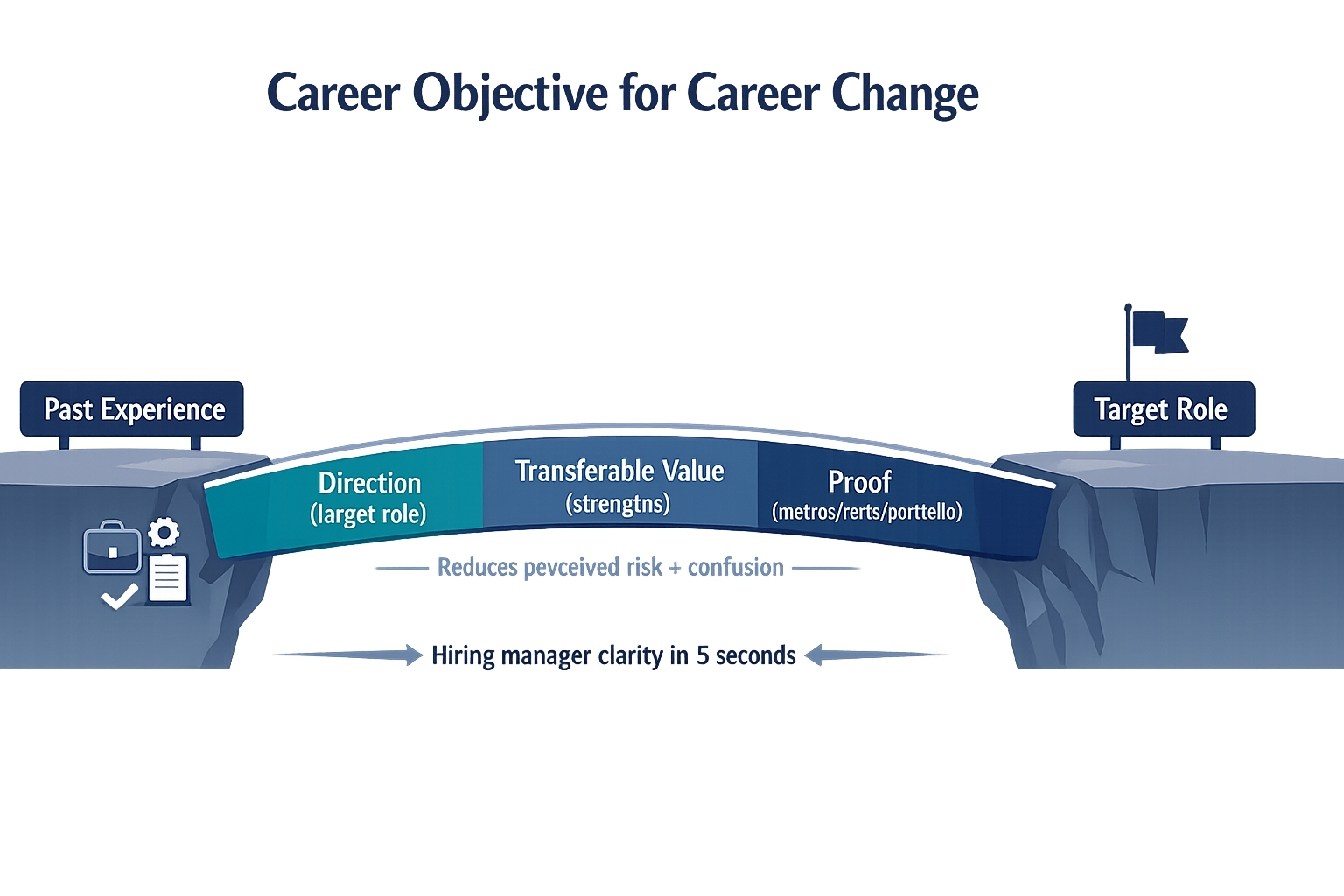
career objective for career change is a short bridge between your past work and
your next role. It should answer, quickly and clearly:
Why does this shift make sense—and what value will you deliver?
A strong objective usually includes three elements:
1) Name the direction you’re heading
Be specific about the role or function. This is not the place for “open to
anything.”
2) Translate your value (not your job titles)
Pull forward the strengths that matter in the new role: communication,
analysis, project coordination, process improvement, customer insight,
troubleshooting, documentation, training, leadership.
3) Add proof so it doesn’t read like a wish
Include one credibility marker: years of experience, measurable results,
certification/coursework, a portfolio project, or an internal initiative.
Quick self-check
If someone read only your objective, would they understand:
- the role you’re targeting, and
- why you’re likely to succeed?
If not, simplify and add one proof point.
EXAMPLE CAREER CHANGE OBJECTIVES
1)
Project Management (from operations/administration)
Objective: Transitioning into a Project Manager role, bringing 8+ years of
operations experience, cross-functional coordination, and a track record of
improving workflow efficiency and on-time delivery across departments.
2) UX/UI Design (from customer service/sales)
Objective: Pursuing a UX Designer role, leveraging 5 years of client-facing
experience in issue resolution, plus UX training and portfolio projects focused
on improving onboarding usability and conversion.
3) Data Analytics (from marketing/communications)
Objective: Moving into a Data Analyst position, combining marketing strategy
experience with Excel/SQL skills to build dashboards and translate complex data
into actionable insights tied to measurable results.
4) Human Resources (from teaching/training)
Objective: Seeking an HR Coordinator role, applying 7 years of coaching and
training experience, strength in conflict resolution, and a people-focused
approach to onboarding and employee support.
5) Cybersecurity (from IT support)
Objective: Shifting from IT Support to an entry-level Cybersecurity Analyst
role, with 5 years of troubleshooting experience, security-focused
documentation, and a systems-based approach to incident tracking and risk
reduction.
A bad example (what to avoid)
“Seeking a position that will challenge me in a fast-paced company where I can
utilize my skills, grow and contribute to a team.”
This fails because it’s vague, overused, and doesn’t explain the pivot.
Plug
and Play Formula:
If
you want a reliable way to write a career objective for career change, use this
structure. It keeps you specific and employer-focused:
[Pivot phrase] + [Old role/field + proof (years/results)] + [Transferable
strengths] + [New target role/field] + [Outcome/value you’ll deliver]
Pivot phrase ideas:
“Transitioning from…”, “Shifting from…”, “Moving into…”, “Pursuing…”
Filled-in example 1 (Ops → Project Management)
Transitioning from Operations (6+ years improving workflows) with
cross-functional coordination and stakeholder communication into an Associate
Project Manager role to strengthen delivery timelines and execution
consistency.
Filled-in example 2 (Marketing → Data Analytics)
Moving from Marketing/Communications with Excel/SQL training into a Data
Analyst role to build clear dashboards and insight-driven recommendations that
support growth targets.
Upgrade
your Career Objective with these 10 Power Verbs
Use
one or two of these in your career objective for career change where they genuinely fit. Precision beats “corporate-sounding.”
- Robust (instead of Strong)
- Implement (instead of started/began)
- Systematize (instead of Organized)
- Deliver (instead of Provide)
- Launch (instead of Set Up)
- Scale (instead of grew)
- Optimize (instead of Improved)
- Streamline (instead of organized)
- Strengthen (instead of Improve)
- Initiate (instead of Start)
THE FLUFF - Phrases To Avoid
Not
every transition follows a predictable ladder. Some pivots are
“non-traditional,” where job titles don’t obviously connect but the underlying
strengths of your story do.
Examples of non-traditional career changes
- Work gap/Stay-at-home → Administration
- Retail/Restaurant → Personal Trainer
- Skilled trade → Sales
Writing Career Objectives for non-traditional Career Changes
For non-traditional transitions, clarity and credibility matter even more. Your
objective has to connect the dots for the reader.
1) Lead with purposeful intent
- Name the role you’re targeting
- Avoid emotional framing (“I feel called…”)
2) Communicate your story as transferable value
Translate your past into the language of the new role (coordination,
documentation, client retention, training, compliance, problem-solving).
3) Use measurables to establish credibility
Years, outcomes, certifications, completed projects, portfolio work—anything
that signals you’ve already started the shift.
4) Stay employer-focused
Focus on what you will deliver in the role.
5) Use the Plug and Play formula
This keeps your positioning clear and consistent.
Mini-Profiles: Career-Change Objectives That “Bridge the Gap”
1)
From Healthcare to Tech Support
Objective: Transitioning from 6+ years in patient-facing healthcare to a
Technical Support Specialist role, leveraging calm problem-solving, precise
documentation, and high attention to detail to resolve tickets efficiently and
improve customer satisfaction.
Why it works: It reframes patient support as user support and highlights
documentation and accuracy.
2) From Retail/Restaurant to Sales Development (SDR)
Objective: Moving from 4 years in high-volume retail/hospitality into an SDR
role, bringing upselling experience, objection handling, and CRM training to
generate qualified leads and consistently hit outreach targets.
Why it works: It translates customer-facing performance into pipeline-building
outcomes.
3) From Teaching to Learning & Development
Objective: Shifting from 8 years in education to a Learning & Development
Specialist role, applying curriculum design, facilitation, and coaching to
improve onboarding outcomes and training adoption across teams.
Why it works: It connects instruction to business outcomes instead of job
titles.
4) From Skilled Trades to Project Coordination
Objective: Transitioning from 7 years in electrical/construction work to a
Project Coordinator role, leveraging jobsite scheduling, safety-first
execution, and vendor coordination to support smoother timelines and reduce
rework.
Why it works: It keeps field credibility while translating it into coordination
and delivery.
5) From Stay-at-Home Parent (Work Gap) to Administrative Coordinator
Objective: Returning to the workforce in an Administrative Coordinator role,
bringing 3+ years managing complex schedules and budgets, strong communication,
and advanced organization to streamline calendars, support operations, and
improve follow-through.
Why it works: It frames the gap confidently and focuses on outcomes.
6) From Customer Service to UX Research
Objective: Pursuing a UX Researcher role after 5 years in customer service,
leveraging voice-of-customer insight, interview skills, and 200+ documented
user interactions—plus research coursework—to inform product decisions and
improve usability.
Why it works: It combines credible proof with a clean bridge to research work.
FROM CONFUSION TO CLARITY
1)
Step 1: Define the career you’re moving toward (name it clearly).
Choose the role/function (and ideally industry). Specificity keeps your search
focused and your objective believable.
2) Step 2: Identify your core attributes (the person you are at work,
regardless of field).
Pick 3–5 traits that carry across roles, such as reliability, ownership,
emotional maturity under pressure, resilience, and consistency. These support
trust when your titles don’t match.
3) Step 3: List your top 5 transferable strengths (skills you can prove).
Select strengths that match the new role and that you can back up with
examples.
4) Step 4: Add proof points (evidence you’ve started the pivot).
Include measurable outcomes, coursework/certifications, portfolio projects,
volunteer work, or internal projects.
5) Step 5: Draft your objective using the formula above.
This is where everything comes together in 1–2 sentences—clear direction,
transferable value, and proof.
Final note: your objective is not the whole story—it’s the headline
A career objective for career change is a positioning tool. Done well, it
reduces confusion, increases trust, and makes it easier for the reader to say,
“Yes, this transition makes sense.” And that’s exactly what you want from two
sentences at the top of a resume.
Related Posts:
- Should I Quit My Job? How To Decide When It’s Time to Leave or Switch Careers (hub)
- How to Change Your Career (Without Burning Your Life Down): The Identity-Level Shift That Actually Sticks
- Best Jobs for Career Change: Choose the Role That Builds Your Identity (Not Just Your Resume)
- Execute a Career Change: A Step-by-Step Transition Plan (Without Burning Out)
Recent Articles


-
Biggest Change in Life
Dec 31, 25 06:53 PM
 How your career can offer the biggest change in life and why mindset is the hidden barrier
 -
Process of Becoming an Adult
Oct 05, 25 12:18 PM
A practical 5-pillar framework for the process of becoming an adult: build independence, income, resilience, emotional strength, and a reputation you can use. -
Did the results of the last election hurt your industry and career?
May 02, 25 03:20 PM
Career and elections. Some helpful perspective when results seemed to have hurt your career opportunities.