Best Jobs for Career Change: Choose
the Role That Builds Your Identity (Not Just Your Resume)
A core-attribute
approach to switching careers—15 examples plus mini guides that turn your
current skills into calmer, steadier, better-paid work.
If you’re reading this, there’s a decent chance you’re successful on paper and exhausted in your bones.
Maybe your job pays well, looks respectable, and is “fine” in the way a chair is “fine” until you realize you’ve been sitting in it for eight years and your back hates you. Your motivation vanishes mid-afternoon. Your nervous system is jumpy. You fantasize about running away and starting a simpler life, mostly because “simpler” sounds like “I can breathe again.”
So when you start searching for the best jobs for career change, what you’re really looking for isn’t just a different title—it’s relief. It’s a life that fits.
You’re not broken. You’re not lazy. You’re not ungrateful.
You’ve probably outgrown an identity.
And that’s the career-change truth most advice skips: the best career change isn’t just a new set of tasks. It’s a new way of being. The “best fit” role is the one that trains the core attributes you want and need in your life—so the change becomes transformational, not temporary.
The Lens: The Best Jobs For Career Change Are The Ones That Embody New Core Attributes
AKA
what you really want (and need) in the best jobs for career change.
Most people search for “meaningful work” like it’s hidden inside a job title:
Project Manager. UX Designer. Recruiter. Data Analyst.
So when we talk about “best jobs for career change,” we’re not talking about
trendy roles.
We’re talking about roles that:
1) Use Version 1.0 of you (what you can already do).
2) Train Version 2.0 of you (what you most need to become).
That’s what makes a career change stick.
THE CORE ATTRIBUTES (THE INTERNAL SKILL STACK THAT OUTLASTS ANY JOB)
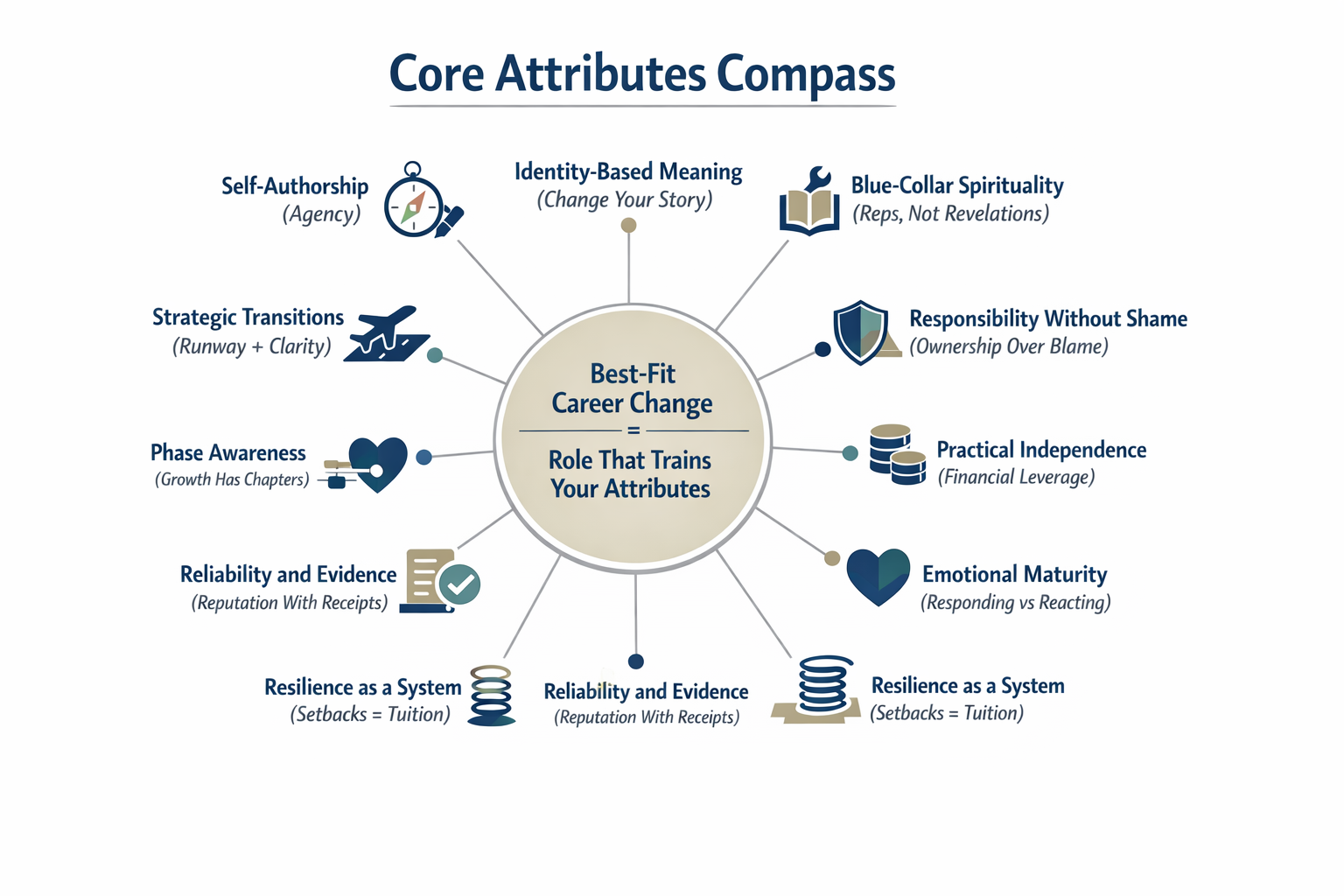
Here are the core attributes this guide uses as a compass. They’re the filter we’ll use to evaluate options—so you’re not just chasing what’s trendy, but choosing the best jobs for career change based on who you need to become next.
1) Self-Authorship (Agency)
2) Identity-Based Meaning (Change Your Story)
3) Blue-Collar Spirituality (Reps, Not Revelations)
4) Responsibility Without Shame (Ownership Over Blame)
5) Practical Independence (Financial Leverage)
6) Emotional Maturity (Responding vs Reacting)
7) Resilience as a System (Setbacks = Tuition)
8) Reliability and Evidence (Reputation With Receipts)
9) Strategic Transitions (Runway + Clarity)
10) Phase Awareness (Growth Has Chapters)
Now let’s use those attributes to choose roles intelligently.
THE
BEST JOBS FOR CAREER CHANGE (WITH SALARY, REQUIREMENTS, AND THE ATTRIBUTES THEY
BUILD)
Important
note on pay: starting salary varies widely by country, city, industry, and
company. Ranges below are typical U.S. starting ranges. Treat them as
“ballpark,” not promises.
1) Project Coordinator / Junior Project Manager
Starting pay: ~$50k–$75k
Education/experience: Often no specific degree required; certifications (CAPM,
Google PM) help; experience coordinating is valuable.
Why it’s a strong career-change role: It turns “I’m overwhelmed” into “I run
systems.”
Core attributes focused:
- Blue-Collar Spirituality (reps)
- Reliability and Evidence (receipts)
- Self-Authorship (agency)
- Phase Awareness (structure through transitions)
2) Customer Success Manager (CSM) / Customer Success Associate
Starting pay: ~$55k–$90k (sometimes plus bonus)
Education/experience: Strong communication + customer-facing experience;
product/industry familiarity helps.
Why it’s strong: You build trust, drive outcomes, and learn calm authority.
Core attributes focused:
- Emotional Maturity
- Reliability and Evidence
- Self-Authorship
3) Consultative B2B Sales (SDR/BDR → AE track)
Starting pay: SDR/BDR ~$45k–$70k base + commission (OTE often ~$60k–$100k); AE
higher.
Education/experience: No specific degree required; training + practice +
coachability matter.
Why it’s strong: Fast feedback loop; you get paid to build resilience and
communication.
Core attributes focused:
- Resilience as a System
- Self-Authorship
- Practical Independence (income leverage)
- Blue-Collar Spirituality (daily reps)
4) HR Coordinator → HR Generalist
Starting pay: HR Coordinator ~$45k–$65k; HR Generalist ~$55k–$80k
Education/experience: Often a degree helps (not always required); admin/ops
experience translates; HR certs can help later.
Why it’s strong: It teaches boundaries, judgment, and people systems.
Core attributes focused:
- Emotional Maturity
- Responsibility Without Shame
- Reliability and Evidence
- Strategic Transitions (you learn how organizations really change)
5) Recruiter (Talent Acquisition Coordinator → Recruiter)
Starting pay: Coordinator ~$45k–$60k; Recruiter ~$55k–$90k (commission/bonus
sometimes)
Education/experience: Conversation skills + organization; sales/hospitality
backgrounds often do well.
Why it’s strong: Your network becomes an asset; you build professional
confidence through relationships.
Core attributes focused:
- Emotional Maturity
- Reliability and Evidence
- Self-Authorship
- Identity-Based Meaning (work becomes “bridge-building”)
6) Data Analyst (Entry-Level)
Starting pay: ~$60k–$95k
Education/experience: Portfolio projects + SQL/Excel + (often) BI tools; degree
helps but proof matters.
Why it’s strong: You learn to separate stories from facts—internally and
externally.
Core attributes focused:
- Reliability and Evidence (proof)
- Blue-Collar Spirituality (practice/projects)
- Resilience (debugging is tuition)
7) Business Analyst (BA)
Starting pay: ~$65k–$100k
Education/experience: Often degree preferred; transferable skills in analysis,
communication, requirements gathering; proof via project examples helps.
Why it’s strong: You become a translator between messy reality and clean
decisions.
Core attributes focused:
- Emotional Maturity (stakeholder conflict)
- Responsibility Without Shame
- Reliability and Evidence
- Self-Authorship
8) UX Designer (Junior)
Starting pay: ~$65k–$110k
Education/experience: Portfolio is essential; bootcamps exist; real projects
matter more than certificates.
Why it’s strong: You build by iterating; perfectionism gets replaced by proof.
Core attributes focused:
- Blue-Collar Spirituality (iterate)
- Reliability and Evidence (portfolio)
- Identity-Based Meaning (craft + empathy)
9) Technical Writer
Starting pay: ~$60k–$95k
Education/experience: Strong writing + ability to learn systems; portfolio
samples; domain knowledge is a huge edge.
Why it’s strong: You turn complexity into clarity—an underrated power skill.
Core attributes focused:
- Reliability and Evidence (clear deliverables)
- Emotional Maturity (collaboration)
- Identity-Based Meaning (service through clarity)
10) Digital Marketing Specialist (Content/SEO/Email)
Starting pay: ~$50k–$80k
Education/experience: Portfolio wins (newsletter, case studies, campaigns);
certificates help but proof wins.
Why it’s strong: Test → learn → adjust. It trains persistence and humility
fast.
Core attributes focused:
- Resilience as a System
- Blue-Collar Spirituality
- Reliability and Evidence
11) Operations Specialist
Starting pay: ~$55k–$85k
Education/experience: Coordination + systems thinking; often degree preferred;
admin/trades/logistics translate well.
Why it’s strong: You build stability by improving what’s directly in front of
you.
Core attributes focused:
- Responsibility Without Shame
- Reliability and Evidence
- Blue-Collar Spirituality
- Practical Independence (career stability)
12) Customer Support (with growth path into CS/Ops/QA/Product Support)
Starting pay: ~$40k–$65k
Education/experience: Often entry-friendly; communication and problem solving
matter.
Why it’s strong: It’s a bridge job that creates footing while you build proof.
Core attributes focused:
- Emotional Maturity
- Reliability and Evidence
- Phase Awareness (ladder mindset)
13) Instructional Designer / Corporate Trainer (Junior)
Starting pay: ~$60k–$90k
Education/experience: Portfolio is key; teaching/coaching backgrounds
translate; tools knowledge (authoring/LMS) helps.
Why it’s strong: Turns your lived experience into structured value.
Core attributes focused:
- Identity-Based Meaning
- Blue-Collar Spirituality
- Reliability and Evidence
14) Career Coach / Resume & Interview Coach (part-time to start)
Starting pay: Wide range; early stages often $0–$2k/month part-time, scaling
upward with positioning and proof.
Education/experience: Credibility comes from results, testimonials, and a clear
niche; coaching certification optional.
Why it’s strong: You build a business by becoming more you, not less you.
Core attributes focused:
- Self-Authorship
- Reliability and Evidence
- Identity-Based Meaning
- Strategic Transitions (you live what you teach)
15) Real Estate Agent (or Loan Officer Assistant path)
Starting pay: Highly variable; early agents often $0–$50k until pipeline
builds; assistants ~$40k–$65k.
Education/experience: Licensing required (varies by state); success depends on
consistency and relationships.
Why it’s strong: It’s a resilience-and-consistency gym with real upside.
Core attributes focused:
- Resilience as a System
- Blue-Collar Spirituality
- Practical Independence
- Self-Authorship
The Point: "Best Fit" = The Role That Builds The Attributes You Need Most
You
can switch jobs and carry the same patterns into the new one:
- over-functioning
- avoiding hard conversations
- leaky money habits
- perfectionism
- quitting when it’s uncomfortable
A best jobs for career change for you is the one that helps you practice a different identity
repeatedly—until it becomes yours.
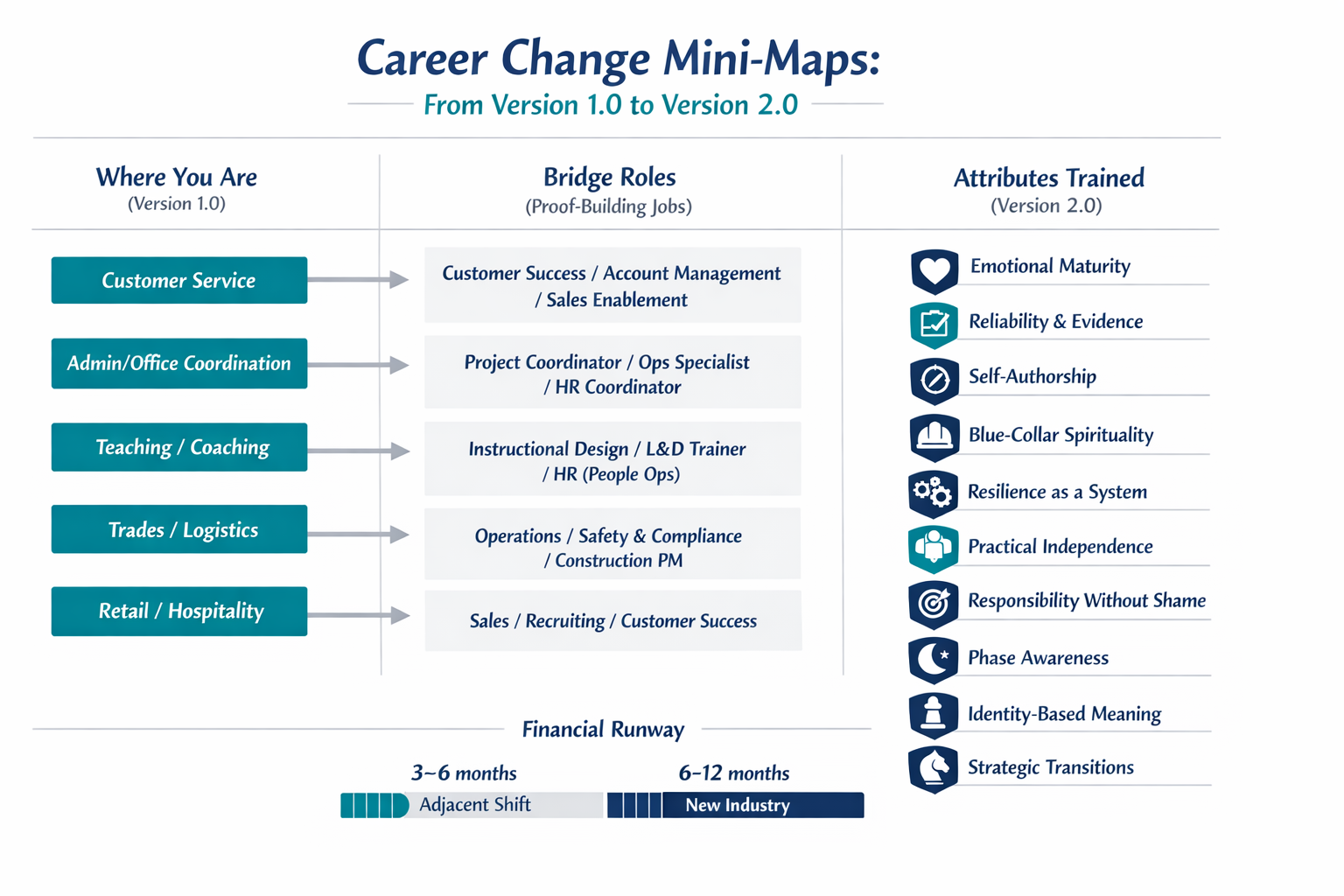
That’s why the mini-maps below matter: they translate your current reality into
a next step that builds proof and trains core attributes.
CAREER
CHANGE MINI-MAPS (CORE-ATTRIBUTE CENTERED)
Career Change Guide 1: From: Customer Service → To: Customer
Success, Sales Manager
Why this fits:
You already know customer pain, de-escalation, and communication. That’s
emotional maturity and trust-building—the core of CS/AM/Enablement.
First steps:
- Track measurable wins (retention saves, cases resolved, etc.
- Shadow Sales or Accounts Manager or help with onboarding so you can say “relevant experience” with proof.
Core attributes you strengthen:
- Emotional Maturity
- Reliability and Evidence
- Self-Authorship
Beyond your career:
You become calmer under pressure, better at boundaries and conflict, and more
trustworthy to yourself (and others). This improves relationships, leadership
capacity, and stability at home—not just at work.
Career Change Guide 2: From: Admin / Office Coordination → To: Project
Coordinator, Operations Specialist, HR Coordinator
Why this fits:
Admin is operations with the title turned down. You already manage priorities
and moving pieces; these roles simply reward that explicitly.
First steps:
- Build a project log: what you’ve coordinated beginning to end and the impact (time saved, errors reduced, smooth handoffs).
- Build a repeatable process and or “hand-off” (onboarding checklist, documentation, company standards).
Core attributes you strengthen:
Blue-Collar Spirituality (reps)
- Reliability and Evidence
- Self-Authorship
- Phase Awareness
Beyond your career:
You stop living in reaction mode. You learn systems thinking, follow-through,
and preparation. skills that make your personal life less chaotic, too.
Career Change Guide 3: From: Teaching / Coaching / People Leadership →
To: Instructional Design, Trainer, Human Resources
Why this fits:
You’re already skilled at development and communication. Burnout often comes
from volume and emotional labor—not the craft of helping people grow.
First steps:
- Take existing materials and build a portfolio
- Create one training asset for a nonprofit or workplace
Core attributes you strengthen:
- Identity-Based Meaning (change your story)
- Blue-Collar Spirituality
- Emotional Maturity
- Reliability and Evidence
Beyond your career:
You learn to build meaning from action instead of waiting to “feel aligned.”
That makes you steadier in any season—parenting, relationships, health,
leadership, and future transitions.
Career Change Guide 4: From: Trades / Field Work / Logistics → To:
Operations, Safety Manager, Project Management
Why this fits:
You understand real constraints: time, budget, safety, quality. That
reality-based competence translates directly into operations and Project
Manager environments.
First steps:
- Build Documentation (Scheduling, Vendor, Inventory, Quality Control, Safety protocols)
- Collect “receipts”: document 5 setbacks and what you changed afterward (systems, checklists, preventive steps).
Core attributes you strengthen:
- Responsibility Without Shame
- Resilience as a System
- Reliability and Evidence
- Practical Independence
Beyond your career:
You build durable confidence: “I can handle
problems without spiraling.” That shows up in money decisions, health choices,
family responsibilities, and long-term stability.
Career Change Guide 5: From: Retail / Hospitality → To: Sales,
Recruiting, Manager
Why this fits:
You already perform under pressure with real humans. That is the raw material
for trust-based roles where communication becomes leverage.
First steps:
- Build a “proof project” (choose one): sales outreach script; recruiting system; Onboarding checklist.
- Do 2 informational interviews to learn what “first day success” actually looks like.
Core attributes you strengthen:
- Self-Authorship
- Emotional Maturity
- Practical Independence
Reliability and Evidence
Beyond career change:
Agency + leverage changes your whole life: you can create options, negotiate,
and take smart risks without chaos. Less fear, more choice.
Managing the Financial Side
Money
matters because financial chaos turns career change into panic.
1) Know your runway (Runway + Clarity)
- Calculate bare-minimum monthly expenses.
- Typical runway targets:
- 3–6 months for adjacent role shifts
- 6–12 months for new industry/retraining
2) Consider a strategic “step back”
A lateral move, contract role, or bridge job isn’t failure. It’s buying time,
proof, and nervous-system stability.
3) Lower your burn rate (Leverage)
Cut recurring expenses, pause lifestyle inflation, and redirect savings into a
buffer. This isn’t punishment—it’s freedom.
4) Build transition income
Part-time work, freelance, contracts, or paid apprenticeships can keep you
steady while you build proof.
5) Don’t let money fear become procrastination
One step this week: update resume, build one portfolio project, book one
informational interview, take one course module, ask to shadow internally.
A PRACTICAL NEXT STEP (simple, real, Version 1.0 friendly):
Write down:
1) What you want more of (energy, autonomy, creativity, stability, people, quiet).
2) What you want less of (fires, politics, constant urgency, emotional labor, meaninglessness).
3) The top 5 skills you already use that you’re proud of.
4) The ONE core attribute you most need to strengthen next.
Then use that list to spot the best jobs for career change for you—roles that match your strengths today and build the attributes you need next.
Choose one mini-map direction and take one grounded step this week.
Not a perfect step. A real one.
Related Posts:
- Should I Quit My Job? How To Decide When It’s Time to Leave or Switch Careers
- How to Change Your Career (Without Burning Your Life Down): The Identity-Level Shift That Actually Sticks
- Career Objective for Career Change: Write a Resume Objective That Makes Your Pivot Make Sense
- Execute a Career Change: A Step-by-Step Transition Plan (Without Burning Out)
Recent Articles


-
Biggest Change in Life
Dec 31, 25 06:53 PM
 How your career can offer the biggest change in life and why mindset is the hidden barrier
 -
Process of Becoming an Adult
Oct 05, 25 12:18 PM
A practical 5-pillar framework for the process of becoming an adult: build independence, income, resilience, emotional strength, and a reputation you can use. -
Did the results of the last election hurt your industry and career?
May 02, 25 03:20 PM
Career and elections. Some helpful perspective when results seemed to have hurt your career opportunities.