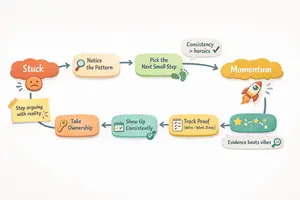
Execute a
Career Change: A Step-by-Step Transition Plan (Without Burning Out)
This Isn’t a Reinvention. It’s an Execution Problem.
Execution
beats inspiration. If you’re burned out right now, odds are you don’t have a
“motivation problem” or a “character problem” — you have a systems problem. The
way your days are structured, the expectations you carry, the pace you’re
running… it’s been draining you for a long time. If you want to Execute a
career change without breaking yourself in the process, you’ll need a plan that
protects your energy while still creating real momentum.
And when it’s time to shift, what you’re really doing isn’t just swapping jobs.
You’re building a life where you don’t need rescuing — because you can steer.
You’re rebuilding stability, self-respect, and real progress… especially if
work has been bleeding into your evenings, your health, and the way you show up
for the people you care about.
So the goal isn’t a dramatic leap. The goal is to expand your choices, buy
yourself time, and lower fear enough that you can make clear decisions —
without chaos, guilt, or self-betrayal.
One more thing that helps: careers move in phases. Misalignment often turns
into loops — the same frustrations repeating until you start thinking it’s
“just who you are.” It’s not. Your job in this season is to learn the
curriculum of the phase, so you can move forward with agency and grounded
action.
So let me ask you the question that decides everything:
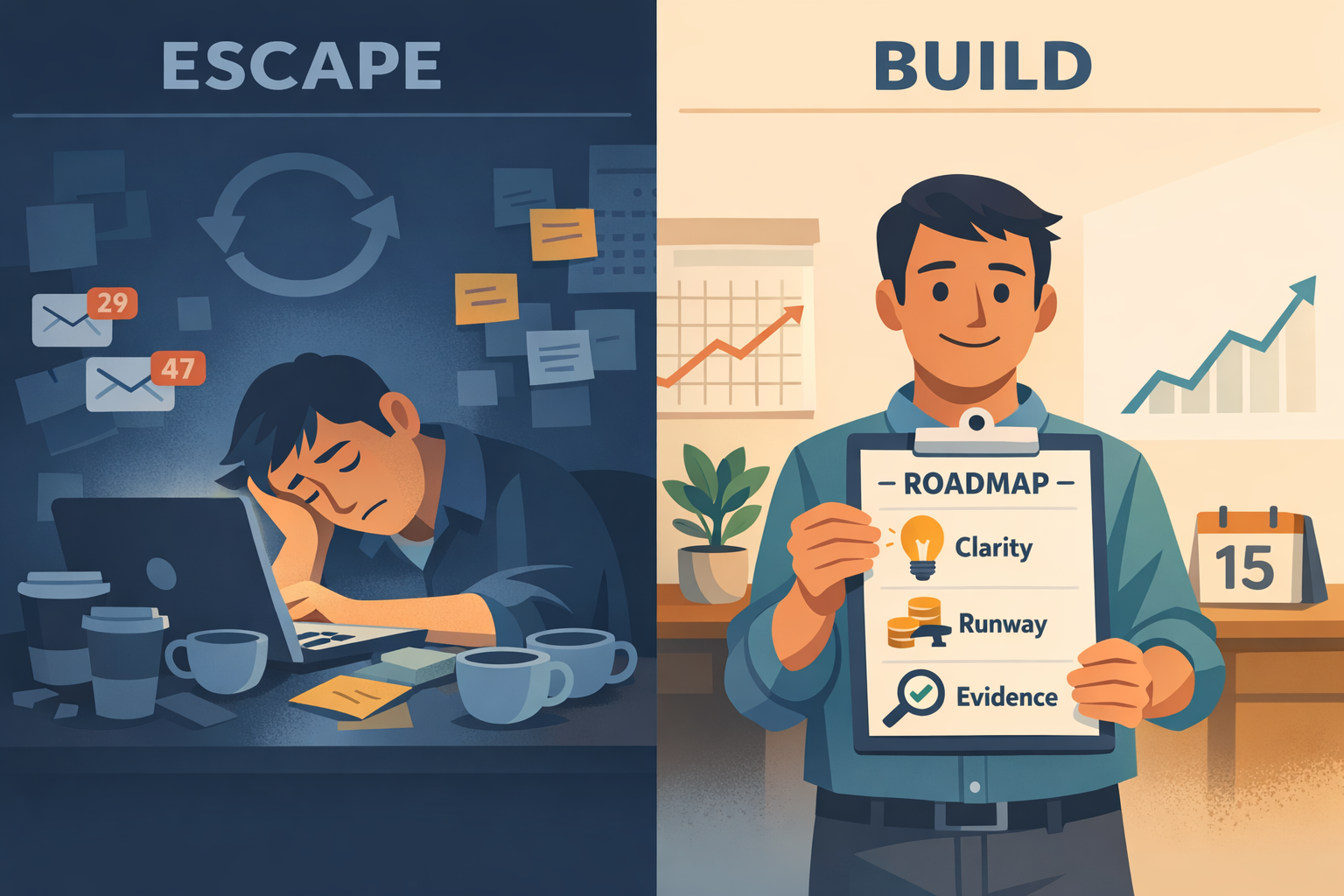
Are you trying to escape… or are you trying to build?
The Career Change Execution Framework (10 Core Attributes → 10 Steps)
Here’s
the idea: a career shift that lasts isn’t just a series of external moves.
It’s the result of internal attributes becoming stronger.
These core attributes are “career-shaped, life-transcending” characteristics.
They’re less about the job title and more about the person you become: agency,
consistency, emotional maturity, practical independence, resilience, and
evidence-based confidence.
In other words: the kind of person who can navigate work—and life—without
falling apart or relying on constant motivation.
We’ll walk through a 10-step framework in a minute, but first, take something
to heart:
You don’t need to do it all at once.
You need to Execute a career change like a strategist:
- name the phase
- pick the next controllable step
- build runway
- build proof
- tell the story
- run the pipeline
- keep your nervous system intact while you do it
Now let’s go step-by-step, in a way your real life can actually support.
New to this process? Start with: How to Change Your Career (Without Burning Your Life Down): The Identity-Level Shift That Actually Sticks.
Execute A Career Change - Step By Step
STEP
1 — NAME YOUR CURRENT PHASE (PHASE AWARENESS)
If you’re tired and quietly wondering, “Is this it?” don’t treat it like a
personal flaw.
Treat it like a phase.
A phase is a chapter defined by a dominant pattern: how you’re thinking,
responding, and showing up. When you name the phase, you stop arguing with
yourself and start choosing the right next step.
Here’s the common progression:
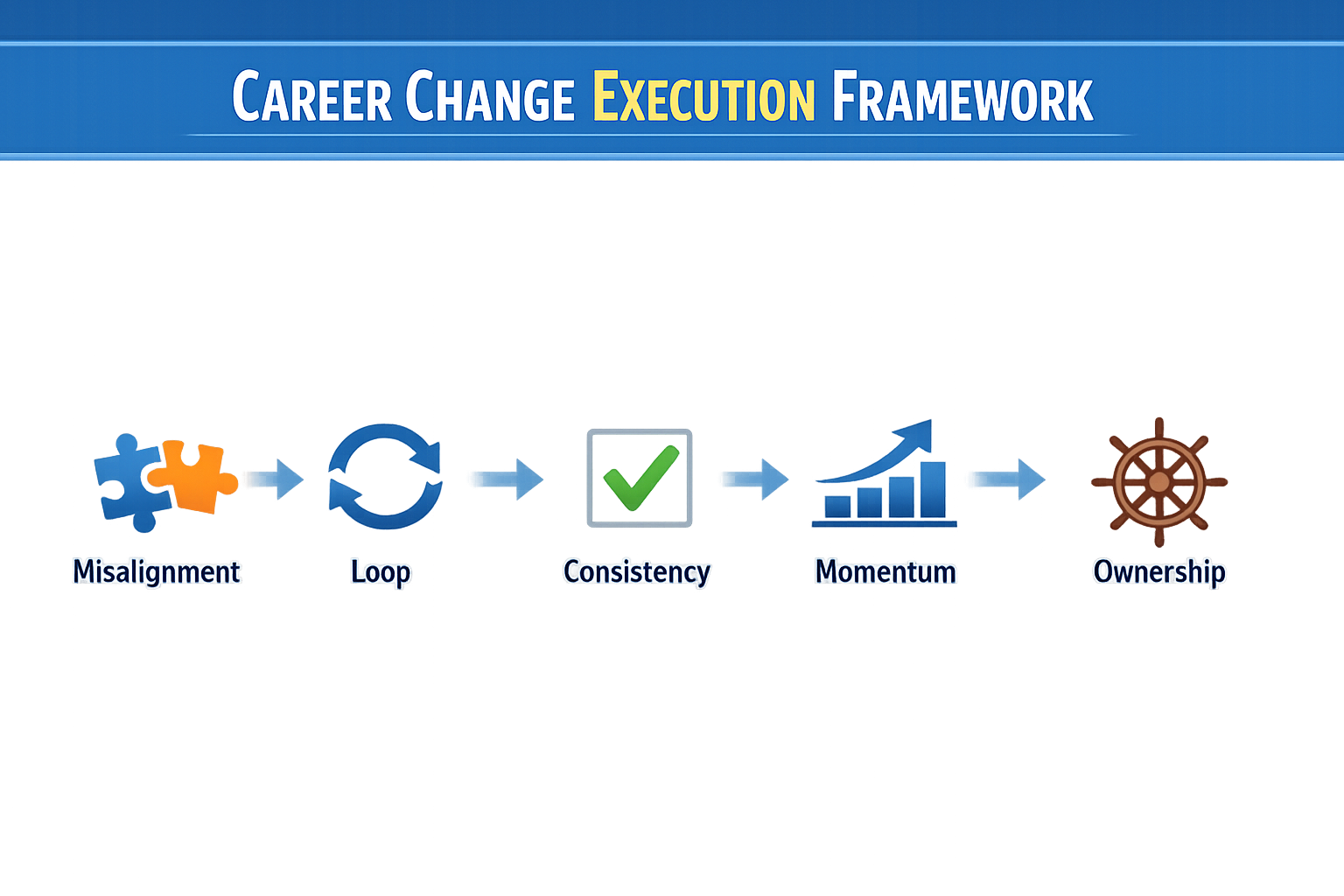
Misalignment (it no longer fits) → Loop (same wall, different day) →
Consistency (unsexy reps) → Momentum (doors start opening) → Ownership (you
steer with standards)
Misalignment at work can put you into a looping state where you’re spending
enormous mental energy trying to “figure it out,” but nothing changes.
Consistency is what breaks the loop.
Consider:
- What pattern keeps repeating at work? (avoidance, overdelivering, conflict avoidance, quitting, overthinking, numbing out)
- Am I in a cycle that’s designed to keep me stuck?
- What feels “costly” now that didn’t before? (energy, health, integrity, relationships, growth)
- What are you unwilling to trade anymore? (evenings, sleep, self-respect, autonomy, time with family)
Outputs:
1) Phase Diagnosis:
“My current pattern is ____. The cost is ____. I’m no longer willing to trade
____. My next phase is ____, and my next 14-day step is ____.”
2) Three non-negotiables (values as behaviors):
Examples:
- “No work after 7:30pm 4 nights/week.”
- “3 hours/week skill-building.”
- “One weekly networking conversation.”
This is Phase Awareness: growth has chapters. You’re not behind. You’re in
curriculum.
--------------------------------------------
STEP 2 — SWITCH FROM “JOB TITLE” TO “CORE ATTRIBUTES” (IDENTITY-BASED MEANING)
If you only focus on job titles, your career change will feel like gambling.
Core attributes make it feel like building.
Most career-change stress comes from over-attaching meaning to a title:
“If I pick the wrong role, I’m stuck.”
Core attributes flip the model:
You become the kind of person who can thrive in many roles.
Your next job becomes a vehicle for growth, contribution, and integrity—not a
lottery ticket for constant passion.
Exercise: “When do I respect myself?”
Career instability can wreck your inner dialogue in a very unkind (and untrue)
way. We’re going to rebuild your career self-image on the strength of your
truths, not your internal critic.
1) Re-meet your earlier self.
Think back to the version of you who first stepped into your current role. From
then until now, list what you’ve accomplished:
- people you helped
- reputation/track record you built
- independence or financial stability you created
- life experiences work made possible
- “I can’t believe I pulled that off” moments
Then answer:
- How would that earlier version of you feel knowing what you’ve achieved?
- Is there anything they set out to do that you didn’t?
- Is there anything left that would matter more than what you’ve already done?
If the last two are mostly “no,” treat that as evidence:
This chapter is complete. You’re not failing—you’re graduating.
Now extract 5–7 core attributes you already embody (or want to embody daily):
reliable, calm, decisive, creative, direct, patient, strategic, courageous,
service-driven, disciplined, curious
Define meaning so you stop chasing a myth:
Meaning = growth + contribution + integrity.
Not constant passion. Not perpetual excitement. Not “I love every second.”
Two-sentence identity statement:
“I’m the kind of person who has embodied [attributes] through my track record.
I choose work that lets me grow, contribute, and act with integrity—even when
it’s uncomfortable.”
This is Identity-Based Meaning: you change your story.
--------------------------------------------
STEP 3 — PICK THE NEXT CONTROLLABLE STEP (SELF-AUTHORSHIP)
Overwhelm usually comes from trying to solve your entire future at once.
Agency comes from choosing one small step that creates new data.
That’s the 80/20 rule:
pick the smallest step that produces information (clarity, feedback, proof, or
a new contact).
Choose one lane for the next 14 days:
1) Skill-building (proof)
Best when you lack confidence or credentials.
Examples: complete one course module, build one portfolio piece, earn one
micro-credential, write one case study from past work.
2) Conversations (insight)
Best when you’re stuck in your head.
Examples: schedule 2 informational interviews, ask 3 people for a “strengths +
blind spots” mirror, attend one meetup.
3) Small experiments (traction)
Best when you need momentum fast.
Examples: apply to 3 roles, pitch one freelance project, volunteer for a
relevant task at your current job, run a “weekend test” project.
Output:
A 14-day micro-plan with calendar blocks:
- Block 30–60 minutes, 3–4 times/week.
- Write the exact action in the block.
(Not “work on career change.” More like “book 1 informational interview.”)
At day 14, review:
What did I learn? What’s the next controllable step?
This is Self-Authorship: you stop negotiating with reality and start choosing
the next step at your feet.
And yes—this is how you begin to Execute a career change without needing to
feel “ready.”
--------------------------------------------
STEP 4 — BUILD A BURNOUT-SAFE OPERATING SYSTEM (EMOTIONAL MATURITY + REPS)
Burnout isn’t a “try harder” problem.
It’s an operating system problem.
If you’ve been high-RPM for years—hyper-driven, vigilant, always proving
something—your nervous system may treat slowing down like danger.
So we build a system that creates progress without self-abandonment.
1) Set an energy budget
Decide what you can spend weekly in:
- Time: how many 30–45 minute blocks?
- Attention: when are you sharpest?
- Emotional load: what triggers dread, irritability, numbness?
2) Minimum viable habits (reps, not inspiration)
- Career Change Block: 30–45 minutes, 3x/week
Rule: one concrete output each block.
- Weekly Closure Ritual: 20 minutes, once/week
Review: what drained vs fueled you?
Plan: next 3 actions.
Reset: if energy is dropping, remove one commitment next week.
3) Protect nights/weekends with simple scripts
- “I can deliver this by Thursday, or we can reprioritize.”
- “I’m offline after 7pm. If urgent, text with the deadline.”
- “I can do A or B this week—what’s most important?”
Outputs:
- Weekly schedule: 3 career-change blocks + 1 closure ritual + 1 recovery block
- “Stop doing” list: after-hours quick tasks, inbox-first mornings, yes-without-boundaries commitments
This is Blue-Collar Spirituality (reps, not revelations) plus Emotional
Maturity (responding vs reacting).
It’s also how you protect your health while you Execute a career change over
weeks and months, not in one desperate sprint.
--------------------------------------------
STEP 5 — BUILD RUNWAY (PRACTICAL INDEPENDENCE)
A career change gets much easier when fear drops.
Runway buys you time. Time lowers pressure. Lower pressure lets you make clean
decisions instead of desperate ones.
Runway math:
1) Monthly baseline expenses (must-pays)
2) Debt minimums (plus interest rates)
3) Healthcare plan (how you’ll stay insured + monthly cost)
4) Emergency buffer target:
- Starter runway: 3 months essential expenses
- Full runway: 6 months if income is variable or you have dependents
5) Time-to-next-income: estimate realistic timeline + buffer
Rule of thumb:
If you don’t meet at least 3 of these 5, delay quitting or line up a bridge
job.
A bridge job for career change can be the cleanest way to protect income while you recover, regain clarity, and keep momentum.
Leverage ladder (in order):
Negotiate → cut expenses → consolidate/refinance → add side income → automate
savings
Output:
A 1-page Runway Plan:
- baseline monthly number
- runway targets
- current savings
- gap + date you’ll hit runway
This is Practical Independence: money as a tool, not a mood.
And yes, runway is often the difference between trying to “feel brave” and
being able to Execute a career change with real options.
--------------------------------------------
STEP 6 — TEST FIXABILITY BEFORE YOU QUIT (RESPONSIBILITY WITHOUT SHAME)
When you’re exhausted, quitting can feel like the cleanest escape hatch.
But here’s the trap: sometimes you’re not escaping the job—you’re escaping a
repeatable pattern.
So before you quit, run a 2–4 week fixability test. This keeps you out of panic
exits and helps you make evidence-based decisions.
First, diagnose the likely cause:
- Environment: manager, workload, culture
- Role fit: miscast, bored, strengths unused
- Life load: sleep debt, health, caregiving
Then run 1–2 reset experiments:
- Real downtime (no Slack-from-a-towel). If dread snaps back instantly, it’s likely environment/role.
- One boundary (one, not ten): meetings, scope, deep work time, no after-hours messaging. Watch the response.
- Internal shift: project swap, change manager, adjust responsibilities, internal transfer.
Decision rule:
If you genuinely run at least one reset test and the core experience doesn’t
improve (same dread, depletion, values conflict), your “timing” signal gets
stronger.
At that point, quitting becomes strategy—not escape.
Output:
Fixability checklist + decision notes:
- Cause:
- Tests run + dates:
- What changed:
- Evidence-based decision:
This is Responsibility Without Shame: ownership over blame.
--------------------------------------------
STEP 7 — CHOOSE A DIRECTION USING EVIDENCE, NOT VIBES (STRATEGIC TRANSITIONS)
The “best” career change isn’t a trendy title.
It’s a role that uses Version 1.0 of you (what you can already do) and trains
Version 2.0 (what you need to become).
Run each option through these filters:
- Aligns with core attributes
- Pays for the life you want
- Has a realistic entry path you can execute
- Has a tolerable downside
Avoid identity whiplash:
if the leap is big, a bridge job for career change stabilizes your nervous system while you build proof and options.
Output:
Shortlist 1–2 target roles + entry strategy per role.
Not sure what roles to target? Best Jobs for Career Change: Choose the Role That Builds Your Identity (Not Just Your Resume)
This is Strategic Transitions: runway + clarity.
--------------------------------------------
STEP 8 — BUILD PROOF (REPUTATION WITH RECEIPTS)
When you change careers, your experience can look misaligned at first
glance—even if you’re fully capable.
Proof fixes that.
Employers don’t hire you because you feel ready.
They hire when they can see evidence you’ll perform.
Proof types:
- portfolio project
- reframed case study from your current job
- certification (only if it’s signal, not procrastination)
- volunteering/freelance pilot
Simple rule:
Receipts > resumes.
Show outcomes, not effort.
Output:
Proof Plan:
- 1 flagship project (2–4 weeks)
- 2 supporting proofs (1–2 weeks each)
This is Reliability and Evidence: reputation with receipts—one of the fastest
ways to Execute a career change without begging the market to “take a chance”
on you.
--------------------------------------------
STEP 9 — UPDATE YOUR STORY + MATERIALS (MEANING + RELIABILITY)
Your career change has to sound like a continuation of your growth—not a
chaotic reset.
The market is listening for:
Meaning (this move makes sense)
Reliability (you’ll follow through)
Use the 3-part story:
1) What I did (credible past)
2) What I’m doing now (bridge + proof)
3) Where I’m going (target + why)
Resume/LinkedIn angle:
Lead with transferable outcomes, not old titles.
Keep it clean. Show up, communicate, leave well.
Output:
- Transition narrative
- Bullet bank: 8–12 accomplishment bullets rewritten in the language of the new role (metrics, scope, outcomes)
Need exact wording? See: Career Objective for Career Change: Write a Resume
Objective That Makes Your Pivot Make Sense for the headline bridge.
This is part of how you make the change legible, so you can Execute a career
change without confusion, mixed signals, or a story that sounds like a panic
pivot.
--------------------------------------------
STEP 10 — EXECUTE A CAREER CHANGE: RUN THE TRANSITION (RESILIENCE AS A SYSTEM)
Now we run it like a system—so your emotions don’t get to be the project manager.
Pipeline (weekly targets):
- Outreach: 5–10 messages to humans
- Applications: 3–7 high-fit applications
- Conversations: 2–4 calls
- Proof-building: 2–3 hours
Rejection protocol (setbacks = tuition):
1) Capture the lesson
2) Adjust one variable
3) Repeat
“When to quit” thresholds:
- Runway threshold met
- Offer quality threshold met
- Health threshold (if symptoms worsen, reduce load or switch to bridge job)
Output:
30/60/90-day sprint + tracking sheet:
Outreach | Applications | Conversations | Proof hours | Lessons | Next
adjustment
This is resilience as a system.
And it’s the difference between “I tried” and “I executed.”
Burnout Proofing The Plan
Burnout
sneaks in when chronic pressure becomes your baseline. When effort stops
refueling you and starts draining you.
Signs you’re executing (not escaping):
- small scheduled actions that create options
- a plan you can state in one sentence
- steadier nervous system week to week
Signs you’re escaping:
- fantasy leaps and panic quitting
- hero weeks followed by crashes
- using change to avoid boundaries/conflict/discomfort
Three non-negotiables:
- sleep/movement basics
- one relationship protected
- one joy practice (small, consistent)
If you’re already burned out: stabilize first (2 weeks)
- name your burnout pattern + triggers
- lower RPM in one low-risk area
- one structural change at work
- weekly energy check-in; if under 6, remove one commitment
This is the “keep the car from exploding while you fix the direction” section.
EXAMPLE
TIMELINES (PICK ONE)
Option
A: 30 days (3–5 hours/week)
Outputs: clarity + starter runway + first proof
Good progress: you stop spiraling, have a cadence, and one visible receipt
Option B: 90 days (5–8 hours/week)
Outputs: shortlist + proof + narrative + pipeline
Good progress: interviews or networking momentum; story feels coherent
Option C: 6–12 months (3–6 hours/week + bridge role)
Outputs: full runway + bridge role + full transition
Good progress: energy stabilizes, savings grows, opportunities compound
FAQ QUICK HITS
Can
I change careers without going back to school?
Yes. Often the fastest path is proof: projects, reframed case studies, and
conversations. School is only worth it when it’s clear signal.
How do I change careers when I’m exhausted?
If you’re exhausted, talk to a medical professional first. Then build a
burnout-safe cadence and stabilize your system before you scale effort.
What if I don’t know what I want?
You don’t need perfect clarity. You need a next step that produces
information—then you course-correct.
Should I quit before I have something lined up?
Usually no, unless you have runway and your health is at risk. Run fixability
tests first so quitting becomes strategy.
How long does it take?
30 days for clarity and initial proof, 90 days for a credible story and
pipeline, 6–12 months for bigger pivots.
How do I explain a career change in interviews?
Use the 3-part story: credible past, bridge and proof now, specific target and
why.
ONE LAST THING (THE REAL POINT)
A
lot of ambitious people want a career change because they want relief.
Less dread.
Less burnout.
More energy.
More alignment.
Totally fair.
But the lasting relief usually comes from something deeper:
You becoming someone you respect again.
Someone with a plan.
Someone who follows through.
Someone who can tolerate discomfort without hitting the eject button.
Someone who makes decisions with numbers and standards, not panic.
Someone who knows how to Execute a career change in a way that’s strategic and
kind to their nervous system.
That’s what we’re building here.
So, back to the question:
Are you trying to escape… or are you trying to build?
If you’re trying to build, your next step is simple:
Pick one lane for the next 14 days.
Put it on the calendar.
Do the rep.
Collect the receipt.
Then do the next rep.
That’s how a new chapter starts.
Less dramatic reinvention.
More strategic follow-through.
Because that’s how you Execute a career change—six months from now, a year from
now, for the rest of your life—like someone who can steer.
Related Posts:
- Should I Quit My Job? How To Decide When It’s Time to Leave or Switch Careers (hub)
- How to Change Your Career (Without Burning Your Life Down): The Identity-Level Shift That Actually Sticks
- Career Objective for Career Change: Write a Resume Objective That Makes Your Pivot Make Sense
- Best Jobs for Career Change: Choose the Role That Builds Your Identity (Not Just Your Resume)
- Bridge Job for Career Change: How to Get Unstuck Without Quitting in Panic
Recent Articles


-
Biggest Change in Life
Dec 31, 25 06:53 PM
 How your career can offer the biggest change in life and why mindset is the hidden barrier
 -
Process of Becoming an Adult
Oct 05, 25 12:18 PM
A practical 5-pillar framework for the process of becoming an adult: build independence, income, resilience, emotional strength, and a reputation you can use. -
Did the results of the last election hurt your industry and career?
May 02, 25 03:20 PM
Career and elections. Some helpful perspective when results seemed to have hurt your career opportunities.