When to Quit Your Job: Timing It
Right Without Blowing Up Your Life
When you’re trying to figure out when to quit your job, the most useful question usually isn’t “Can I quit?”
It’s: “Is it time?”
Because this isn’t just a logistical move. It’s an identity-level shift. It’s you admitting, “The version of me that fit here? They’ve grown out of it.”
And to decide when to quit your job, you’re balancing two very real forces:
1) Your internal signals (the stuff you can’t un-feel)
- Burnout that sleep won’t fix
- Misalignment that makes even “good days” feel heavy
- That subtle identity shrink… where you’re succeeding on paper but getting smaller as a person
2) The external realities (the stuff you can’t ignore)
- Money and runway
- Options, timing, and the state of the market
- Obligations—to family, to debt, to future-you
Here’s the tricky part: when the consequences feel huge, your brain does the most human thing ever—freeze. You stall, you overthink, you wait for certainty to arrive like an email update.
But autonomy doesn’t come from waiting until you feel fearless. It comes from choosing on purpose.
So instead of sliding into “quiet quitting” (emotionally checking out while staying stuck), aim for something more grounded and powerful:
Name what’s true. Measure the risks. Create a plan. Then move with intention—one practical step at a time—toward the life and work that actually fit who you are now.
THE TIMING SIGNALS — when to quit your job (Signs It’s Time)
When those “it’s time” nudges start showing up, it’s usually your subconscious trying to get a message through. And yes—ignoring them tends to make them louder. Like a smoke alarm with feelings.
Here are the most common signals I see. Not as drama. As data.
1) Body + Brain Signals (your nervous system is waving a tiny red flag)
- Sunday night dread (the weekly preview of misery)
- Sleep disruption (can’t fall asleep, can’t stay asleep, wake up already tired)
- Constant fatigue (even after “rest”)
- Work anxiety spikes (tight chest, racing mind, doom-scrolling job boards)
- Cynicism (when “fine” becomes your personality)
2) Role + Values Misalignment (you’re winning, but it feels weirdly hollow)
- Successful but “empty”
- Work values violate personal values (even subtly)
- Disappearing pride in your work
- Identity shrinking (you’re becoming a smaller version of yourself to fit the role)
3) Career Trajectory Signals (the path ahead is a hallway with no doors)
- No lane for growth
- Negative politics (energy leaks everywhere)
- Narrowing future options (your skills are getting boxed in)
Quick self-check:
If 4+ of these are true for you, don’t panic—just take it seriously. That’s your cue to slow down, assess, and run a smarter decision process (like the Quit Readiness Score you’ll do next).
RUN
A RESET TEST (before you confuse burnout with a fixable system)
When
you’re exhausted and disillusioned, quitting can feel like the cleanest escape
hatch.
But here’s the trap: sometimes you’re not escaping a job—you’re escaping a
repeatable pattern.
If you leave without learning what this season was trying to teach you
(boundaries, follow-through, speaking up, tolerating “beginner” discomfort),
you can carry the same pain into the next role… even if the next job looks
shinier on LinkedIn.
Before you declare “It’s time,” separate the possible causes:
a) Environment
A specific manager, workload, team politics, or culture is draining you.
b) Role fit
Your strengths aren’t being used. You’re bored, miscast, or doing work that
fights your natural wiring.
c) Life load
Sleep debt, health issues, caregiving, or chronic stress is making any job feel
unbearable.
Then run a few reset tests for 2–4 weeks—short enough to be doable, long enough
to reveal the truth.
Reset Tests (pick at least one; two is better)
1) Take real downtime
Extended time off if possible, or true mental downtime (not “vacation” where
you answer Slack in a towel).
- If you recover, but dread snaps back instantly when you return: likely environment/role—not just fatigue.
2) Negotiate one boundary (one, not ten)
Choose a single, meaningful boundary:
- Reduce meeting load
- Tighten scope of work
- Protect deep work time over trivial tasks
- No after-hours messaging
Then watch the response.
- Does the system adapt?
- Or does it punish you for acting like a human?
3) Shift internally if you can
Test role fit without the full risk of exit:
- Change projects
- Change manager
- Adjust responsibilities
Decision rule (simple and surprisingly powerful):
If you genuinely run at least one reset test and the core experience doesn’t
improve (same dread, same depletion, same values conflict), your “timing”
signal just got a lot stronger.
At that point, you’re not asking when to quit your job—you’re gathering evidence for when to quit your job with far less regret.
At that point, quitting becomes strategy—not escape.
RISK MANAGEMENT: Runway + Reality Checklist (before you pick a quit date)
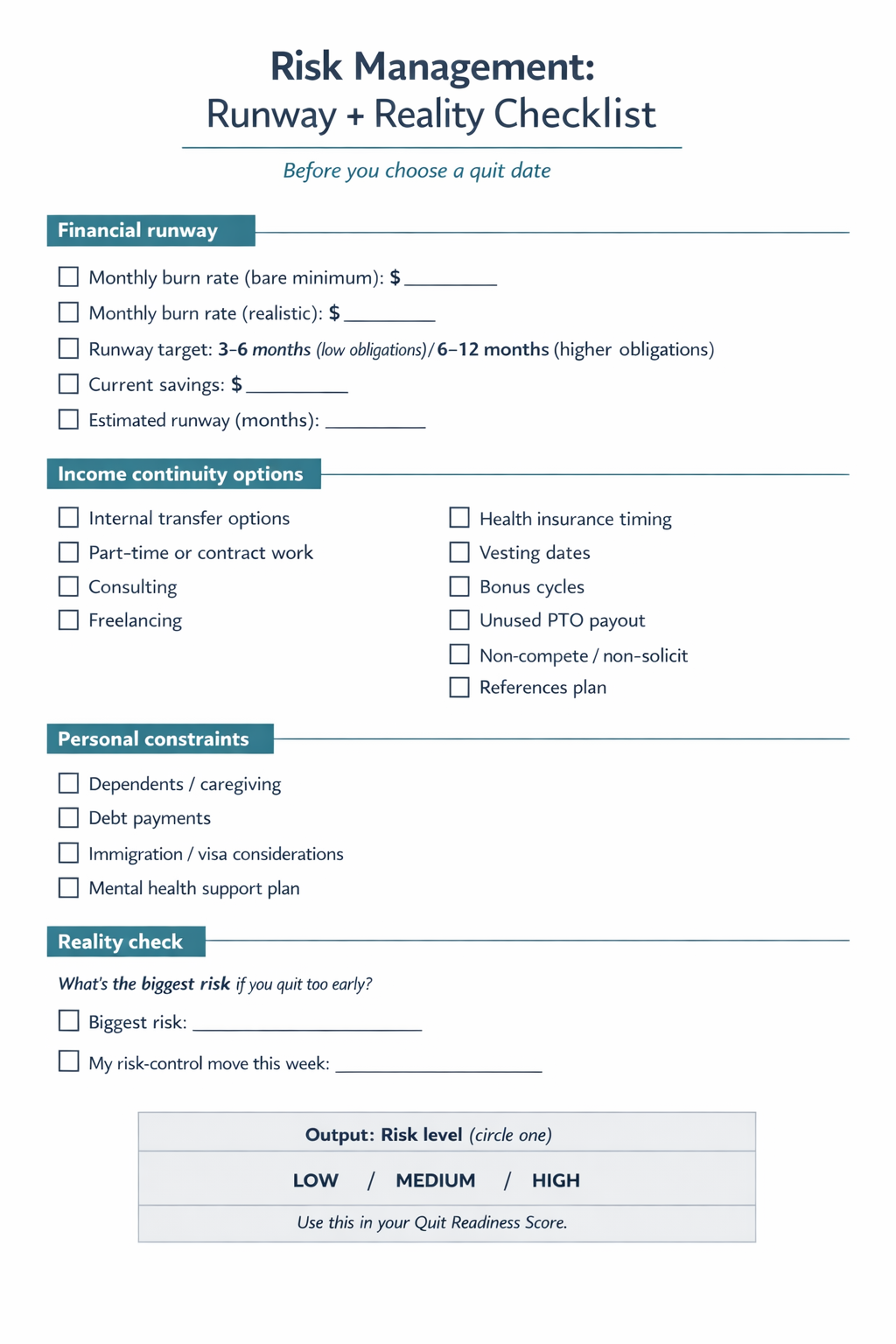
This
is your practical backbone. The calm, grown-up part of the plan.
Financial runway
- Monthly burn rate (bare minimum + realistic)
- Runway target:
- 3–6 months if obligations are low
- 6–12 months if obligations are higher
Income continuity options (bridges count)
- Internal transfer possibilities
- Part-time/contract work
- Consulting/freelancing
- Short-term bridge role
Benefits + administrative risks
- Health insurance timing
- Vesting/RSUs/bonus cycles
- Unused PTO
- Non-compete considerations
- References and relationship cleanup
Personal constraints
- Dependents
- Debt
- Immigration/visa issues
- Mental health support and stability
Output:
Give yourself a simple “risk level” you’ll use in your scoring tool later: low
/ medium / high. This will help offer clarity on knowing when to quit your job.
Pick Your Exit Window (so you don’t get stuck in decision paralysis)
A
good exit isn’t impulsive. It’s well-timed.
Consider:
Work-cycle timing
- After a major deliverable (clean break, less guilt)
- Before burnout becomes medical
- Avoid quitting mid-crisis unless safety/health requires it
Market-cycle timing
- When hiring season peaks for your role/industry (this varies—know yours)
Money-cycle timing
- Bonus vesting dates
- RSU schedules
- Annual benefits resets
Emotional timing
Quit from clarity, not from one awful Tuesday.
If you’re still unsure when to quit your job, this “cycle timing” lens often clears up more confusion than another round of overthinking.
Now — Choose Your Timing Strategy:
Do you want a clean leap (set date, full exit), a calibrated step-down
(internal move, reduced scope), or a bridge plan (contract/consulting while you
search)?
YOUR
3 EXIT PATHS
1) Stay-and-reset (4–8 weeks)
Description: Use this when your path feels “dusty,” but you still have levers
you can pull. You’re not committing to forever—you’re running a focused
experiment to see if the job can fit again.
Do this:
- Boundaries + renegotiation plan: pick one pressure point (hours, meeting load, scope) and reset it in writing.
- Internal move / manager change: shift terrain without blowing up your income—new projects, new team, new reporting line.
- Therapy/doctor support if needed: treat burnout like a real health signal, not a motivation problem.
Performance Indicator: “Is energy returning?” If not, move to Plan-and-exit.
2) Plan-and-exit (30–90 days)
Description: This is the lowest-regret route when the role no longer feeds you
and the system won’t change. You build a bridge while still employed.
Do this:
- Choose a quit date window: pick a realistic range, not a vague someday.
- Build runway + update resume/LinkedIn + quietly network: restore options and reduce fear.
- Start interviewing: not just for offers—also to rebuild confidence and clarity.
Performance Indicator: “Do I have 2–3 realistic next steps?”
3) Exit-now (2–14 days)
Description: Choose this when your job has become confinement with active
harm—health decline, toxicity, unsafe or unethical pressure.
Do this:
- Safety-first exit: protect your nervous system and health now.
- Minimum viable runway + bridge income plan: cut expenses, secure temporary income, ask for support.
- Script for resignation + references strategy: leave clean, keep it simple, protect relationships where possible.
If you’re leaning toward Exit-now but don’t have a new role yet, read: Quitting Before Finding Another Job: The Exit Plan for When Staying Costs More Than Leaving.
The Identity-Level Pivot: What
You’re Leaving For (so
you don’t repeat the same trap)
If
you only leave a job to “get away from” discomfort, you’ll often recreate the
same confinement in a new location. The goal of a smart career pivot isn’t a
shinier title—it’s becoming the version of you who can choose, steer, and grow
on purpose.
1) Separate identity from title
Your job is a context, not a verdict.
Instead of “I am a burnt-out marketer/manager/lawyer,” shift to: “I’m a capable
person whose current environment and patterns are costing me energy.” This
keeps you from chasing meaning as a fantasy “out there,” and focuses you on
building meaning through who you become.
2) Define your non-negotiables for the next chapter
Think “path of freedom,” not perfect mission. Write yours under these headings:
- Values: What must be true for you to respect yourself here? (integrity, learning, autonomy, service, creativity)
- Boundaries: What will you no longer trade for stability? (evenings, weekends, disrespect, constant urgency, unclear scope)
- Problems you want to solve: What work feels worth your effort even when it’s hard? (building systems, leading people, creating, fixing, selling, teaching)
- Energy profile: What kind of work gives energy vs. drains it? (deep work vs. meetings, fast-paced vs. steady, collaborative vs. solo)
3) Build your “Next Role Filter”
Must-haves (pick 3):
1) ____________________
2) ____________________
3) ____________________
Dealbreakers (pick 3):
1) ____________________
2) ____________________
3) ____________________
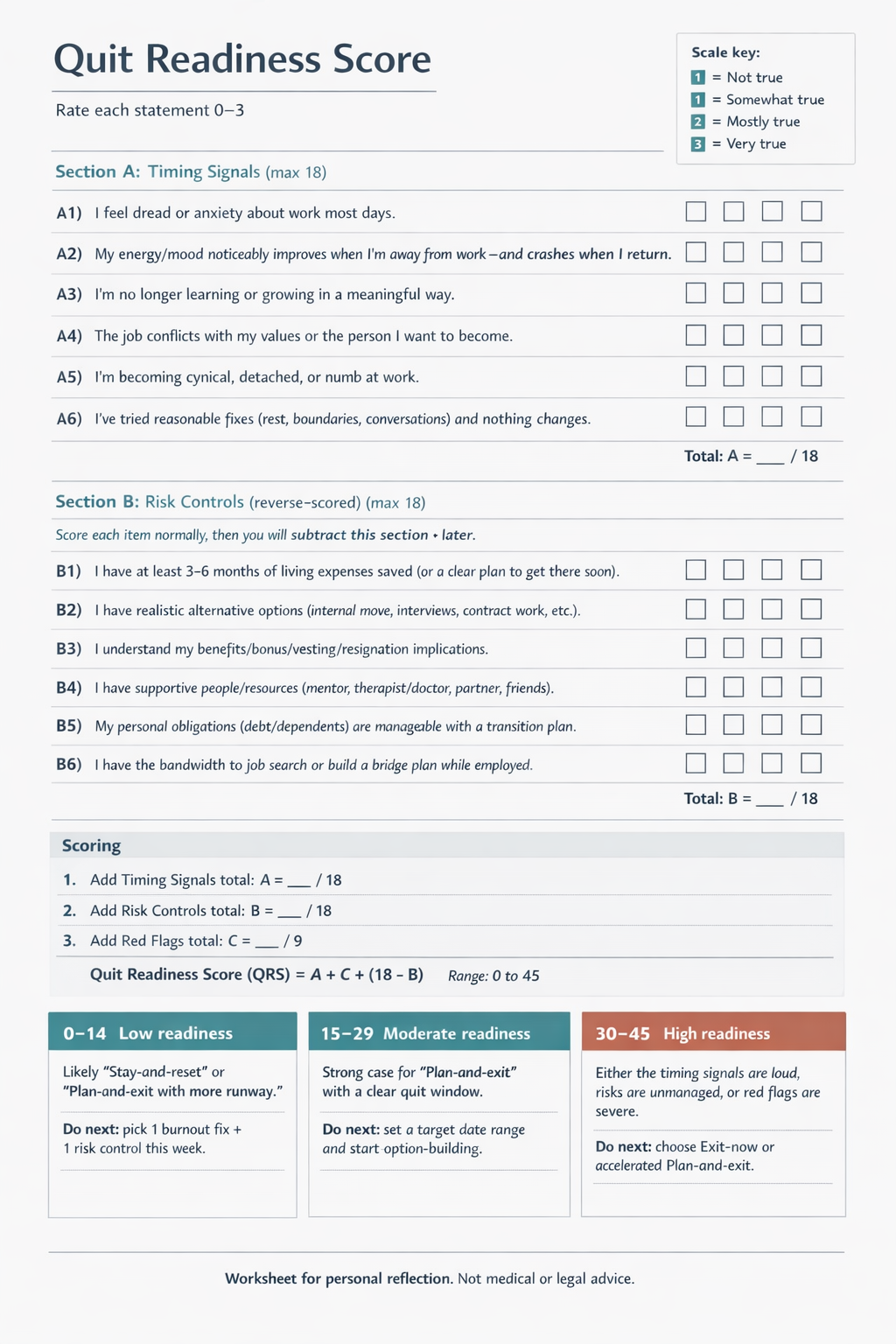
Next: Take your Quit Readiness Score:
Related Posts:
Recent Articles


-
Biggest Change in Life
Dec 31, 25 06:53 PM
 How your career can offer the biggest change in life and why mindset is the hidden barrier
 -
Process of Becoming an Adult
Oct 05, 25 12:18 PM
A practical 5-pillar framework for the process of becoming an adult: build independence, income, resilience, emotional strength, and a reputation you can use. -
Did the results of the last election hurt your industry and career?
May 02, 25 03:20 PM
Career and elections. Some helpful perspective when results seemed to have hurt your career opportunities.