Quitting
Before Finding Another Job: The Exit Plan for When Staying Costs More Than
Leaving
Learn
the hidden cost of staying, the money checks that matter, and a mini-roadmap
for your first 30 days after you quit.
Quitting before you have another job lined up can feel like throwing a Hail Mary pass while blindfolded… during a thunderstorm… with your rent due. And yes—sometimes “quitting before finding another job” feels exactly that intense: equal parts desperation and hope, with a side of nausea.
Now, quitting quitting usually makes sense to do
if…
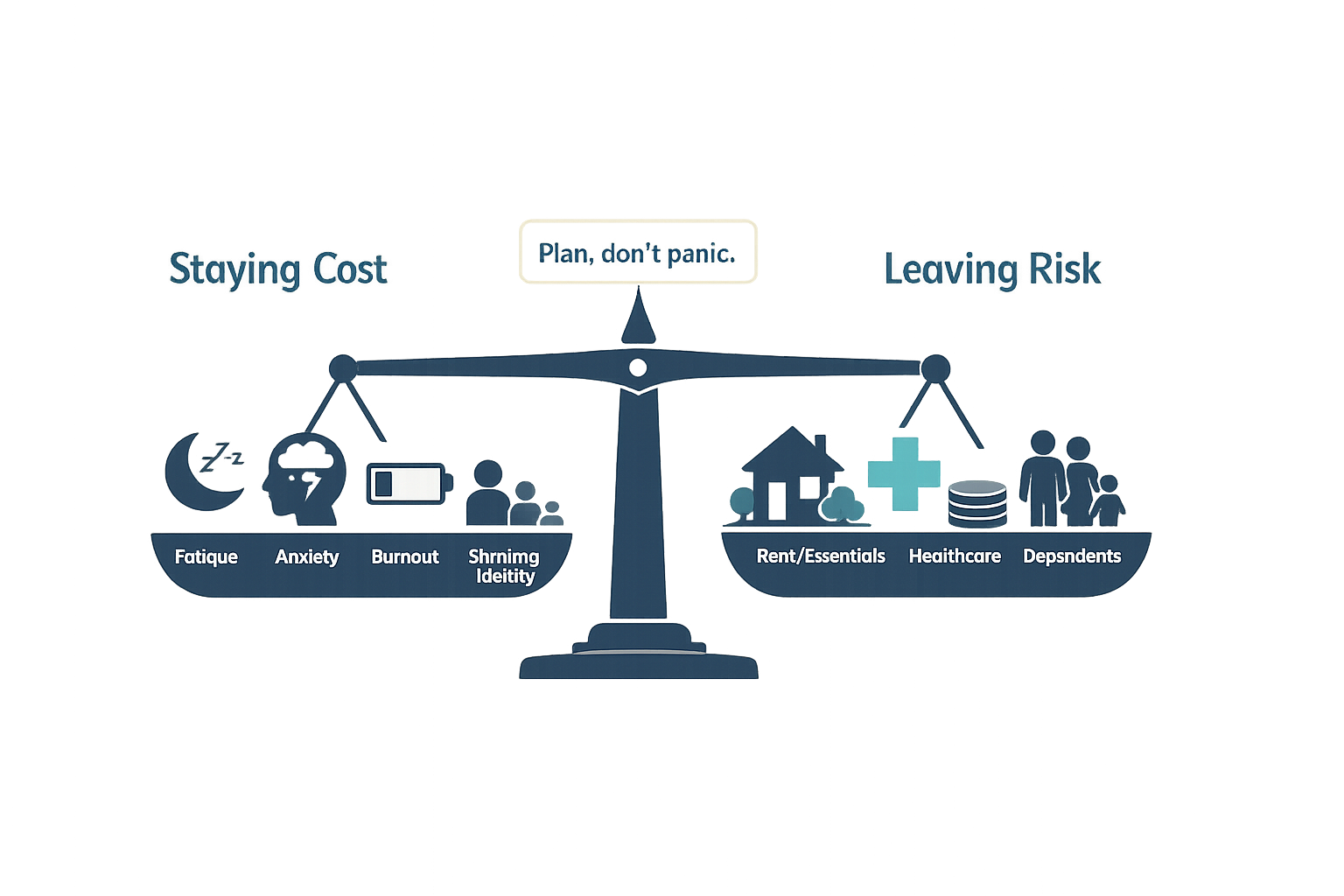
- Your job is actively harming your health (sleep, anxiety, burnout symptoms), and staying is no longer sustainable.
- You have a financial buffer (or a workable support plan) that keeps you safe while you reset and search.
- You’ve tried reasonable interventions (boundaries, conversations, role changes), and the situation still doesn’t improve—distance is the only thing that helps.
But, it’s probably a good idea not to quit yet if…
- Leaving would create a real safety risk (can’t cover essentials, dependents would be impacted, housing/healthcare becomes unstable).
- You can reduce the damage short-term (take leave, set firmer limits, negotiate workload, shift teams) while quietly building options.
- You’re in intense fight-or-flight right now and need a brief pause to think clearly (even a week or two of planning can turn “escape” into a smarter transition).
Quitting a job is always going to be a personal decision with real trade-offs—there
isn’t one “correct” move. The goal is to protect your wellbeing while choosing
the next step you can actually sustain.
The Hidden Cost of Staying Too Long
But, here’s the candid truth: if you’re even considering
doing that, your job probably isn’t just “not ideal.” It’s actively costing you
something—your sleep, your health, your patience, your sense of self. You’re
not being dramatic. You’re getting data.
Usually the thought process looks like this:
“I can’t do this anymore.”
“I need out.”
“I don’t know what’s next.”
“But staying is crushing me.”
That’s not laziness. That’s survival mode.
When you’re in fight-or-flight, your brain does this annoying trick where it
treats every decision like it’s permanent and life-ending. You start thinking
there’s one perfect move, and if you don’t find it, you’ll ruin everything
forever. Options shrink. Guilt grows. Clarity evaporates.
So before we even debate “quit or stay,” let’s name what’s really happening:
This isn’t just a job decision.
This is an identity-level moment.
You’re bumping up against the edge of an old identity:
“I’m the responsible one. I endure. I push through. I don’t risk it.”
And you’re being invited into a new one:
“I protect my life. I choose my future. I build options.”
Now… does that automatically mean you should quitting before finding another job with no plan?
Not necessarily. But it does mean your current situation needs an
intervention—because the cost of staying may be higher than you’re admitting
out loud. And if “quitting before finding another job” is on your mind, your
system is basically waving a giant neon sign that says: “Something has to
change.”
MONEY CHECK (Before You Quit)
- Savings cushion: You have at least 3 months of essential living expenses saved (6 months if your income is usually variable or you have dependents).
- Essential expenses clarity: You’ve listed your true “must-pay” monthly costs (rent/mortgage, utilities, food, insurance, minimum debt payments, transportation, childcare).
- Debt awareness: You know your minimum payments and interest rates, and you’re not relying on new credit cards/loans to cover basics.
- Healthcare plan: You’ve confirmed how you’ll stay insured (COBRA/partner plan/marketplace) and what it will cost monthly.
- Runway math: You’ve estimated a realistic time-to-next-income (job search or business revenue) and your cushion covers that timeline plus a small buffer.
Rule of thumb:
If you don’t meet at least 3 of these 5, delay quitting or line up a bridge job
(part-time, contract, temp, or a “good enough” role) to protect your runway
while you pivot.
Is It Ever Okay to Quit Without Another Job?”
A
case for quitting before you find another job (the uncomfortable argument)
Conventional wisdom says: “Never quit without something lined up.” And for many
people, that’s smart advice.
But there’s another reality that doesn’t get talked about enough:
If you’re the kind of person who always waits until it’s perfectly safe, you
can stay stuck for years—because “perfectly safe” rarely arrives.
Some jobs don’t get better with more strategy.
They get better with distance.
Sometimes the bold move—yes, even a slightly reckless one—shuffles the deck in
a way careful planning never could. It interrupts the loop. It forces a reset.
It creates psychological space to think again.
And honestly? Some people need that clean break to stop negotiating with their
own misery. For them, “quitting before finding another job” isn’t
irresponsibility—it’s the only move that breaks the spell.
Now, let me put on my “responsible coach” hat for a second:
I’m not recommending quitting without a backup plan as a universal best practice.
Consider this a thought experiment—and a permission slip to explore the
possibility without shame.
HOW QUITTING BEFORE FINDING ANOTHER JOB CAN CREATE POSITIVE CHANGE (A Real Example)
When
I stepped away from my previous career in the home maintenance industry, I was
basically quitting before finding another job. I didn't had the next thing neatly lined up.
I didn’t leave because I was brave and glowing with certainty.
I left because I was stuck in career limbo—trying to engineer a fail-proof
transition.
And in trying to eliminate uncertainty, I was procrastinating my own life.
At the time my son was around 6 or 7 months old. I remember looking at him and
realizing something that hit me in the chest:
I wasn’t being the father I wanted to be.
Work unhappiness doesn’t politely stay at work. It leaks. It shows up in your
tone, your energy, your patience. And in that moment I decided: no matter the
consequences, I have to move.
Also—this matters—my situation was unique. I was running a business. If I
stayed, it would keep consuming my time and attention. I knew I wouldn’t truly
commit to a new path while I was still in the old one. I needed a clean slate.
But here’s the important safety note:
I had a financial buffer. Not everyone does.
And you never, ever want to “take a leap” that leads to hunger, homelessness,
or putting your family at risk.
This is where quitting becomes less of a motivational quote and more of a math
problem—especially if you’re seriously considering quitting before finding
another job.
What looks like “failure” might be the start of success
Leaving a job can feel disorienting—even if it was the right decision.
Some people fantasize for years about quitting, then they do it… and instead of
instant freedom they feel weird, tender, foggy, or even panicky. That doesn’t
mean you made the wrong choice. It means you’re human.
Early transition often includes a form of grief:
- grief for the time you spent
- grief for what you hoped it would become
- grief for the identity you wore to survive it
So here’s your assignment in this phase:
Be kind to yourself on purpose.
If you’re prone to low moods (same), don’t interpret emotional turbulence as
proof you “messed up.” Use it as information. Learn what the job taught
you—about your limits, your needs, your values—without falling into the abyss.
The success of a career change is less about whether the transition is
“smooth”…
and more about whether you can handle uncertainty without abandoning yourself.
That’s resilience. That’s the muscle you’re building.
How To Quit Without Just Escaping
Don’t just escape—build toward something
A lot of people quit because they want relief. That makes sense.
But here’s the trap:
If you make choices purely to escape discomfort, you can accidentally trade one
bad situation for another—just with a different job title.
So if you’re planning to quit (or even if you’re staying for now), your power
move is to shift your outlook on work:
A job is what you do because you need money.
A career is what you build intentionally over time because it matches a bigger
vision for your life.
A career can include “meh” jobs along the way—but those jobs are stepping
stones, not dead ends.
If you’re quitting without a backup plan, extend your time horizon.
Stop asking: “What will make me feel better next week?”
Start asking: “What builds the best version of me over the next 2–3 years?”
The you who’s more stable.
More self-respecting.
More capable.
More free.
Your next move doesn’t have to be giant. It just has to be aligned:
- a different work environment
- learning a skill
- further education
- travel and reset
- starting a small business
- taking a “bridge job” while you build something better
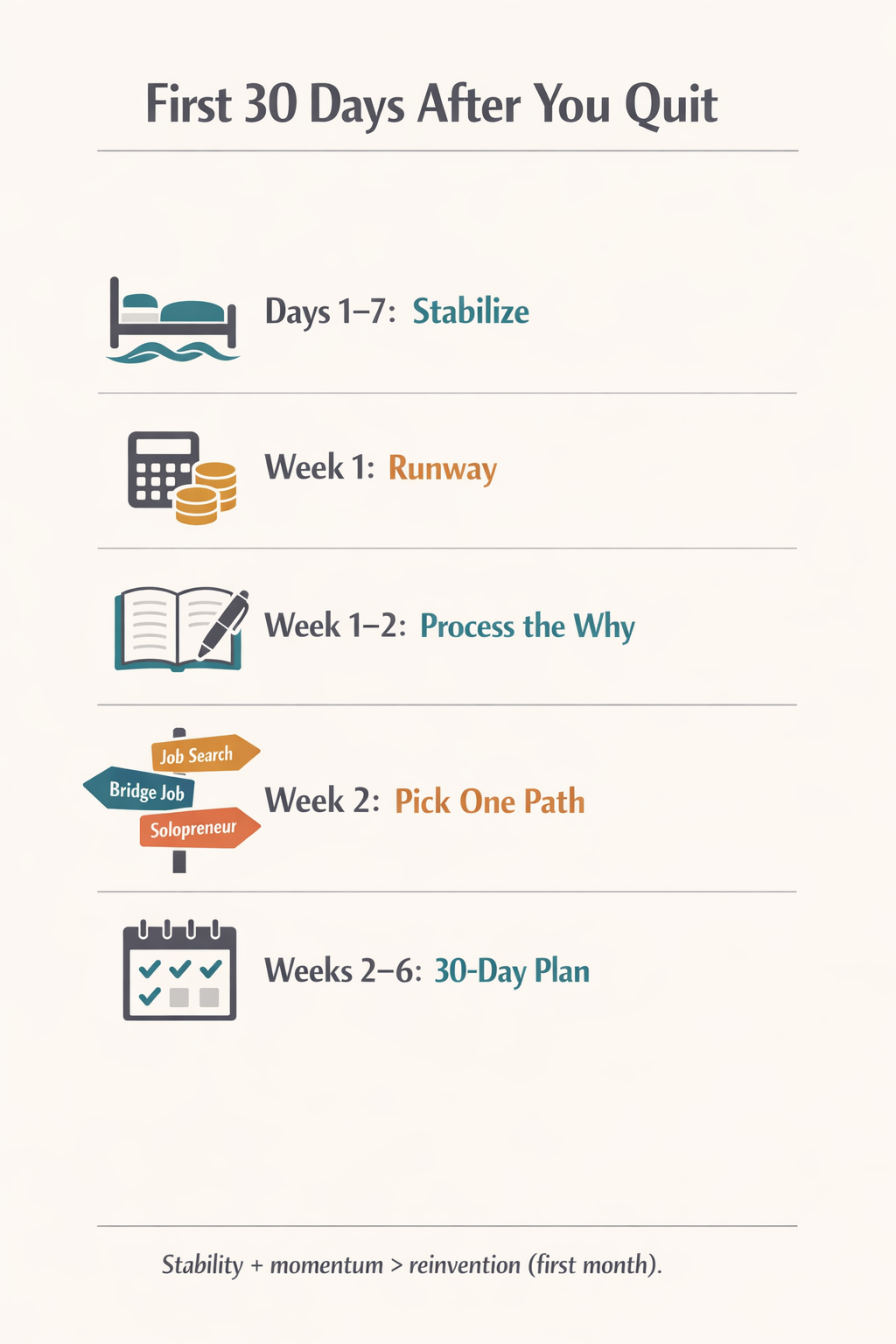
WHAT TO DO AFTER YOU QUIT (Mini Roadmap)
1)
Stabilize (Days 1–7)
- Decompress on purpose: sleep, move your body, eat real meals. Your nervous system needs a reset before you make big calls.
- Set a simple daily structure: wake time, 1–2 focused blocks, and a hard stop so your days don’t dissolve.
- Close the loop: return equipment, confirm final pay/benefits, document anything you might need later (contacts, achievements, logins you’re allowed to keep).
2) Get Your Runway Under Control (Week 1)
- Make a “bare-bones budget” and pick a weekly spending cap.
- Pause or reduce what you can (subscriptions, optional services, renegotiate bills).
- Choose your safety lever now: bridge job, freelance/contract work, or “sell something fast” (unused items, a simple service, etc.).
3) Process the Why (Week 1–2)
- Write down what the job taught you: what drained you, what energized you, and what you will not tolerate again.
- Define your non-negotiables for the next role (hours, manager style, remote/in-person, type of work, minimum pay).
4) Pick One Primary Path (Week 2)
Choose ONE as your main lane for the next 30 days:
- Job search lane (highest stability)
- Bridge job + rebuild lane (stability + space)
- Solopreneur lane (build a simple offer and start selling)
5) Build a 30-Day Plan (Weeks 2–6)
If you’re job searching:
- Update resume + LinkedIn, create 2–3 role targets, and set a weekly application + networking quota.
- Prepare 5–7 stories (wins, conflict, leadership, learning) for interviews.
If you’re building a solopreneur pivot:
- Pick a tiny, sellable offer you can deliver in 1–2 weeks (audit, setup, coaching session, done-for-you package).
- Identify your simplest audience (people you can reach now: former coworkers, local businesses, online communities).
- Do daily outreach: 5–10 conversations/day > perfect branding.
- Create one “proof asset” each week (case study, before/after, testimonial, short how-to post).
6) Rebuild Confidence with Small Wins (Ongoing)
- Track output, not mood: 1–3 measurable actions per day.
- Keep a “wins log” so your brain doesn’t rewrite the story as “I’m failing.”
7) Review and Adjust (Every Friday)
- Ask: What created momentum? What drained me? What moved money closer?
- Decide: double down, pivot, or add a bridge job if the runway is shrinking.
Simple guiding rule:
For the first month, prioritize stability + momentum over reinvention. Your job
now is to restore capacity, then build options.
Summary (the grounded, no-fluff version)
- If you’re considering quitting without another job lined up, your system is likely screaming for change.
- Quitting can be a powerful reset—but don’t ignore basic financial reality and safety.
- Expect emotional turbulence after you leave; it’s normal and it’s not proof of failure.
- Don’t just escape your old job—build toward a meaningful career vision.
- Your next step doesn’t have to be perfect. It has to be forward.
Related Posts
Recent Articles


-
Biggest Change in Life
Dec 31, 25 06:53 PM
 How your career can offer the biggest change in life and why mindset is the hidden barrier
 -
Process of Becoming an Adult
Oct 05, 25 12:18 PM
A practical 5-pillar framework for the process of becoming an adult: build independence, income, resilience, emotional strength, and a reputation you can use. -
Did the results of the last election hurt your industry and career?
May 02, 25 03:20 PM
Career and elections. Some helpful perspective when results seemed to have hurt your career opportunities.