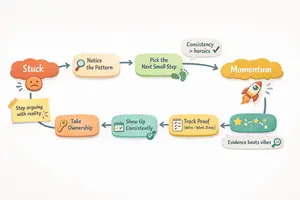
Values Misalignment at work: Signs
It’s Time to Change (and What to Do Next)
When Your Job Isn’t “Bad”… You’ve Just Outgrown the
Version of You It Requires
Let’s talk about the sneaky, slow-burn problem that keeps ambitious people
stuck: values misalignment at work.
When most people hear “values misalignment,” they picture a clear moral
mismatch: the company’s shady, leadership’s sketchy, profits over people,
someone is using “integrity” as a decorative word on a poster. And
yes—sometimes that’s exactly what’s happening.
But the most common form of values misalignment at work isn’t you versus the
company’s mission statement.
It’s you versus you.
It’s the quiet, internal conflict that sounds like:
“The person I have to be to succeed here is not the person I want to be to feel
happy, fulfilled, and motivated.”
That’s not drama. That’s not entitlement. That’s information.
If you’re good at adapting, pushing and making
it work, it’s easy to miss what’s going on.
Here’s the reframe I want you to hold as we go:
A career change isn’t just a logistics change. It’s you deciding who you are
willing to become—and who you’re no longer available to be.
And when you understand values misalignment at work through that lens, you stop
treating your career dissatisfaction like a personal weakness and start
treating it like a strategic signal.
Values Misalignment At Work (How it Happens)
Your life evolves. Your responsibilities evolve. And what you want from work
evolves right along with it.
Think about who you were when you entered the workforce. You might’ve been
optimizing for:
- Proof (to yourself or someone else)
- Independence (money, stability, “I can handle life”)
- Skill-building (learning fast, absorbing everything)
- Opportunity (a brand name, a stepping stone, a network)
- Identity (being the impressive one, the capable one, the reliable one)
Back then, you might’ve been totally willing—even energized—to work 12-hour
shifts. Maybe you were paying off debt. Maybe you were hungry. Maybe you were
fueled by momentum and adrenaline and the thrill of becoming someone.
And now? If you’re in your 30s, 40s, 50s (or beyond), life likely has more
moving parts:
- a spouse, kids, aging parents
- a mortgage, responsibilities, real financial constraints
- a body that has opinions about sleep deprivation
- a desire for flexibility, agency, and time that’s actually yours
None of that means you’ve become “soft.” It means you’ve become real.
The friction happens when your values shift—but your work context stays static.
And it’s rarely a sudden, cinematic moment. It’s usually gradual. So gradual
that you don’t notice it as it’s happening. You just feel a low-grade pressure
building over months or years.
Then one day you realize you’ve been living with values misalignment at work
for a long time—you just didn’t have the language for it. You thought you were
“just stressed.” Or “in a funk.” Or “needing a vacation.”
But the deeper truth is: the role is asking you to keep being a version of
yourself you’ve outgrown. This leads to values misalignment at work.
SIGNS YOUR JOB ISN’T ALIGNED WITH YOUR VALUES
You
might not be able to explain what’s wrong in a neat little sentence. Most
people can’t. That’s normal.
But you can always feel it.
Here are common signals your job is no longer aligned with your values
(especially the internal kind—the “who I’m becoming” kind):
- Chronic stress that doesn’t resolve, even when you’re doing everything “right”
- Burnout, or burnout-adjacent symptoms (exhaustion, cynicism, numbness)
- Depleted motivation (you used to be ambitious; now you’re bargaining with yourself to open your laptop)
- Feeling on edge or irritable—especially with people you normally like
- The Sunday Scaries (also known as: “why does my stomach hate my calendar?”)
- Seeking escape: daydreaming about quitting, scrolling job boards like therapy, fantasizing about a cabin in the woods
- Feeling checked out or emotionally flat at work
- Fixating on “Where did it go wrong?” or “Why can’t I make this work anymore?”
- Making repeated, futile attempts to fix it (new systems, new routines, more hustle) with zero lasting relief
- Work feels chronically heavy and uphill, even when you’re objectively competent
This is often the moment people start questioning themselves:
“Is it me?”
“Am I just ungrateful?”
“Do I need to be more resilient?”
“Is this just adulthood?”
Sometimes it is you—in the sense that you might need better boundaries, better
recovery, better self-leadership.
But sometimes it’s values misalignment at work. And if that’s the root issue,
you can “optimize” all day long and still feel like you’re swimming upstream.
WHEN CHRONIC STRESS IS A MISALIGNMENT SIGNAL
Let’s
be honest: “I’m stressed” can seem like greeting now.
If you mention stress casually, most people respond like you just said you’re
human.
“Yeah, same.”
“Welcome to the club.”
“Just push through.”
But not all stress is the same.
There’s stress that’s clean:
You take on a challenge. It stretches you. You learn. You finish. You recover.
You feel accomplished. You can see the point of it.
That kind of stress is like lifting weights. It’s effort with adaptation.
Then there’s chronic stress—the looping kind:
- There’s no finish line.
- The workload regenerates like a villain in a superhero movie.
- You’re in fight-or-flight: frantic exertion → exhaustion → burnout → escape → repeat.
- Even when you “win,” you don’t feel proud. You feel relieved it’s over.
This kind of stress isn’t about hard work. It’s about being trapped in a system
(external or internal) that doesn’t allow resolution.
And that’s why chronic stress can be a signal of values misalignment at work.
It’s your body telling you: “This isn’t sustainable. And it’s not just a
scheduling problem.”
Here’s the key: if there’s no feasible resolution inside the current setup,
then managing the stress becomes survival—not growth.
And survival mode is a terrible place to make career decisions from.
So the goal isn’t to panic-quit. The goal is to create a fresh set of
options—so your nervous system can exhale and your brain can do what it does
best: think strategically.
GROWTH
CEILING VS. GROWTH PATH
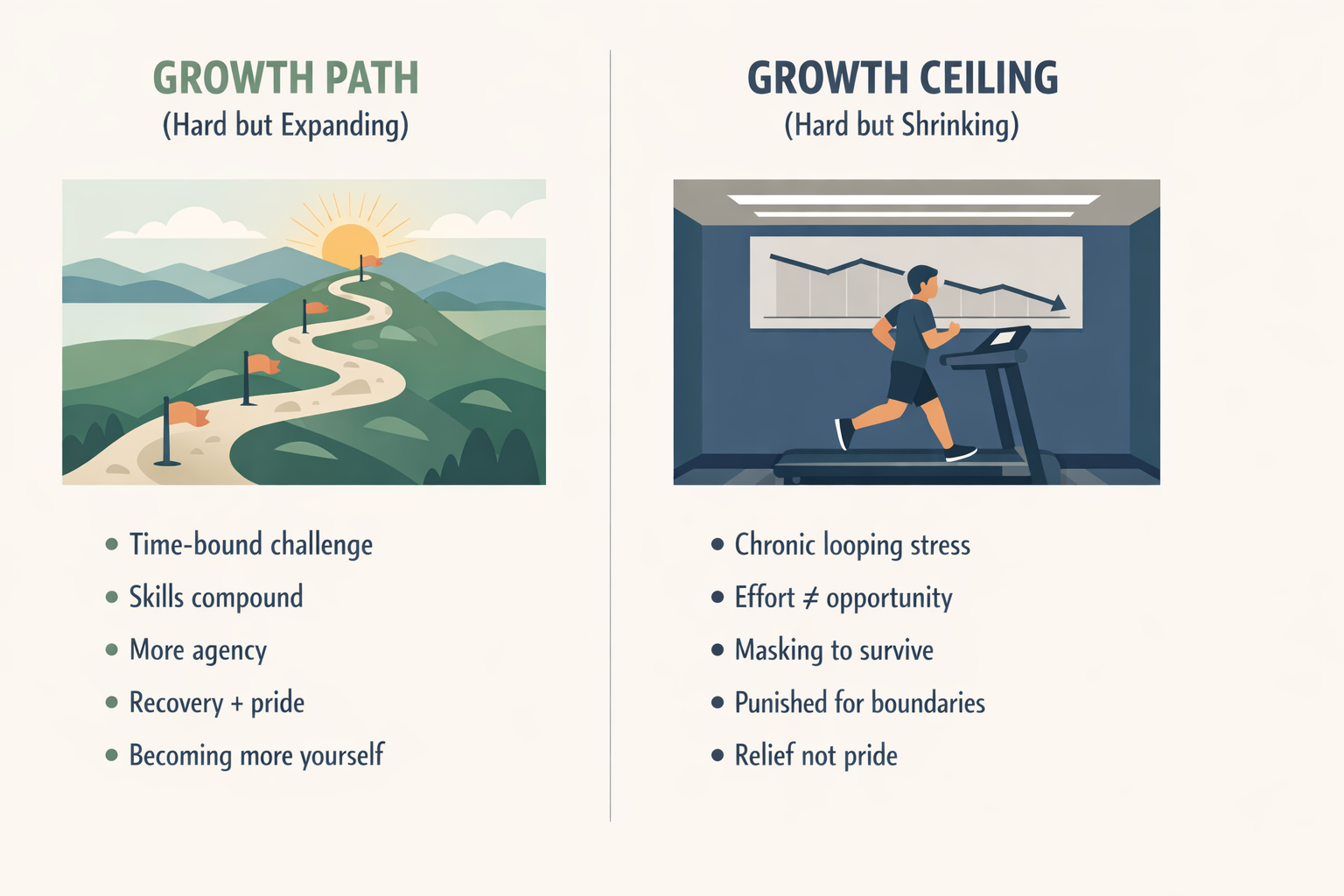
This
is one of the most clarifying frames you can use:
A growth path is “hard but expanding.”
A growth ceiling is “hard but shrinking.”
The difference isn’t whether the job is challenging. Both are challenging.
The difference is what the challenge is turning you into.
Here’s the identity-level question:
Is the person you must become to succeed here someone you want to become?
If yes, you might be on a growth path—even if it’s uncomfortable.
If no, you might be hitting a growth ceiling—no matter how many promotions you
chase.
How to recognize a Growth Path (difficult but the right kind of difficult)
- The challenge is specific and time-bound (a project, a learning curve, a season)
- You’re tired, but not hollow; you recover and feel stronger
- Your competence compounds (you can track your progress)
- You have increasing agency (more say, more autonomy, more influence)
- Feedback is usable; you can act on it and improve
- You’re becoming more of yourself: clearer, braver, more capable, more aligned
- Stress leads to resolution: milestones, mastery, tangible wins
How to recognize a Growth Ceiling (hard and wrong)
- The stress is chronic and pattern-based (same issues, different week)
- Effort doesn’t convert into opportunity (no meaningful growth, no new options)
- You’re forced to perform a version of yourself that feels false (masking, appeasing, political games)
- You’re punished for healthy behavior (boundaries, honesty, rest)
- The role narrows you over time: less creativity, less integrity, less energy
- You’re coping more than building (survival strategies, avoidance, numbness)
- Even wins feel empty—you’re not proud, just relieved
Now, here’s where ambitious people get stuck. It’s the “character-building”
trap.
You convince yourself:
“If I can just become tougher / better / more disciplined, I’ll finally unlock
the opportunities.”
But you look back and realize the opportunities never came. So you double down.
And then you blame yourself for not being the “right kind” of person.
This is especially common when values misalignment at work is subtle—when the
job isn’t objectively terrible. It just keeps demanding you become someone you
don’t respect.
Also: roles aren’t pure ceiling or pure path. They’re usually a mix. But if
it’s 85% ceiling, don’t let the 15% path keep you stuck. That’s like staying in
a sinking boat because one corner is still dry.
THE “SELF-LED” TEST: Choose it again or choose closure
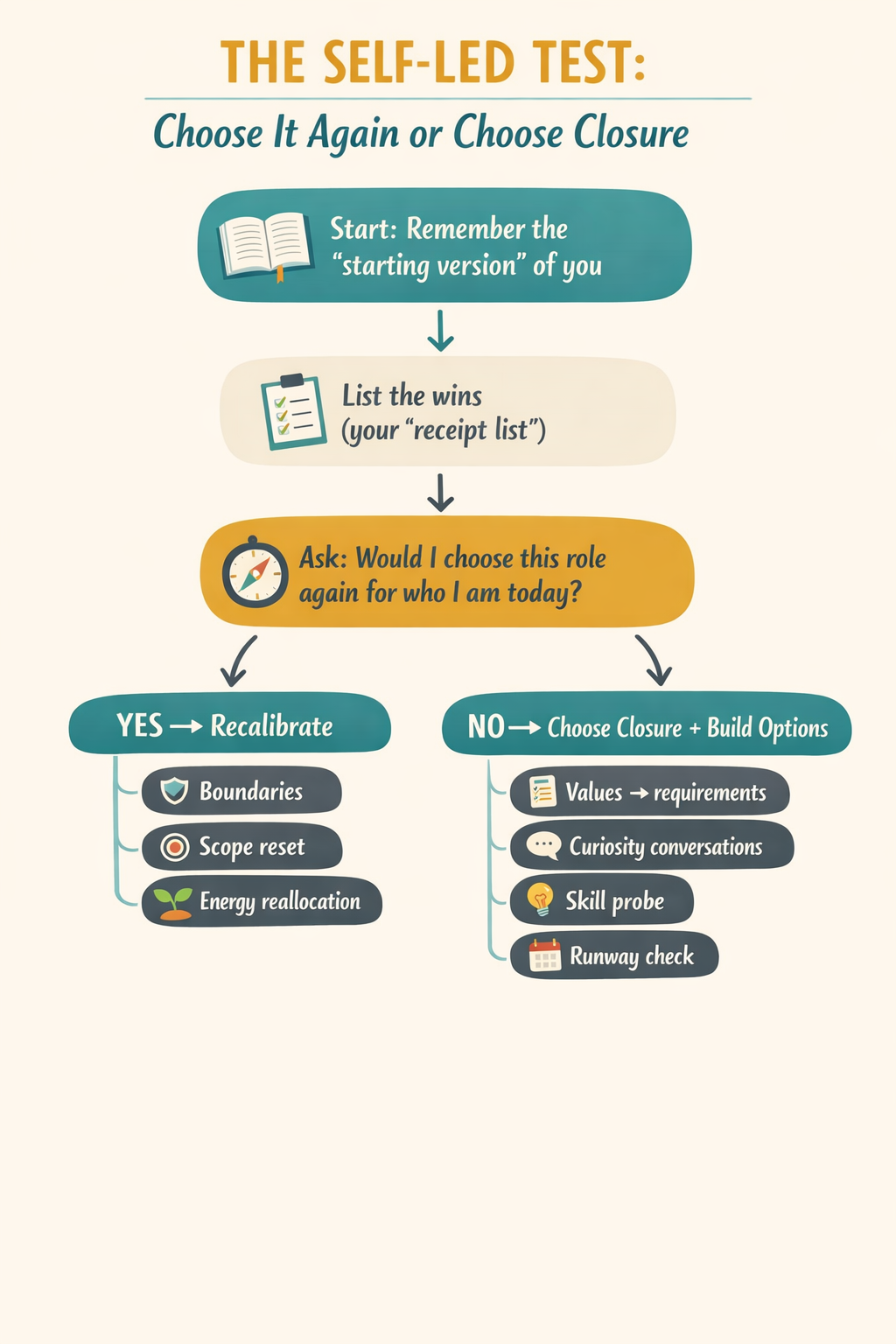
When you’re ambitious, you can make almost anything “work”
through sheer effort. You can adapt, tolerate, perform, and push. That’s a
strength—but it can also keep you stuck in roles that only function if you
abandon yourself.
The self-led test is designed to cut through the noise and get you back into
agency.
Step 1: Return to the “starting version” of you
Bring to mind the earlier version of you who first stepped into your current role.
Picture:
- What you wanted then
- What you needed then (security, confidence, experience, stability, credibility)
- What you were willing to trade (time, energy, comfort) to get it
Write: “Back then, I was optimizing for: ________.”
Step 2: Name what this chapter gave you (evidence of success)
From that starting point until now, what did this role/career make possible?
Consider:
- The people you helped / problems you solved
- The reputation, track record, and credibility you built
- The skills you now have because you did this work
- The independence and financial freedom you created
- The life outside of work this role afforded (family, experiences, stability, community)
- How far you’ve come from what once felt out of reach
- Any strengths you developed (discipline, leadership, resilience, communication, systems thinking)
Write it as a “receipt list” of wins:
“Because of this chapter, I now have: ________.”
Step 3: The Self-Led Closure Questions
Answer these in writing (don’t overthink—let the honest answer land).
1) How would that earlier version of you feel knowing what you’ve achieved?
(Examples: proud, relieved, amazed, grateful, safe, validated, surprised.)
2) Looking at what you’ve accomplished, what were you truly trying to prove or
build back then—and did you build it?
Be specific. (Security? Confidence? Capability? A certain income? Respect?
Freedom?)
3) Is there anything that earlier version of you set out to achieve here that
you did not complete?
If yes: What is it? Is it still meaningful now—or is it just unfinished out of
habit?
4) If you stayed in this role for 2 more years and did “more of the same,”
would that growth still matter to you?
Or would it mostly be maintaining, tolerating, and repeating?
5) Is there something new you want now that this role is no longer designed to
give you?
(Examples: autonomy, creativity, health, more time, values-aligned leadership,
a different pace, deeper meaning, learning, reinvention.)
Step 4: The “Would You Choose It Again?” Reframe (with closure)
Now ask the self-led question in a way that honors the chapter:
“Knowing what I know now, would I choose this role again for the version of me
I am today?”
Answer in one sentence, then add:
- “It was the right choice because ________.”
- “It’s complete now because ________.”
- “The chapter I’m ready for next is ________.”
How to interpret your answers (without self-judgment)
If you answered “Yes, I’d choose it again”:
This may still be a growth path—your next move might be recalibration (scope,
boundaries, team, role design), not reinvention.
If you answered “No, but I’m grateful”:
That’s the signature of positive closure.
It means:
- The role did its job in your life.
- You extracted the value.
- You became who you needed to become here.
And now continuing isn’t “loyalty” or “resilience”—it’s postponing the next
chapter.
If you answered “No, and I feel resentment/emptiness”:
That’s not failure either—it’s information.
It suggests misalignment is costing you more than you’re getting back, and you
may need a cleaner break plus a grounded plan.
Closing statement (write this as your final line)
“This chapter was successful. It doesn’t need to continue for this to be true.”
GROUNDED NEXT STEPS BEFORE YOU QUIT (Small Experiments)
When you’re misaligned, it’s tempting to quit for fast
relief. But relief isn’t the same as direction. Before you make a big move, run
small experiments that (1) lower fight-or-flight so you can think clearly, and
(2) generate real data about whether you need a recalibration or a new chapter.
1) The Misalignment Map (10 minutes)
List: what drains you, what energizes you, what violates your values. Pick ONE
drain to reduce by 10–20% for two weeks.
2) The Boundary Test (14 days)
Choose one boundary (after-hours cutoff, meeting-free block, “24-hour response”
rule, protected lunch). If stress drops and agency rises, you may be able to
recalibrate. If you’re punished or nothing changes, that’s ceiling data.
3) The Scope Reset Conversation (one meeting)
Ask for a 30-day pilot change: swap responsibilities, adjust
priorities/metrics, shift projects, reduce on-call. Frame it as sustainability
and performance, not complaints.
4) Energy Reallocation Sprint (2 weeks)
Move your best work to your best energy window. Batch shallow tasks.
Cut/shorten one meeting. Say no to one extra request per week. Notice if you
feel more like yourself—or still trapped.
5) Values → Requirements
Turn values into concrete job needs (e.g., “growth” = quarterly learning +
autonomy + feedback). Write 3 non-negotiables and 5 preferences for your next
role.
6) Curiosity Circuit (3 conversations)
Do 2 informational interviews + 1 talk with someone who switched fields. After
each, rate interest/energy/values-fit (1–10).
7) Skill Probe (one micro-project)
In 2–10 hours, test a skill/direction (mini portfolio piece, course module
applied, small case study). Did it expand you or drain you?
8) Financial Runway Check
Know your monthly baseline and runway. Take one small “runway builder” step
(auto-save, debt plan, transition fund target).
After 2–4 weeks: if small changes restore agency, recalibrate. If not, build a
transition plan while you still have stability and choice.
If you’re ready to build a real plan (without panic-quitting), read: I need a career change.
Related Posts:
Recent Articles


-
Biggest Change in Life
Dec 31, 25 06:53 PM
 How your career can offer the biggest change in life and why mindset is the hidden barrier
 -
Process of Becoming an Adult
Oct 05, 25 12:18 PM
A practical 5-pillar framework for the process of becoming an adult: build independence, income, resilience, emotional strength, and a reputation you can use. -
Did the results of the last election hurt your industry and career?
May 02, 25 03:20 PM
Career and elections. Some helpful perspective when results seemed to have hurt your career opportunities.