"I Need a Career Change”—How to Tell
When You’re Not in the Wrong Job, You’ve Outgrown the Old You
The next steps to
choose alignment without panic-quitting

When “I need a career change” isn’t about boredom — it’s about outgrowing the old you
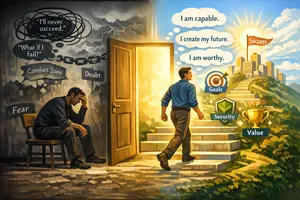
When the thought “I need a career change” starts looping in your head, it’s usually not because you’re bored. It’s because something deeper is tapping you on the shoulder (okay, sometimes it’s tapping you with a frying pan) and saying: “This isn’t who you are anymore.”
A career change isn’t just a job swap. It’s not trading one calendar-full-of-meetings for another calendar-full-of-meetings and hoping you magically feel better.
This is why a real transition has to be bigger than the job title. It’s an identity-level pivot. A “new way of being” moment. The kind where you stop negotiating with your own misery and decide, calmly but firmly: enough.
Why It Feels So Heavy (and Why You Still Can’t Move)
Because let’s be honest—this kind of stuck doesn’t feel like a mild inconvenience.
It feels like dragging an emotional boat anchor around all day. Your work leaks into your evenings. Your patience gets shorter. You’re more irritable than you want to be. Some days you’re fine, and other days you’re one weird email away from staring at the wall and reconsidering every life choice you’ve ever made.
And the worst part? You can want out with your whole heart and still feel unable to move.
You tell yourself, “I need a job change,” and then immediately follow it with, “But how? And when? And what if I blow up my life?”
So you stay. You overthink. You keep trying to “make it work.” You push the discomfort down and attempt to out-discipline the misalignment.
That’s not a character flaw. That’s a very human response to stress, uncertainty, responsibility, and the fear of making the wrong move.
But here’s the thing: suffering louder doesn’t create a plan.
Saying “I need a career change” on repeat—without shifting your mindset and your strategy—just turns into a mental hamster wheel. Exhausting. Impressive cardio. Zero forward progress.
A little perspective (and yes, it matters)
There’s a career myth that you’re supposed to pick a destination and then arrive there like a motivational poster: Successful Person Achieves Final Form.
Real life doesn’t work like that.
Career Changes Happen in Phases (Not Final Forms)
Careers move in phases. Your needs change. Your values mature. Your responsibilities evolve. A job that fit you perfectly in one season can become painfully wrong in the next—and that doesn’t mean you failed. It means you’re growing.
I’ve lived this.
In my early adult years, I ran a window cleaning and home services business. At
the time, it fit. It gave me freedom. It gave me pride. It made me feel capable
and energized. It was humble, but it was mine.
Then life shifted—more responsibility, a mortgage, bigger goals, a different
definition of stability. And slowly, the work stopped matching the life I was
building.
I didn’t notice right away (because I was busy being responsible and tough and
“fine”). I tried to fix it by working harder. I doubled down. I forced it.
Ironically, that’s when I lost touch with the best part of me—the visionary,
steady, “bulletproof” version who can handle challenges without being tossed
around by emotion every five minutes.
And this is a big clue:
When your work is misaligned long enough, it doesn’t just drain your energy.
It messes with your identity.
Signs it’s time (and why it takes so long)
Nobody wakes up one random Tuesday and calmly decides to reinvent their
professional life before lunch.
This realization usually comes after weeks, months, or years of oscillating
between:
“I can make this work.”
and
“I am so done. I need a job change.”
If you’ve been in a role for a long time—especially one you’ve built your
identity around—there’s emotion attached. Leaving can feel like walking away
from a version of you that used to be proud, capable, and certain.
So if part of you is resisting the change, that’s not weird. That’s normal.
But it’s also not a reason to stay stuck.
Why you feel stuck (the part no one puts on LinkedIn)
Here’s the core problem: the mindset you’re in when you’re desperate, angry,
hopeless, and tapped out… is not the mindset that makes smart decisions.
When you’re deep in fight-or-flight, your brain is scanning for threats, not
possibilities. You’re not brainstorming. You’re surviving.
So you say “I need a career change,” but your nervous system hears: “Danger!
Uncertainty! Risk!”
And then you freeze.
The goal isn’t to “be less emotional.”
The goal is to get grounded enough that your best self is back in the driver’s
seat.
MINI
SELF-ASSESSMENT: SPOT THE MISALIGNMENT + CLARIFY WHAT YOU WANT
Grab
a notebook. Give yourself 15 minutes. Answer honestly.
1) Where am I most misaligned right now?
Work itself, culture, hours, growth, mission, pay, leadership, stress level, or
my role identity?
2) What are my top 3 “energy leaks” at work?
Be specific: tasks, meetings, people dynamics, unclear expectations, constant
urgency, lack of control, etc.
3) When do I feel most capable and switched on?
What am I doing? What skill is showing up?
4) What do I want my work to make possible in my life?
Freedom, stability, creativity, contribution, family time, health, mastery,
leadership, flexibility?
5) Which values am I no longer willing to bargain with?
Integrity, autonomy, growth, simplicity, excellence, service, fairness,
creativity, etc.
6) What version of “success” am I chasing that isn’t actually mine?
Whose expectations are you still trying to satisfy?
7) If I could redesign my ideal workweek, what would change?
Hours, pace, type of problems, people interaction, remote/in-person, deep work
vs. meetings.
HOW
TO REGAIN YOUR “RESILIENT” SELF
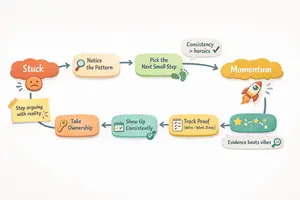
1)
Name the pattern (no drama, just truth)
When you’re spiraling, say it plainly:
“I’m in reaction mode. Reaction mode can’t build my next chapter.”
2) Separate your identity from your job
You are not your role. You’re the person choosing the role.
That one shift creates room to move.
3) Replace suffering with standards
Instead of “I can’t do this anymore,” define what you require:
- Work that energizes more than it drains
- Alignment with your values
- Forward motion (growth, learning, purpose)
4) Reconnect with the builder version of you
You’ve solved hard problems before. You can do it again.
Start acting like a curious strategist, not a trapped employee.
5) Commit to transformation, not escape
A meaningful transition isn’t just “get me out.”
It’s “build a life pattern I respect.”
And yes—sometimes “I need a career change” is the doorway to rebuilding your
confidence, your standards, and your sense of self.
CAREER
CHANGE ACTION CHECKLIST (Simple, Focused, Doable)
A)
Clarify your values (30–45 minutes)
- List 8–12 values that matter to you
- Write:
“This value looks like _____ at work.”
“This value is violated when _____.”
B) Inventory your transferable skills (45–60 minutes)
- 3 columns:
1) Skills you use now
2) Skills you enjoy using
3) Skills people thank/praise you for
- Turn that into 6–10 skill statements (clear, reusable, role-agnostic)
C) Explore 2–3 new paths (7–10 days)
For each path:
- Read 3 job descriptions
- Watch 1–2 “day in the life” videos or listen to a podcast
- Ask: “Is this aligned enough to test?”
D) Set ONE concrete experiment (schedule it today)
Choose one:
- Conversation: one informational chat
- Course: one short course (3–10 hours) tied to a target skill
- Side project: one small deliverable you can finish in 7–14 days
E) Quick commitment (2 minutes)
Write and sign:
“For the next 14 days, I will act like a builder—not a victim. My next step is
________, scheduled for ________.”
If you’re thinking “I need a career change,” let’s make sure you don’t just
move—let’s make sure you move forward.
Related Posts:
Recent Articles


-
Biggest Change in Life
Dec 31, 25 06:53 PM
 How your career can offer the biggest change in life and why mindset is the hidden barrier
 -
Process of Becoming an Adult
Oct 05, 25 12:18 PM
A practical 5-pillar framework for the process of becoming an adult: build independence, income, resilience, emotional strength, and a reputation you can use. -
Did the results of the last election hurt your industry and career?
May 02, 25 03:20 PM
Career and elections. Some helpful perspective when results seemed to have hurt your career opportunities.