Fear of Career Change: Why “Choosing Wrong” Isn’t the Problem (Stagnation Is)
There’s a popular misconception that a career change is supposed to feel like a clean leap into passion, happiness, and certainty. Like you’ll wake up one morning, feel “aligned,” pick the perfect path, and never again question your life choices while brushing your teeth.
And when that doesn’t happen, the fear of career change kicks in.
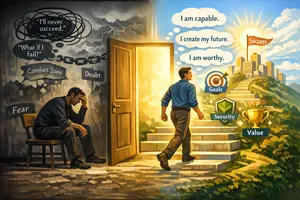
“What if I choose wrong?”
“What if it doesn’t work out?”
“What if I regret it?”
So you stay. Not because staying is good—but because staying is familiar. And familiar feels safer than uncertain.
This page is about the shift that unlocks movement: career change isn’t about finding the one right choice. It’s about choosing change. Choosing the fork in the road. Choosing new over stagnancy—and building the identity that can make your next chapter work.
The passion trap: why “find your passion” keeps you stuck
If you’ve been stuck for a while, you’ve probably been sold some version of this story:
“Just find what you love.”
“Follow your passion.”
“Do what makes you happy.”
Sounds nice. The problem is it turns your career change into a high-stakes treasure hunt for the perfect feeling.
And the moment you treat your next move like it must produce guaranteed passion and happiness, you accidentally create the perfect conditions for paralysis.
The myth of the perfect path
The myth goes like this:
- There is one correct career path for you.
- You’ll know it when you see it.
- Once you choose it, things will feel clear and right.
Real life usually looks like:
- You pick a direction.
- It’s awkward at first.
- You learn what fits.
- You learn what doesn’t.
- You refine.
- You grow into clarity.
Clarity isn’t a prerequisite. It’s a byproduct of movement.
Why passion-first thinking creates decision paralysis
When passion becomes the requirement, every option feels risky:
- “What if I’m not passionate enough?”
- “What if it turns out boring?”
- “What if I’m good at it but don’t love it?”
That’s not a decision framework. That’s a perfection trap.
In other words: the fear of career change often isn’t fear of change—it’s fear of imperfection.
What you’re actually afraid of isn’t change — it’s regret
Most people aren’t afraid of “change” in the abstract. They change phones, cities, relationships, haircuts. (Some of those are more traumatic than others.)
What makes career change feel uniquely terrifying is the sense that it’s irreversible and expensive.
“What if it doesn’t work?”
This is the fear underneath a lot of overthinking.
It’s not really “What if I choose wrong?”
It’s “What if I choose… and then I’m stuck again?”
So you keep researching, planning, thinking, waiting for a guarantee that never arrives.
“What if I waste years?”
This is where the pressure gets loud.
You tell yourself:
“I can’t afford to waste time.”
And then you proceed to waste time by not moving.
The irony is painful, but also helpful—because it reveals the real problem: stagnation is already costing you something.
Why your brain treats uncertainty as danger
Your brain likes predictable outcomes. Uncertainty is interpreted as risk.
So when you consider career change, your mind does what it’s designed to do:
- scans for threats
- highlights worst-case scenarios
- asks you to wait until you’re “more sure”
That’s not you being weak. That’s your nervous system trying to keep you safe.
The question is whether “safe” is actually safe long-term.
Because staying stuck has consequences too—just slower, quieter ones.
The reframe: career change isn’t about being right
Here’s the liberating shift:
Career change is not about making the right choice.
It’s about choosing change.
This is where your power comes back.
Because “right vs wrong” assumes there’s one correct path and your job is to guess it.
But “choosing change” assumes something else:
- you can adapt
- you can learn
- you can course-correct
- you can make a decision work through identity-level growth
The fork in the road is the point
A fork in the road isn’t a test you have to pass.
It’s an invitation to engage with your life again.
Choosing the fork means:
“I’m no longer going to let fear and stagnation pick for me.”
“I will move, learn, and adjust.”
That’s not reckless. That’s alive.
Choosing change is choosing aliveness over stagnation
If you’ve been living in a loop—same frustrations, same dread, same avoidance—then change isn’t just a career move. It’s an integrity move.
And yes, it will have costs. But stagnation has costs too:
- your energy
- your confidence
- your creativity
- your sense of possibility
- your relationship with work (and often your relationships at home)
The fear of career change shrinks when you recognize the bigger risk isn’t “choosing wrong.”
The bigger risk is staying in a life that quietly drains you.
“Right vs wrong” is the wrong scoreboard
“Right vs wrong” sounds logical, but it’s usually just fear wearing a suit.
A better scoreboard is:
- alignment over fantasy
- momentum over perfection
- self-respect over approval
- learning over certainty
The better question: “Can I make this work?”
Instead of asking:
“What’s the right choice?”
Ask:
“Can I make this work?”
That question returns agency to you.
Because the truth is: most decent career paths can work if you bring the right identity into them.
And most career paths will fail if you bring the same self-betrayal patterns into them.
Identity-level power: adaptability, ownership, resilience
Your future isn’t determined by your first step being perfect.
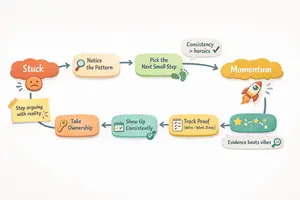
It’s determined by your ability to:
- take responsibility without shame
- stay consistent when it gets uncomfortable
- learn fast
- tell the truth about what’s not working
- adjust course instead of quitting in panic
That’s identity-level transformation.
That’s what makes career change sustainable.
The cost of change (and why accepting it is liberating)
A lot of fear evaporates when you stop demanding change be free.
Career change has costs.
Name them openly, and they become manageable.
Avoid them, and they become monsters.
The real costs: ego, learning curve, temporary instability
Common costs include:
- feeling like a beginner again
- a bruised ego (“I used to be good at things”)
- slower momentum in the early phase
- financial adjustments (sometimes)
- awkward explanations to friends/family/coworkers
- discomfort as your identity updates
These aren’t signs you chose wrong.
They’re signs you’re in the curriculum.
What costs you more: change, or staying stuck?
This is a question worth sitting with:
What is the cost of staying for another year?
Not just in money.
In energy.
In health.
In self-respect.
In your capacity to feel hopeful.
For many people, the fear of career change is actually the fear of paying the upfront cost.
But stagnation charges interest.
A grounded way to choose without needing certainty
You don’t need blind faith.
You need a practical way to move forward without pretending you can predict everything.
Here’s a grounded approach.
Choose the “good-enough” direction you can test
Instead of “the perfect job,” choose:
- a direction that seems more honest
- a role that reduces the biggest pain points
- a step that increases your leverage (skills, runway, network, energy)
Your goal is to create options, not lock yourself into a forever decision.
Build a 90-day experiment plan
Think in experiments:
- 2–4 informational conversations
- 1 small portfolio project or skill sprint
- 3–5 targeted applications (if job searching)
- one boundary renegotiation (if you’re staying while you plan)
- a bridge job if you need breathing room and stability
Then evaluate with real criteria:
- Did my energy improve?
- Am I more myself in this direction?
- Is the stress more “healthy challenge” or “soul-drain”?
- Am I building momentum or just coping?
Define success metrics that aren’t just money
Money matters. But it’s not the only metric.
Include:
- energy (am I less depleted?)
- integrity (am I proud of how I’m living?)
- skill growth (am I becoming more capable?)
- optionality (are my choices expanding?)
- nervous system (am I calmer, steadier, less reactive?)
When your metrics are grounded, the fear of career change becomes less emotional and more actionable.
Closing: You don’t need the perfect choice — you need a committed one
A career change isn’t a prophecy.
It’s a practice.
It’s you choosing a fork in the road and deciding:
“I will make this work.”
“I will learn the lessons.”
“I will become the person who can hold the life I want.”
You can always course-correct.
You can iterate.
You can pivot again later with more information and more strength.
But you can’t build a new chapter from the same stagnant place.
So if you’re caught in fear, keep it simple:
Don’t aim for certainty.
Aim for movement.
Choose change—and let the path respond to who you become as you walk it.
Related Posts:
Recent Articles


-
Biggest Change in Life
Dec 31, 25 06:53 PM
 How your career can offer the biggest change in life and why mindset is the hidden barrier
 -
Process of Becoming an Adult
Oct 05, 25 12:18 PM
A practical 5-pillar framework for the process of becoming an adult: build independence, income, resilience, emotional strength, and a reputation you can use. -
Did the results of the last election hurt your industry and career?
May 02, 25 03:20 PM
Career and elections. Some helpful perspective when results seemed to have hurt your career opportunities.