Follow Your Intuition in a Career Change: The Inner Curriculum That Reveals Your Next Step

The honest beginning: “I don’t know what I want, but I know this isn’t it”
Most people don’t start a career change with a 12-step plan and a color-coded spreadsheet. They start with a sentence that feels equal parts terrifying and true: “I’m not sure what I need, but I know this isn’t it.”
And if you’re in a career change when you don’t know what you want, that doesn’t mean you’re failing at life. It usually means you’ve outgrown a chapter before you can fully describe the next one. That’s not weakness. That’s awareness.
Here’s the part that’s oddly empowering: being willing to lean into uncertainty is a form of courage most people don’t practice. They’d rather stay in the familiar discomfort of a job they resent than face the honest discomfort of not knowing. So if you’re here — genuinely willing to step into the fog — that can become your strength.
Why uncertainty isn’t a red flag — it’s the doorway
If you already knew exactly what the destination looked like, you’d probably already be there. Or at least you’d have taken the first few steps months ago.
Uncertainty is often the doorway to the next phase because it forces you to stop living on autopilot. It forces you to get honest. And honesty is the beginning of a path that actually fits.
The virtue most people skip: staying brave while things are unclear
A lot of people want a guarantee before they move.
But career change rarely works like that.
The virtue most people skip: staying brave while things are unclear
The virtue is this: you move anyway — not recklessly, not impulsively, but with grounded courage. You let your next step reveal the next step. You don’t demand the whole map from yourself on day one.
Career change when you don’t know what you want: why intuition matters more than certainty
Let’s name the trap: when you don’t know what you want, it’s easy to treat strategy like a security blanket. More research. More videos. More options. More “maybe I should…”
But in a career change when you don’t know what you want, you can gather information forever and still feel stuck — because the missing ingredient isn’t information. It’s inner guidance. Intuition. The part of you that knows what is “alive” versus what is dead, heavy, or performative.
Strategy vs intuition (it’s not either/or)
Strategy matters. Planning matters. Skill-building matters. Absolutely.
But strategy is a tool. Intuition is the compass.
If you only use strategy, you can build a very impressive life you don’t actually want.
If you only use intuition without structure, you can drift in circles and call it “trusting the process.”
The sweet spot is intuition first (direction), strategy second (execution).
Intuition isn’t a vibe — it’s pattern recognition + self-trust
Intuition is not just a gut feeling that floats down from the universe like a motivational poster.
It’s often:
- your body noticing what environments drain you vs energize you
- your mind recognizing patterns you’ve ignored
- your values pushing back when you compromise them
- your self-respect trying to come back online
The problem is: if you don’t trust yourself yet, you won’t trust your intuition. You’ll call it “irrational” and go back to what’s familiar.
Why “waiting to feel ready” keeps you stuck
Readiness is overrated. Evidence is better.
If you’re in a career change when you don’t know what you want, waiting until you feel 100% ready usually means waiting until you feel 100% safe. And most growth does not arrive that way.
The inner curriculum: life teaches you as you move
Here’s one of my favorite ways to look at career change: it’s a personal curriculum.
The moment you choose change, you’re not just switching jobs. You’re enrolling in a course called “Become the person who can actually live the next chapter.”
And the curriculum is annoyingly customized. Your friend’s syllabus will look different. Their dragons will be different. Their timing will be different.
Why you can’t see the whole map from where you’re standing
You can’t plan your way into a future you haven’t become yet.
That’s why clarity often arrives after movement:
- after a conversation that surprises you
- after you try a small experiment and learn what you hate (useful!)
- after you set a boundary and realize you’ve been living without oxygen
- after you prove to yourself you can do hard things while uncertain
The repeating lesson: where the old you retreats
The curriculum tends to present a familiar challenge — the one where the “old you” would retreat.
Maybe it’s:
- speaking up
- being seen
- disappointing someone
- risking looking foolish
- tolerating short-term discomfort for long-term freedom
The threshold moment: the future you moves through
This is where courage becomes practical.
In a career change when you don’t know what you want, the win is not “figuring it all out.” The win is becoming the version of you who doesn’t retreat at the threshold.
That’s the person your next chapter requires.
The inner dragons (the real gatekeepers of your next chapter)
People often think the gatekeeper is a credential, a resume, or an algorithm.
Sometimes, sure.
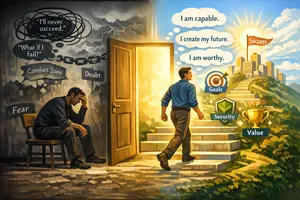
But more often the gatekeepers are internal. The dragons. The parts of you that learned to stay small because it felt safer.
Fear of disappointing people
This one has teeth.
If your identity is “the dependable one,” change can feel like betrayal — even when it’s necessary. Your dragon will insist that your job is to keep everyone comfortable.
But your actual job is to build a life that’s honest.
Approval addiction and “permission seeking”
A sneaky dragon says: “Once someone approves, then I can move.”
But in adulthood, permission is rarely granted. It’s claimed. Gently, responsibly, but firmly.
Perfectionism (the dragon in a lab coat)
Perfectionism is just fear wearing a clipboard.
It says: “We can’t start until we know we’ll succeed.”
But the only way to know is to start.
Conflict avoidance and boundary weakness
If you can’t hold boundaries, every career path will eventually drain you. You’ll overextend, overdeliver, and quietly resent the life you built.
Identity attachment: “If I leave this, who am I?”
This is one of the biggest ones.
In a career change when you don’t know what you want, part of the discomfort is identity withdrawal. You’re releasing an old label before you’ve earned the new one.
That limbo is not failure. It’s transformation.
How to follow your intuition without drifting (a grounded framework)
This is how you make intuition practical — so it doesn’t become a poetic excuse to do nothing.
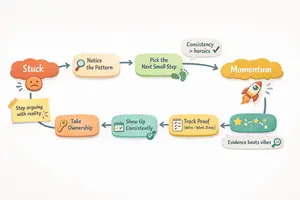
Step 1 — Stabilize your nervous system (or your intuition will sound like panic)
If you’re exhausted, anxious, or chronically stressed, your intuition will often sound like panic.
Stabilizing can be:
- protecting sleep
- creating financial runway or bridge work
- reducing unnecessary obligations
- setting one real boundary at work
Step 2 — Define the next honest step (not the final destination)
In a career change when you don’t know what you want, the “next step” might be:
- one conversation
- one small skill-building project
- one experiment
- one boundary
- one commitment to stop tolerating what’s draining you
Step 3 — Run one small experiment that creates data
Data beats spiraling.
A small experiment gives you feedback:
- “This is interesting.”
- “This drains me.”
- “I like the work but not the environment.”
- “I’m not scared of the work — I’m scared of being seen.”
Step 4 — Notice expansion vs contraction (and learn the difference)
Expansion feels like:
- more energy
- more honesty
- more self-respect
- a calmer nervous system
Contraction feels like:
- dread
- self-betrayal
- numbness
- “I’m doing this because I should.”
Step 5 — Meet the dragon; don’t negotiate with it
When you move, a dragon appears. That’s not a sign you’re on the wrong path — it’s usually a sign you’re at the lesson.
Step 6 — Repeat until the path reveals itself
This is how careers actually change for most people: not in one leap, but through a series of courageous, grounded steps.
Signs you’re on the right path (even before it “makes sense”)
You won’t always feel “certain,” but you’ll notice a few things shift.
Your energy stabilizes
You’re not living on adrenaline and dread.
Your self-respect increases
You’re making choices you can stand behind.
You stop fantasizing and start building
Even small reps create momentum. And momentum creates clarity.
Closing: meaning is on the other side of the lesson
Most people want career change to be smooth, clean, comfortable.
But life usually delivers the challenge you need, not the comfort you requested.
That’s not punishment. It’s curriculum.
And if you’re willing to face that curriculum — to treat uncertainty like training and courage like a practice — then a career change when you don’t know what you want stops being a weakness.
It becomes the start of becoming someone you trust.
Related Posts:
Recent Articles


-
Biggest Change in Life
Dec 31, 25 06:53 PM
 How your career can offer the biggest change in life and why mindset is the hidden barrier
 -
Process of Becoming an Adult
Oct 05, 25 12:18 PM
A practical 5-pillar framework for the process of becoming an adult: build independence, income, resilience, emotional strength, and a reputation you can use. -
Did the results of the last election hurt your industry and career?
May 02, 25 03:20 PM
Career and elections. Some helpful perspective when results seemed to have hurt your career opportunities.