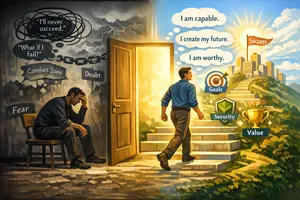
What the Biggest Change in Life Really
Looks Like (Through Your Career)
Why
mindset is the hidden barrier
When
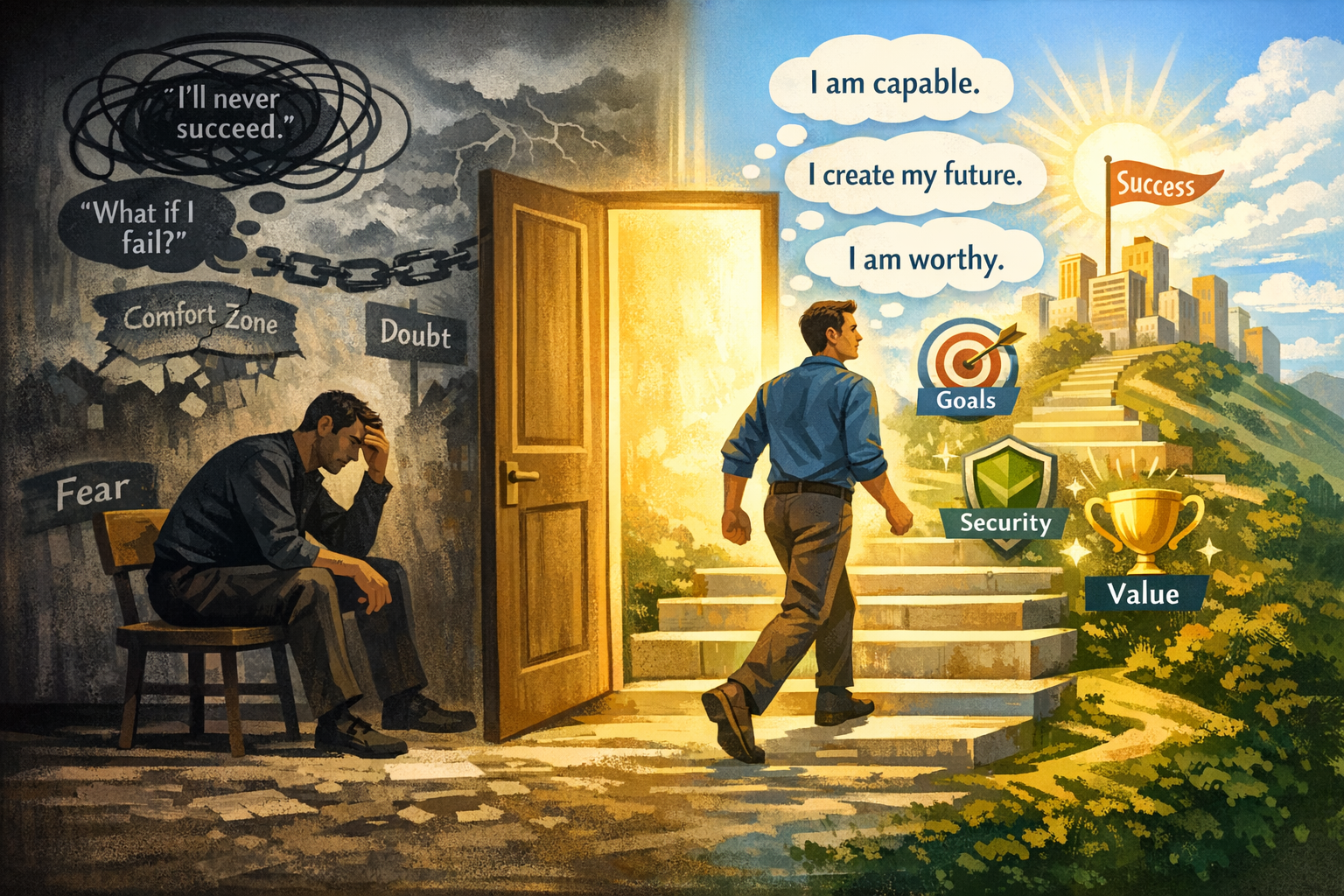
you really understand your core work patterns — the stories you tell yourself
about success, security, worth, and “what people like me do” — you start to
notice something quietly powerful:
You don’t just see opportunities differently.
You see yourself differently inside those opportunities.
And that’s the moment a “career leap” stops sounding like motivational poster
talk and starts feeling like what it often is: the biggest change in life you
can make, because it changes your identity, not just your income.
In most performance-driven worlds, this isn’t controversial. Athletes have
coaches. Executives have coaches. Even pro golfers have someone watching how
they breathe before a putt.
But career-wise? A lot of us still act like mindset is optional.
We’ll invest in more skills, another certification, a new tool… and ignore the
inner framework that decides whether we actually use any of it when it counts —
especially when you’re staring down the biggest change in life and your nervous
system wants to keep things familiar.
ESCAPING CURRENT CIRCUMSTANCES (WITHOUT PRETENDING THAT’S “BAD”)
When
people say “career change,” it doesn’t always mean a dramatic apples-to-oranges
job swap.
Sometimes it’s:
- taking a course to open a new lane
- stepping away on a sabbatical to get your head back
- moving from full-time to consulting
- building a side business that quietly becomes the main thing
But if we’re being honest (in a kind, non-self-judgy way), behind almost every
strategic career move is a desire to escape something:
a pace that’s draining you, a role that shrank you, a ceiling you keep bumping
your head on.
It’s not just running away — it’s also reaching for more.
More meaning, more autonomy, more alignment.
The tricky part is that we often underestimate how deep the shift has to go to disrupt the momentum when making the biggest change in life. Culture makes big reinventions look suspiciously
easy. Like you wake up one day, update your LinkedIn, buy a new notebook, and
boom — new life.
Then you try it, and life does what life does: it tests you.
When you aim bigger, your old roadblocks don’t politely step aside. They show
up louder:
procrastination, resistance, second-guessing, “maybe I should just stay where I
am.”
And that doesn’t mean you’re failing.
It means you’re stretching past the current framework your life has been
running on.
If you don’t build the skill of understanding why you’re dissatisfied — what
specifically isn’t working and what you actually need — the leap can turn into
disillusionment. You can change the job and still drag the same internal
operating system along for the ride, which is why the biggest change in life is
rarely the external move alone.
STUCK IN OLD TERRITORY (EVEN
IN A NEW ROLE)
A
career change isn’t only about a new paycheck. It’s an inflection point — it
changes how you relate to yourself, your time, and your future.
Behind every uninspired job is a person who’s been adapting to it.
Coping. Normalizing. Mentally “making it work.”
And when a role is deeply misaligned, a very human thing happens: you start
protecting yourself.
You withdraw. You numb out. You stop dreaming big because it hurts less.
Over time, you can become hard-wired to manage dissatisfaction instead of
moving freely toward goals. So even when a new opportunity appears, part of you
hesitates — not because you don’t want it, but because your brain learned to
stay safe by staying small.
That’s why mindset, attitude, and self-image aren’t “nice extras.” They’re
often the bottleneck.
And very few people treat them like something to actively work on.
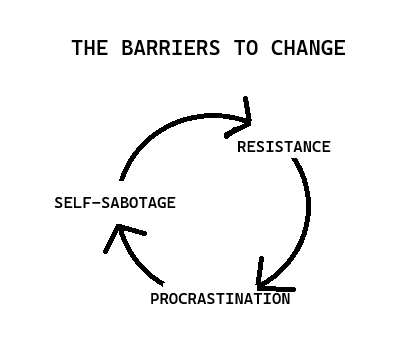
The momentum of your current framework wants to keep you in the "stuck cycle." Procrastination, Resistance and Self-sabotage. Rinse and Repeat.
BARRIERS TO CHANGE (AKA: WHY YOU KEEP “ALMOST” DOING IT)
Your
current framework has momentum. It wants to keep you where you are — even if
“where you are” isn’t great.
It shows up as:
- procrastination
- resistance
- self-sabotage
- overthinking until the moment passes
Here’s the weird part: you can feel the barrier, but still be blind to what
it’s made of.
Until you change the patterns and beliefs underneath, new career potential can
feel like it’s always one step away — close enough to see, not close enough to
grab.
THE
KEY TO THE BIGGEST CHANGE IN LIFE: A NEW MINDSET (NOT JUST NEW ACTION STEPS)
A
new mindset is often the thing that blows the doors off the barrier.
Not “positive vibes only” — but a more accurate, supportive, reality-based way
of seeing yourself and what you’re capable of.
A NEW FRAMEWORK: CAREER CHANGE JOURNAL EXERCISE
You
open a new door more cleanly when you close the old one with a grounded,
respectful outlook.
Do this reflection if you:
- feel stuck or unhappy on your current path, or
- made a career move but still aren’t getting traction or fulfillment
1) Think back to the version of you who first stepped into your most prominent
role.
The earlier-you. The one who said yes to that path.
2) From then until now, what have you accomplished?
Consider:
- people you helped
- skills you built the hard way
- reputation/track record you earned
- independence or financial stability you created
- life experiences work made possible
- growth that once felt out of reach
Answer these:
- How would that earlier version of you feel knowing what you’ve achieved?
- Was there anything they truly set out to do that you didn’t do?
- s there something still left to achieve that matters more than what you already built?
If your answer is “no” to the last two, consider this:
What you built might be complete — even if it's not done with you.
You’re not “quitting.”
You’re graduating.
CRAFTING A NEW FRAMEWORK MIGHT BE THE REAL LESSON
Seeking
greater fulfillment can be the thing that forces your biggest growth.
It tends to go like this:
You make a brave decision…
and then life hands you the curriculum.
The lesson usually tests you more than you wanted. You think, “I knew this
would be hard… but did it have to be this emotionally educational?”
Resistance often runs deeper than your initial motivation.
But a more intentional life has a way of pulling you forward anyway —
especially when staying the same starts to cost too much.
A helpful question:
What feels uncomfortable right now only because your old frame of mind no
longer fits?
Put simply: change often requires you to get out of your own way.
And here’s the kicker: once you see what’s been keeping you trapped in
unfulfilling work, it can ripple out into everything.
You might notice:
- relationships soften and improve
- habits get cleaner
- your attitude becomes lighter
- momentum returns (less uphill slog, more forward pull)
And once you believe you can shift your work life on purpose, that belief tends
to leak — in the best way — into the rest of your life too.
CARRYING OLD BAGGAGE INTO A NEW CHAPTER (MY OWN WAKE-UP CALL)
In
my own life, I wanted a career leap and I assumed the decision alone would
reignite me. Like flipping a switch.
It didn’t.
In summer 2022, after a decade running a small service-based home maintenance
business, I grew painfully unhappy. I realized it might not be my forever work
anymore. The inspiration that used to fuel me had faded, and I knew something
had to change.
But instead of feeling proud and clear, I dragged an old, broken framework
forward. I didn’t see “new beginning.”
I saw “failed ending.”
Looking back, it’s obvious: I tried to change my circumstances without
addressing the beliefs and patterns that were shaping how I experienced those
circumstances.
THE BIG SHIFT I NEEDED
If you’re a high achiever, you know the deal: high expectations can build great
things… and also quietly turn you into your own worst critic.
That was me.
The truth was, there was so much to be proud of:
I built a successful company with integrity.
I created something durable.
It gave me a life that matched what I genuinely wanted.
But I wasn’t framing it that way. I framed it like it was incomplete — like it
didn’t count because it wasn’t perfect.
That mindset put a bitter spin on the entire story, and it followed me into the
next chapter.
My biggest shift was simple, but not easy:
I stopped treating my inner framework like background noise.
I made it part of the work.
And once I did, everything changed — not overnight, not magically, but
steadily.
More clarity. More self-respect. More traction.
A cleaner, kinder story to build the next chapter on — because for many of us,
that inner rewrite is the biggest change in life.
We all have the capacity to alter our inner framework on the way to a more positive outlook in our life's work. It's just a matter of taking the steps to do so.
5 Steps to turn a career change into the biggest
positive change in your life
1) Start with openness (aka: stop demanding certainty up front)
Any major career change will feel daunting at some point. That’s not a sign you’re doing it wrong — it’s a sign you’re doing something that actually matters.
Also: the biggest change in life isn't politely contained inside your work calendar. They ripple into your routines, your relationships, your identity, and how you see your future. So when you decide, “Okay, I’m changing,” don’t just brace for impact — stay open to what unfolds next. The path will almost always rearrange itself as you move.
Coach note: watch for “stuck in the past” glue.
If you notice yourself looping on old events, old relationships, or old narratives (“I should’ve…”, “If only…”, “Back when…”), gently label it: That’s my brain trying to keep me familiar, not necessarily keeping me safe.
Your job isn’t to erase the past. It’s to stop living there.
2) Audit your framework + self-talk (your inner operating system)
Before you change the job, check the system running the job.
Ask:
- What do I believe about success, worth, security, or “people like me” that I’ve never questioned?
- What assumptions am I treating like facts?
- What do I “affirm” unconsciously that isn’t actually true?
Then get specific:
- Have you adopted a self-narration that’s quietly working against you?
Examples:
- “I’m behind.”
- “I always mess things up at the finish line.”
- “I’m not the kind of person who…”
- “If I change paths, it means I failed.”
If you’ve been using that narration for years, it will feel familiar — which is exactly why it’s dangerous. Familiar isn’t the same as accurate.
3) Reframe past achievements (build your highlight reel on purpose)
When life is in transition, everything can feel wobbly. And when things feel wobbly, the default human reflex is: “This must be my fault.”
Let’s interrupt that.
If you’re in a career transition, you’re not “unstable.” The biggest change in life is motion. And motion takes courage.
So instead of staring at the chaos and blaming yourself, do this:
- Call up your track record.
- Make a quick “success reel” of what you’ve built:
- problems you’ve solved
- people you’ve helped
- skills you earned the hard way
- results you created repeatedly
- the resilience you’ve proven (especially when it wasn’t convenient)
This isn’t ego. This is evidence.
You’re not starting from scratch. You’re starting from experience.
4) Redefine your value (authentic confidence, not fake “hype yourself” energy)
Now that you’ve reframed your wins, use them to consciously rebuild self-confidence — the real kind. Not the puffed-up, “I’m amazing!” kind. The grounded kind that says:
“I know what I’m capable of, and I trust myself to figure out the next step.”
Prompts that work:
- What are my unique strengths (the ones that show up in multiple jobs, not just one title)?
- What do my biggest supporters consistently thank me for?
- What problems do people naturally bring to me?
- What do I do that seems “easy” to me but valuable to others?
Think of your renewed mindset as a compass.
When everything feels foggy, your values + strengths are what keep you walking in the right direction.
5) Design your next small career experiment (because thinking isn’t the same as moving)
A small career experiment is where this stops being “a plan in your head” and becomes a real-life data point.
Because yes, mindset matters — but mindset is a tool. It only helps when you use it.
Design one small experiment using SMART:
S — Specific
What exactly are you testing or building?
Example: “Interview 5 people working in UX research to see if I’d enjoy the day-to-day.”
M — Measurable
What will you track?
Example: “5 conversations booked, 5 completed, plus a 1–10 score after each call for interest/energy.”
A — Achievable
Make it realistic with your current life constraints.
Example: “Two calls per week” instead of “completely reinvent my career by next Tuesday.”
R — Relevant
Will this experiment actually give you clarity about a bigger direction?
Example: “These conversations will help me confirm whether UX research fits my strengths (and what skills I’d need).”
T — Time-based
Set a deadline so it doesn’t become an eternal ‘someday.’
Example: “Complete by the last day of this month.”
If you want a simple rule:
Make the experiment small enough to complete, but real enough to teach you something.
Recent Articles


-
Biggest Change in Life
Dec 31, 25 06:53 PM
 How your career can offer the biggest change in life and why mindset is the hidden barrier
 -
The process of becoming an adult
Oct 05, 25 12:18 PM
 The capacity to earn a living parallels the process of becoming an adult. Growing up is played out through establishing a career.
 -
Did the results of the last election hurt your industry and career?
May 02, 25 03:20 PM
Career and elections. Some helpful perspective when results seemed to have hurt your career opportunities.